
IEP Goals at Home: Turning Plans Into Daily Routines
A goal mastered in your room and invisible at home is not generalizing. A provider guide to translating IEP goals into routines families actually run.
By VizyPlan Team · August 31, 2026
Clinical-grade insights for families and providers navigating autism, ADHD, and visual learning. Filter by who it is written for.
How are they doing gets you great, thanks. These eight questions to ask your child's teacher get you information you can actually use all year.
August 30, 2026
The gym teacher benches your child like a kid with a broken arm, except nothing is broken. What the law says about exclusion, and how to advocate step by step.
August 29, 2026
The first day sign photo is not the only tradition. Here are back to school rituals built for kids who will not pose, answer interview questions, or love surprises.
August 28, 2026
Delivering minutes in the building is not the same as your client being included in it. The evidence points at peer-mediated supports providers can coach in minutes.
August 27, 2026
The teacher says we never see that here. At home the afternoon falls apart daily. After school restraint collapse explains both halves, and it is fixable.
August 26, 2026
The first week of school rarely goes smoothly for neurodivergent kids. Here is how to tell ordinary adjustment noise from the signals that deserve a closer look.
August 25, 2026
Fall scheduling forces the question every year. The evidence on push-in therapy versus pull-out is thinner than either camp claims, and what exists points at collaboration more than at location.
August 24, 2026
The twenty minute assignment you set at dismissal is a ninety minute standoff in some houses. Homework accommodations decided in September prevent most of the conflict families never tell you about.
August 23, 2026
If the morning only works when you narrate every step, the routine is running on you. Morning routine independence comes from moving the prompts out of your voice and onto something your child can check.
August 22, 2026
The annual review is not the only door. You can request an IEP meeting at any point in the year, and the first month of school is often the most useful time to do it.
August 21, 2026
Attendance dips every fall and most caseloads absorb it as bad luck. The research on missed therapy appointments points at scheduling, illness, and authorization far more often than at motivation.
August 20, 2026
September brings more writing demand than any other month of the year. Handwriting difficulties in autism are common, physically real, and easy to mistake for refusal in the first weeks of class.
August 19, 2026
The folder, the jacket, and the third water bottle of the month are all somewhere at school. Losing school supplies is usually a working memory problem, and working memory responds to external systems rather than reminders.
August 18, 2026
The baseline you take in September is the number every claim you make this year gets compared against. It is worth more care than the calendar usually allows.
August 17, 2026
The weekend was fine until about five in the afternoon. Sunday night dread is anticipatory, which means reassurance rarely touches it and information usually does.
August 16, 2026
Two weeks in, the reserve your child started the year with is gone. What you do with Saturday decides a lot about what Monday looks like.
August 15, 2026
Arrival is the least planned part of most school days and the one that decides how the next three hours go. Ten minutes of structure buys back more than it costs.
August 14, 2026
VizyPlan is now an approved vendor on ClassWallet. If your child has an Arizona Empowerment Scholarship Account, your scholarship funds can cover their visual schedules — often with nothing out of pocket. Here's the step-by-step.
August 13, 2026
A child who presents as regulated in your room may be unrecognizable in a classroom at two in the afternoon. The data on how much clinic observation misses is worth knowing before you write the plan.
August 13, 2026
Forms, folders, permission slips, medication authorizations, and an IEP to track. The administrative load of a school year is real work, and for families of disabled children it is measurably heavier.
August 12, 2026
Most parents first email a teacher when something has already gone wrong. Sending one in week two, before there is a problem, changes what every message after it sounds like.
August 11, 2026

Nothing undoes three good weeks faster than a Tuesday that is not a normal Tuesday. The school calendar knows about it in July. Getting that information early is the whole strategy.
August 10, 2026
A study that put proximity sensors on children at recess found something surprising. Autistic children were not alone on the playground. What they had less of was mutual.
August 9, 2026
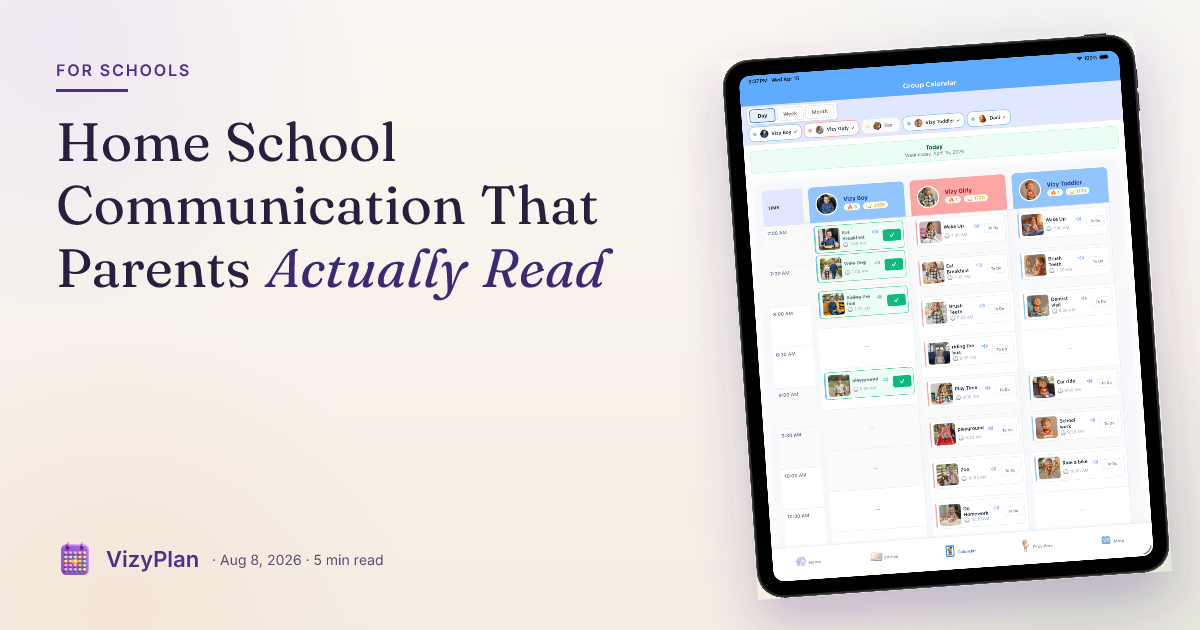
Most home school communication systems die in October. The ones that survive share three things, and none of them involve writing more.
August 8, 2026
Every September, a caseload that ran comfortably in July gets compressed into the four hours between dismissal and bedtime. The scheduling decision is a clinical decision.
August 7, 2026
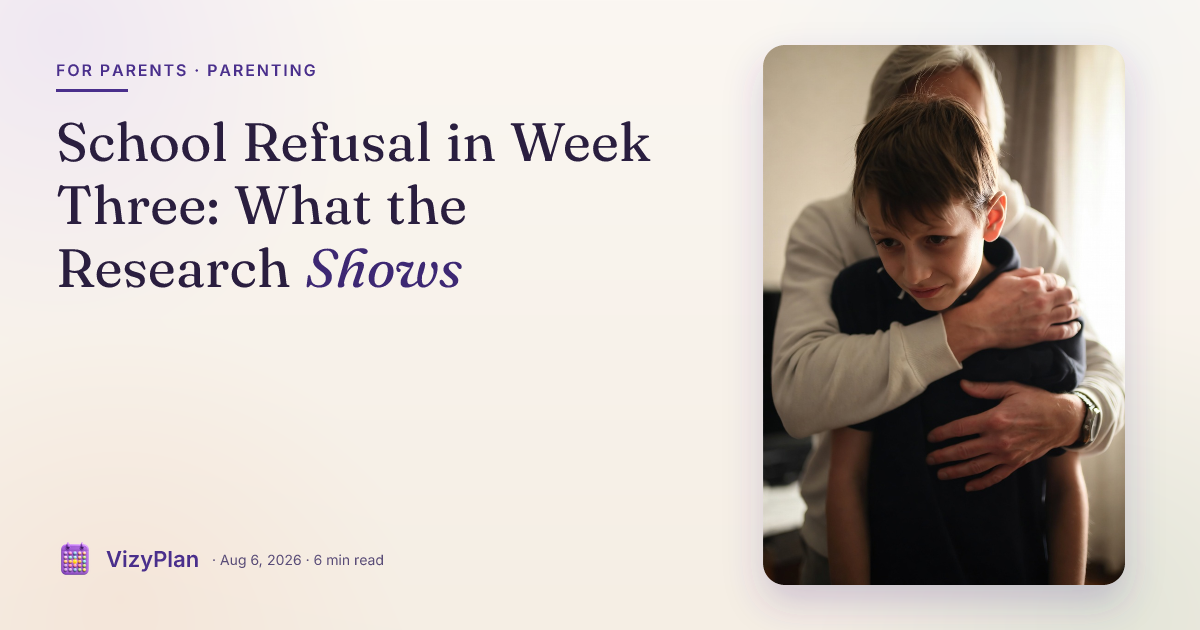
The first two weeks went fine. Then Monday of week three arrives and your child cannot get in the car. That timing is not random, and school refusal is far more common in autistic students than most families are told.
August 6, 2026
August is when providers assign the most homework to families and when families have the least capacity to absorb it. The attendance research says exactly what happens next.
August 5, 2026
Two hours of resistance over twenty minutes of work is not a motivation problem. It is a starting problem, a memory problem, and a timing problem wearing a homework costume.
August 4, 2026
An accommodation that exists in a document and not in a classroom is not an accommodation. The gap usually opens in the first two weeks, and it is closable with a checklist.
August 3, 2026
You get one word and a closed door, and then something falls apart at 6pm over nothing. The problem is usually the question, and memory research has a lot to say about which questions work.
August 2, 2026
The lunchbox comes home untouched and you assume it was the food. Often it was the room. A cafeteria is a sensory event before it is a meal.
August 1, 2026
A fire drill is a scheduled event that arrives as a surprise, at a volume designed to be impossible to ignore. For some students it undoes a week of progress in ninety seconds.
July 31, 2026
Your child is fully toilet trained at home and comes off the bus in wet clothes. That combination is common, it is well documented, and it is almost never about defiance.
July 30, 2026
A child can receive excellent school therapy and excellent clinic therapy and still make no progress, because the two are teaching different versions of the same skill in different words.
July 29, 2026
Elementary school gave your child one adult who knew them. Middle school gives them seven adults who each see them for forty-five minutes, and a hallway with a four-minute clock.
July 28, 2026
Most classroom routines are announced once in September and then enforced for nine months. Teaching them the way you teach content changes what the rest of the year costs.
July 27, 2026
Every instinct tells you to stay one more minute. The research points the other way, and the reason has nothing to do with being cold.
July 26, 2026
The bus is the one part of the school day with no teacher, no schedule, and no adult who knows your child. It is also where a lot of good days get decided before they start.
July 25, 2026
Nobody puts new clothes on the back to school worry list, and then the first Monday falls apart over a seam. Here is what the research says about tactile sensitivity and how to get ahead of it in July.
July 24, 2026
Every August a caseload comes back looking rougher than it left. Some of that is real skill loss and some of it is context loss, and the two need completely different responses.
July 23, 2026
Kindergarten is the largest structural change most autistic children have faced. Research shows that the supports families get are usually the light ones, and the families who need the most tend to receive the least.
July 22, 2026
Every August, a year of hard-won knowledge about a student evaporates between June and September. The IEP survives the summer. The working knowledge usually does not, and rebuilding it costs the student the first six weeks.
July 21, 2026
The supply list has forty-one items and the store has fluorescent lights, a crowd, and a hundred small decisions. Here is how to plan the trip so your child stays regulated and the cart makes it to the register.
July 20, 2026
Calming tools usually get sold to people with time to meditate. Resyna was built for the other moment, when the parent, the caregiver, the provider, and the child have all run out of reserves and calm has to come to them.
July 19, 2026
The data sheet comes back with four entries and an apology. That is almost never low buy-in. Home data collection fails for the same reason clinical fidelity data fails, and the fix is design, not motivation.
July 18, 2026
The teacher says your child had a great day. Then they walk through the door and fall apart. After-school restraint collapse is not a clinical diagnosis, but every ingredient in it is backed by real research.
July 17, 2026
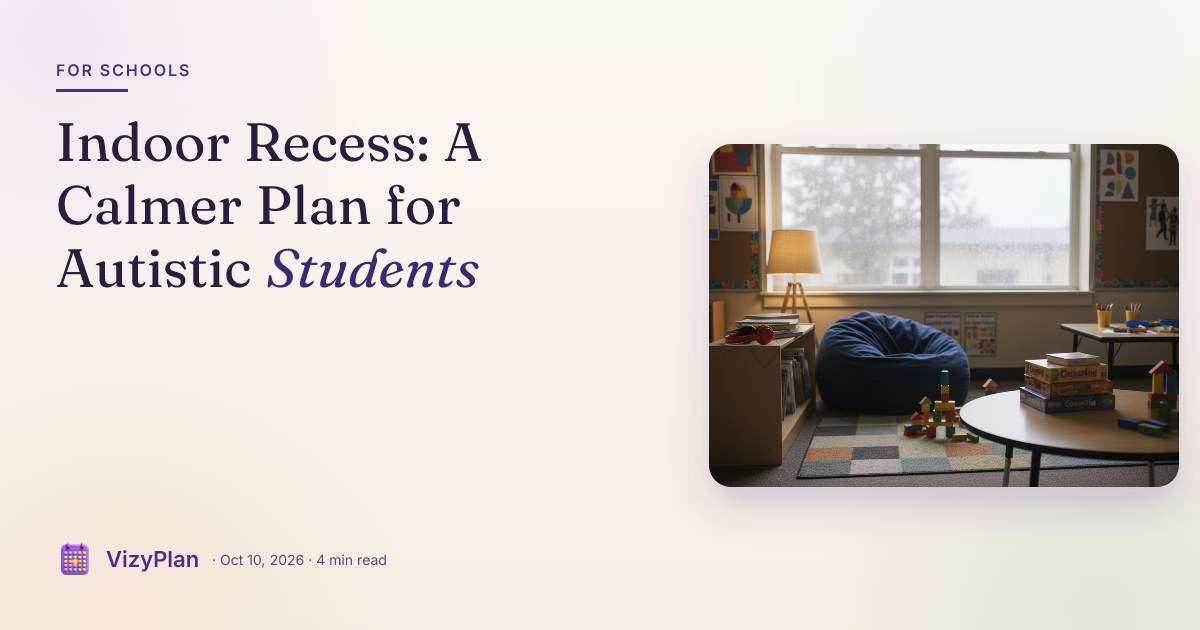
Teachers plan every academic minute and then hand autistic students the two least structured hours of the day. Recess and lunch are where inclusion most often quietly fails, and where a little structure buys the most.
July 16, 2026
The hardest session on your caseload is the last one. Discharge planning is the part of practice most likely to be improvised at the end, and the part most likely to decide whether the work lasted.
July 15, 2026
The meet-the-teacher visit is usually one hurried evening in a crowded room, which is close to the worst possible format for an autistic child. Here is how to turn it into something that actually lowers the anxiety of day one.
July 14, 2026
Teachers get sold visual schedules as a cure for hard transitions. The most rigorous study on the question found the schedule alone did not reduce problem behavior. Here is the honest version, and what it means for your classroom.
July 13, 2026
A goal can be measurable, defensible at authorization review, and still completely unusable by the parent holding it. Parent-friendly therapy goals are what turn a treatment plan into something that runs on a Tuesday morning.
July 12, 2026
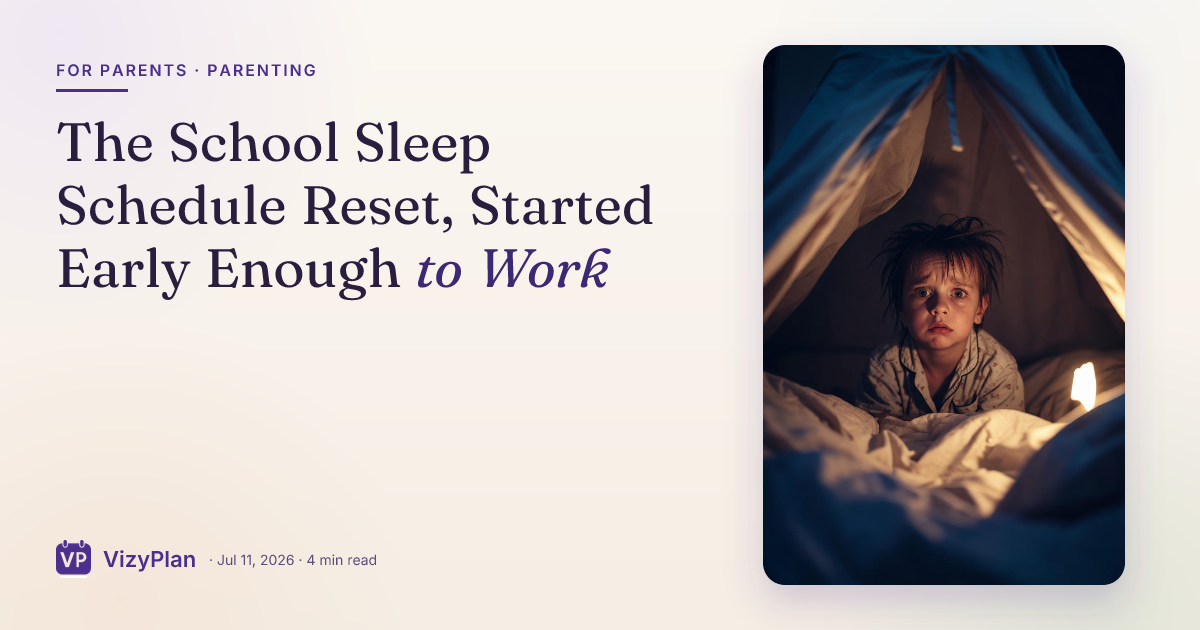
A school sleep schedule reset does not happen the night before. Body clocks move about an hour a week, which means the work starts now, and the method is not the one most parents try first.
July 11, 2026

Your sub plan covers the curriculum. It probably does not cover the student for whom you are the routine. Here is what to leave behind so the day still holds together when you are gone.
July 10, 2026
Resyna is a gentle, adaptive calming sound built inside VizyPlan that listens to your heart rhythm and guides your family toward a calmer, steadier breath. Patent pending, and rolling out now for the hard moments.
July 9, 2026
A child with autism often runs three different systems before lunch. The clinic uses one set of picture cards, the classroom uses another, and home uses whatever the family cobbled together. A shared visual system is the mechanism that lets a skill generalize.
July 7, 2026
You do not need a renovation budget to build a sensory-friendly classroom. Some of the changes with the strongest evidence behind them cost nothing but a rearranged shelf and a few minutes of planning.
July 6, 2026
It comes up in the middle of a session, between a goal update and a scheduling question. Does my kid need a 504 or an IEP? Providers get asked the 504 plan vs IEP question constantly, and families trust your answer more than a pamphlet.
July 5, 2026
Fireworks get all the attention, but for many families the Fourth of July with autism is a whole weekend of hard, not one loud night. Crowds, cookouts, disrupted routines, late bedtimes, and open water all stack on top of each other.
July 4, 2026
Your child’s new teacher will meet a room full of students in the first week and read a stack of files an inch thick. A one-page profile is how you make sure the few things that matter most about your child rise to the top before the first hard moment.
July 3, 2026
Paraprofessionals may be the most important adults in an inclusive classroom that almost no one writes for. Strong paraprofessional support is a real skill, and the research is surprisingly clear about the line between helping and hovering.
July 2, 2026
A child nails a skill in your session, and by the time it needs to show up in a classroom or a new provider’s room, it has vanished. Therapy carryover is not a bonus that happens on its own. It is a separate skill you have to plan for, and the clinic-to-school handoff is where it most often falls apart.
July 1, 2026

The calendar still says summer, but a back to school routine reset is the kindest gift you can give your neurodivergent child before the first bell. Starting the reset early, and gently, changes how the whole first month goes.
June 30, 2026

Ask a special education teacher where the hard moments hide and few point to the lessons. The friction lives in the seams between activities. A visual schedule in the classroom is one of the most researched tools for smoothing those transitions, and it costs almost nothing to start.
June 29, 2026

After sixteen years and countless revisions, the Polaris manuscript is finally ready. Watch the very first teaser, and follow the journey as I look for the right publishing home.
June 28, 2026

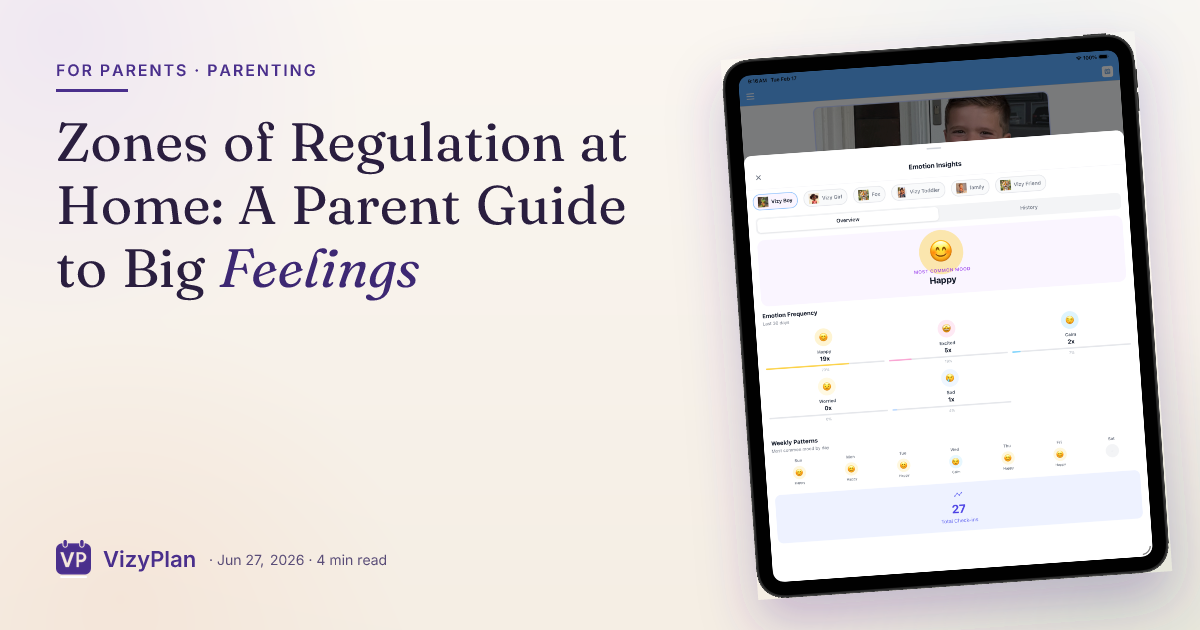
A warm, parent-friendly look at using a zones of regulation color framework at home so your child can name and manage emotions without shame.
June 27, 2026

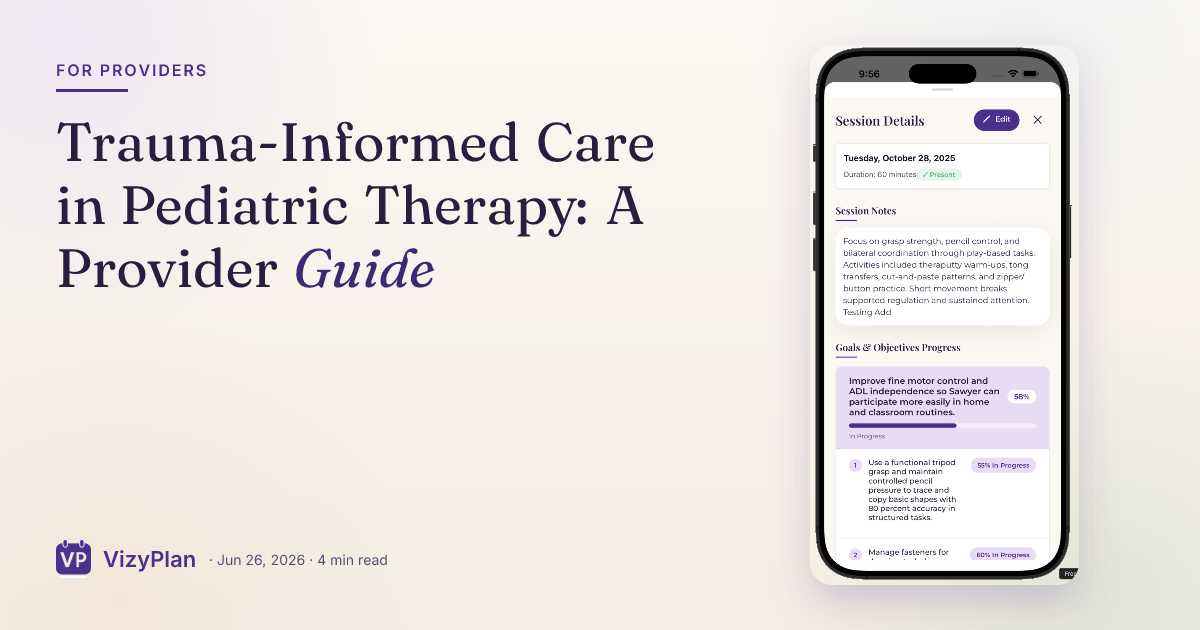
Trauma-informed care helps autistic and neurodivergent clients feel safe, builds trust, and treats dysregulation as communication. Here is how to apply it in everyday sessions.
June 26, 2026

ARFID is more than picky eating. Learn how ARFID overlaps with autism and explore gentle, low-pressure ways to support your child at mealtimes.
June 25, 2026
RBT turnover is one of the toughest challenges in ABA. Here is what high turnover costs clinics and clients, plus practical retention strategies that actually stick.
June 24, 2026
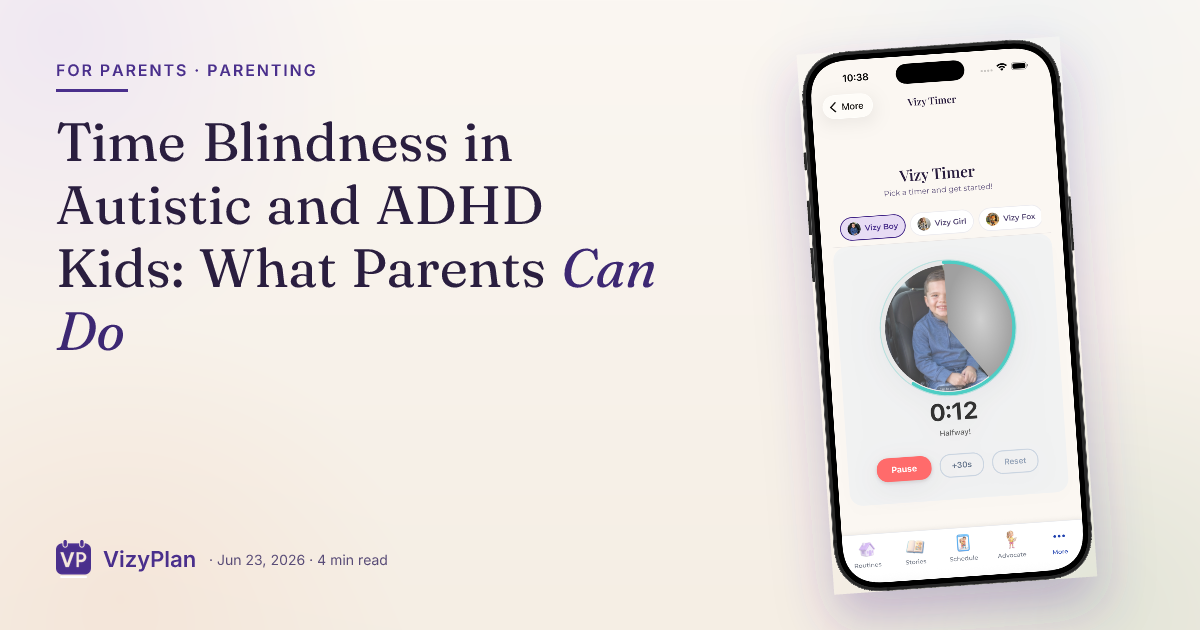
Time blindness is real, and it explains why your neurodivergent child keeps losing track of time. Learn why autistic and ADHD kids cannot feel time passing, and the practical tools that build external structure when the internal clock goes quiet.
June 23, 2026
A child often has an OT, an SLP, a BCBA, and a teacher all running separate plans, leaving the family to translate between them. Interdisciplinary collaboration around one shared visual is how you align the team. Here is how.
June 22, 2026
Your child can finally start homework the moment you sit down next to them, even though you are not helping. That is body doubling, and there is real science behind it. Here is how to use body doubling at home.
June 21, 2026
Trains, dinosaurs, elevators, a single video game. Special interests get treated as something to limit. The research says the opposite. Here is how parents and providers can use special interests to build real skills.
June 20, 2026
Neurodiversity-affirming practice is the phrase every family now searches for. For ABA, SLP, and OT it is more than a label. Here is what neurodiversity-affirming practice looks like in real goals, sessions, and home carryover.
June 19, 2026
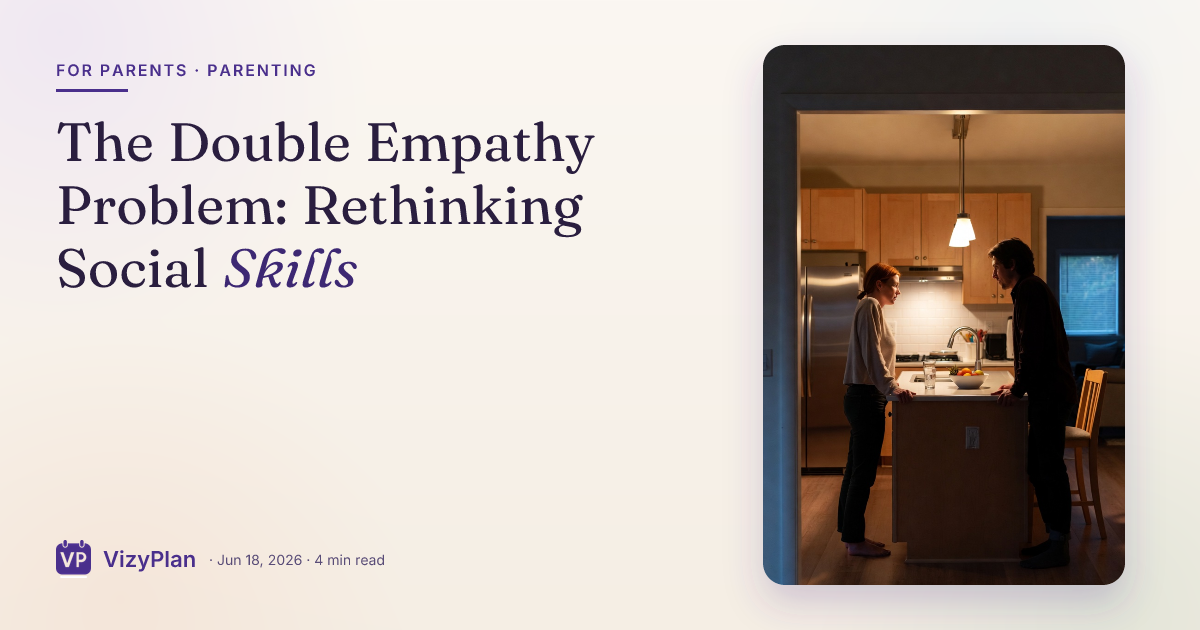
For decades, autistic kids were told they lacked social skills. The double empathy problem flips that: the misunderstanding runs both ways. Here is what the research shows and what it means for how you support your child.
June 18, 2026
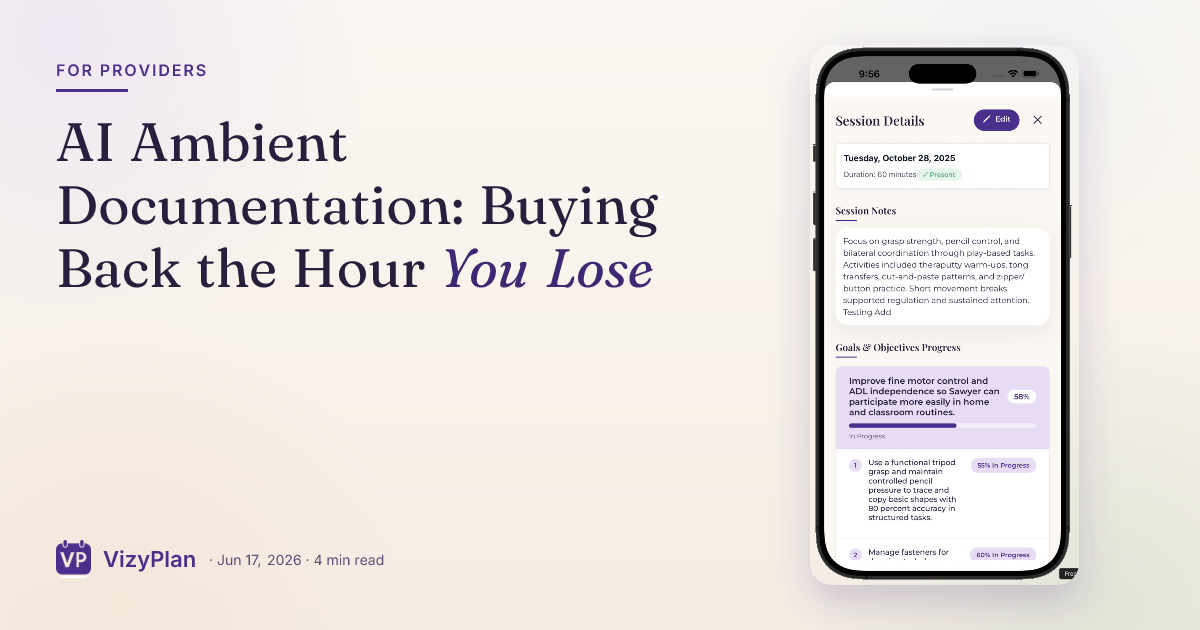
Clinicians lose 30 to 40 percent of their week to paperwork. AI ambient documentation drafts the note while you work, cutting charting to minutes. Here is what it does well, where the line is, and what to do with the time you reclaim.
June 17, 2026
Monotropism is the autistic-led theory that finally explains the deep focus, the meltdowns at transitions, and the all-or-nothing attention. Here is what monotropism means and how to support your child once you see it.
June 16, 2026
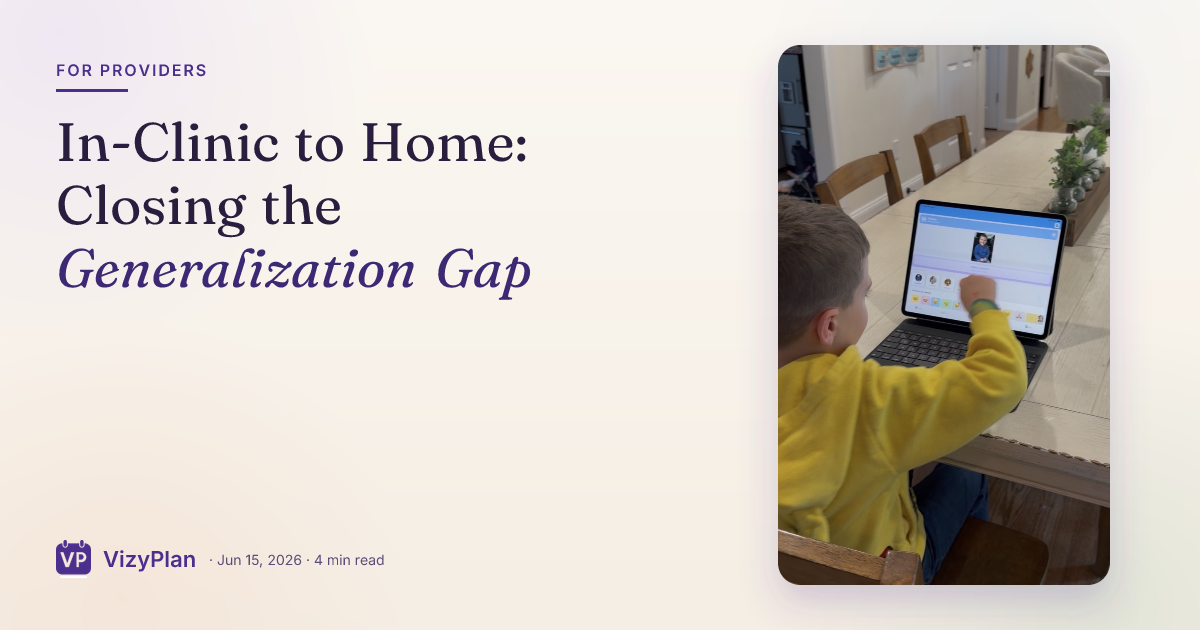
As autism therapy shifts toward in-clinic delivery, the oldest problem in the field gets louder. A skill mastered in your therapy room does not automatically show up at home. Here is the provider scaffold that closes the generalization gap.
June 15, 2026
A 2026 review found autism misinformation is widespread on social media. When every scroll offers a new fix, you need a filter. Here is how to vet autism advice online and tell credible guidance from confident nonsense.
June 14, 2026
Assent-based care has moved from the margins to the ethical gold standard of ABA in 2026. Here is what assent-based care looks like in practice and how predictability and choice at home reinforce it between sessions.
June 13, 2026
A meltdown is loud and obvious. An autistic shutdown is the same overload turned inward, and it is easy to miss or mistake for defiance. Here is how to tell an autistic shutdown from a meltdown and what helps each one.
June 12, 2026
Telehealth parent coaching matches in-person outcomes when it is done well, yet the strategy still evaporates by Wednesday. Here is the provider scaffold that makes virtual coaching carry over into the family routine.
June 11, 2026

Most of what we say to autistic kids is a question or a command. Declarative language flips that by sharing observations instead of issuing directions, which lowers the demand and builds connection. Here is how to use it at home.
June 10, 2026
Parents are arriving at intake asking for NDBI by name. Naturalistic developmental behavioral intervention blends ABA and developmental science into play and daily routines. Here is the provider-friendly explainer and where the home routine fits.
June 9, 2026
A 2026 study identified two biologically distinct autism subtypes, each tied to a different pattern of brain communication. Here is what the autism subtypes research actually found and what it means for your child at home.
June 8, 2026
Fewer authorized hours are the new reality as payers tighten utilization and trim rates. The math only works if gains hold between sessions. Here is how to densify carryover, pick the highest-leverage goal, and generate the generalization data that also supports continued-care authorization.
June 7, 2026
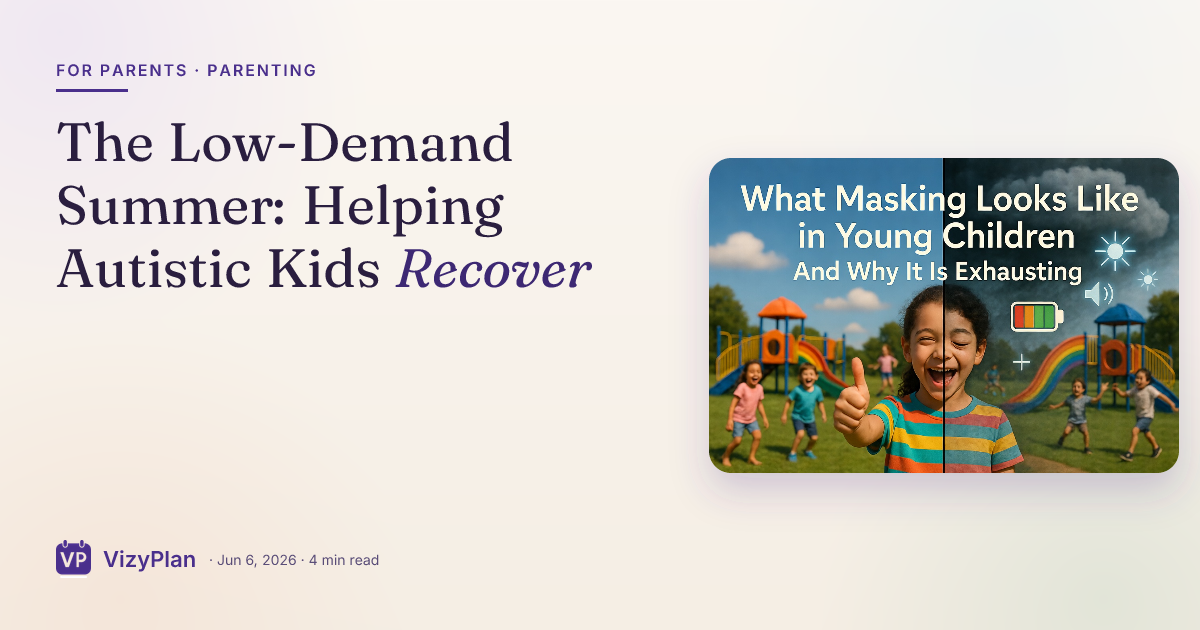
A low-demand summer is not laziness. For an autistic child who spent the school year masking, regulating, and performing, summer can be the recovery the nervous system has been waiting for. Here is how to lower the demands on purpose without losing the predictability your child still needs.
June 6, 2026
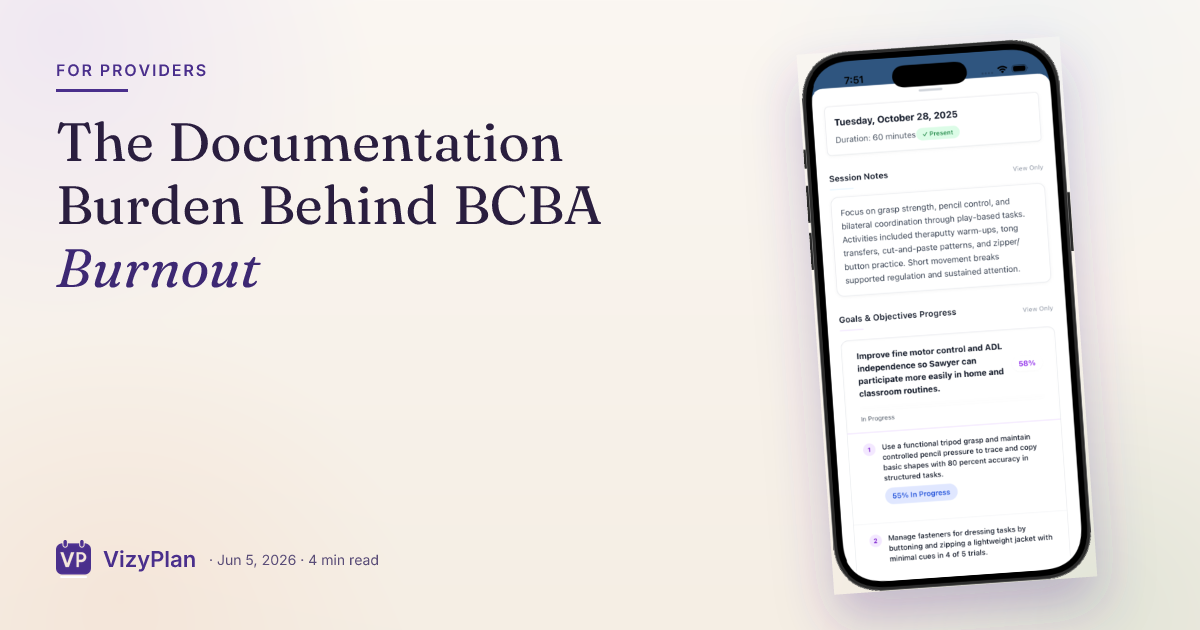
BCBA burnout is no longer a quiet problem. Surveys show most have considered leaving, and the biggest culprit is not the children. It is the paperwork. Here is what the documentation burden is doing to your team and the practical levers that give clinicians their time back without cutting corners on care.
June 5, 2026
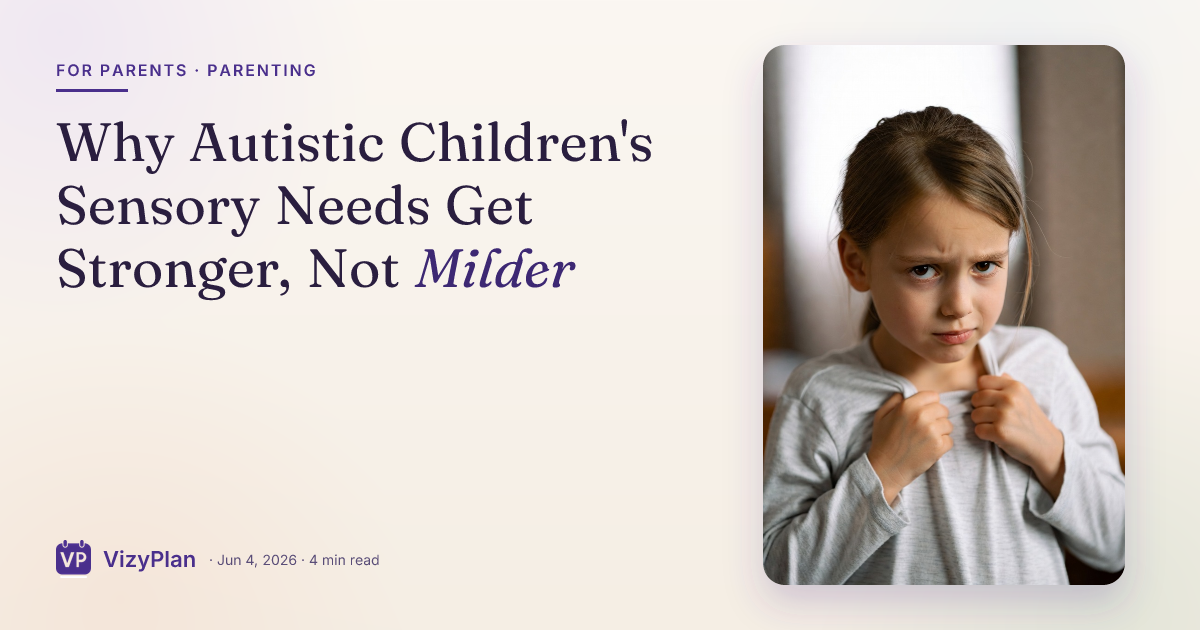
Many parents are quietly told their child will grow out of their sensory sensitivities. A large study following more than 1,500 children suggests the opposite. Autistic children's sensory needs tend to get stronger over time, not milder. Here is what the research found and what it changes about how you build the day.
June 4, 2026
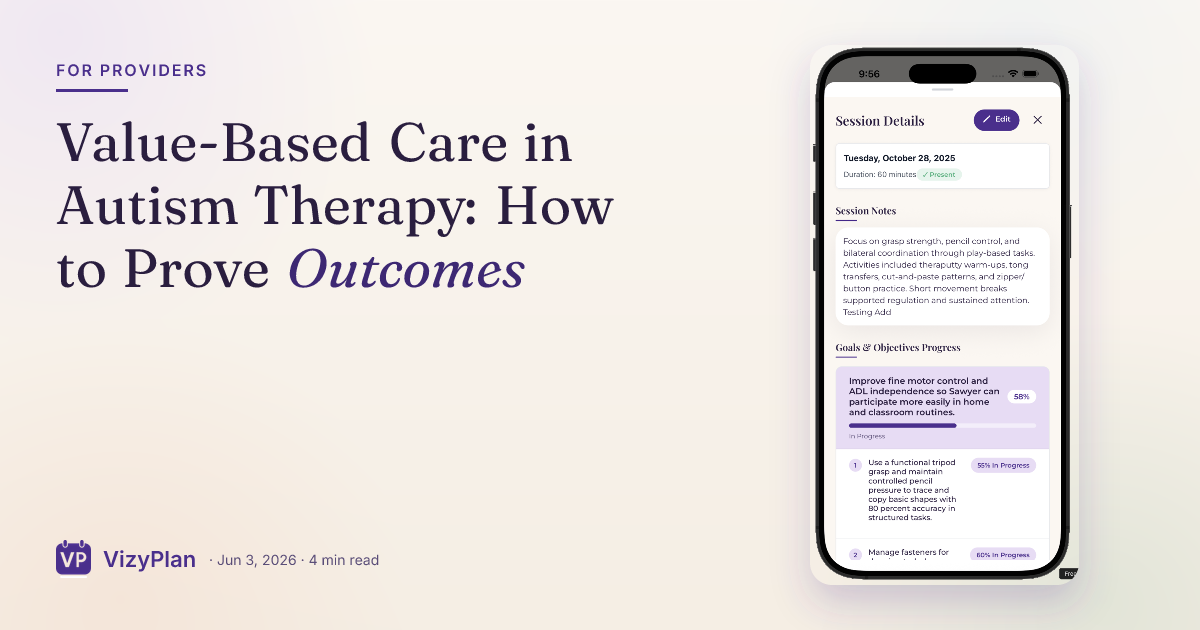
Value-based care in autism therapy is moving from conference panels to contract language. Payers and investors increasingly want proof of progress, not a log of hours billed. Here is what outcomes they are looking for, why generalization is the hardest one to show, and how to build the evidence into your model.
June 3, 2026
Autism therapy Medicaid cuts are showing up in the authorization letters families open at the kitchen table. States are trimming ABA rates and tightening approvals. Here is what is actually changing, what it means for your child, and the practical steps that keep progress going when hours get cut.
June 2, 2026
The moment lands hard. Your autistic child looks up and says, "I hate being autistic." My son is five and we have not arrived at this moment yet, but I have heard the story from enough other parents to know it is coming for many of us. Here is what the research says about autistic identity in kids and what helps when the day arrives.
June 1, 2026
ESY runs a few hours a few days a week. The IEP goal still has to survive the rest of the summer. Extended school year carryover is the gap between the goal page and the kitchen at 9 a.m. Here is the visual scaffold school clinicians can hand the family.
May 31, 2026
Drowning is the leading cause of death in autistic children under fourteen who wander. Swim lessons for autistic kids are not enrichment, they are safety infrastructure. Here is what research says and the lesson setup that works.
May 30, 2026
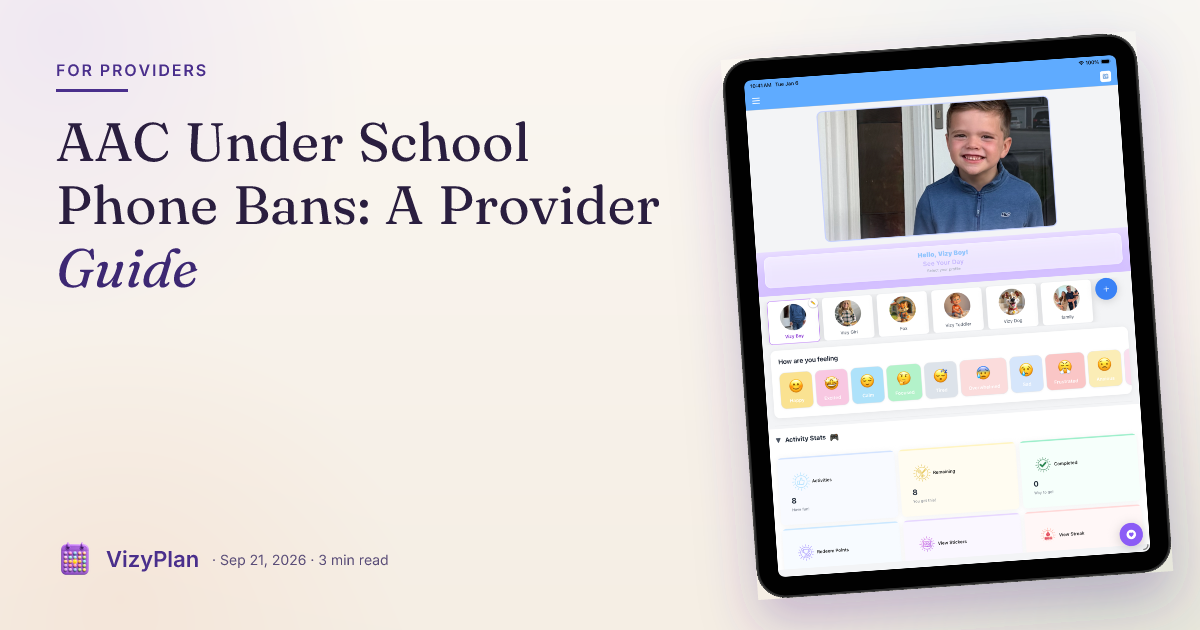
If you are an SLP working with an AAC user, you already know the gap. The device gets used in your session and stays in the bag at home. AAC visual schedules are the bridge that turns a communication tool into part of the day.
May 29, 2026
Your neighborhood is already stockpiling for the Fourth, and you can feel the dread building. Fireworks and autism can be one of the hardest sensory collisions of summer. Here is what research says about noise sensitivity and the prep that helps.
May 28, 2026
Executive function is the lane every OT is working in even when the IEP does not name it. Written for the OT building EF scaffolding that travels home with the family. Here is the literature and the visual sequence bridge.
May 27, 2026
Interoception is the sense your families are not naming when they describe meltdowns, toileting accidents, picky eating, and the kid who runs himself into exhaustion. Written for the OT building body awareness as an actual program, not a buzzword.
May 26, 2026
Gestalt language processors need a stable corpus of context anchored scripts to move through NLA Stage 1 and 2. Written for the SLP whose home programs lose the NLA thread between sessions. Here is what the literature says and where a visual planner fits.
May 25, 2026
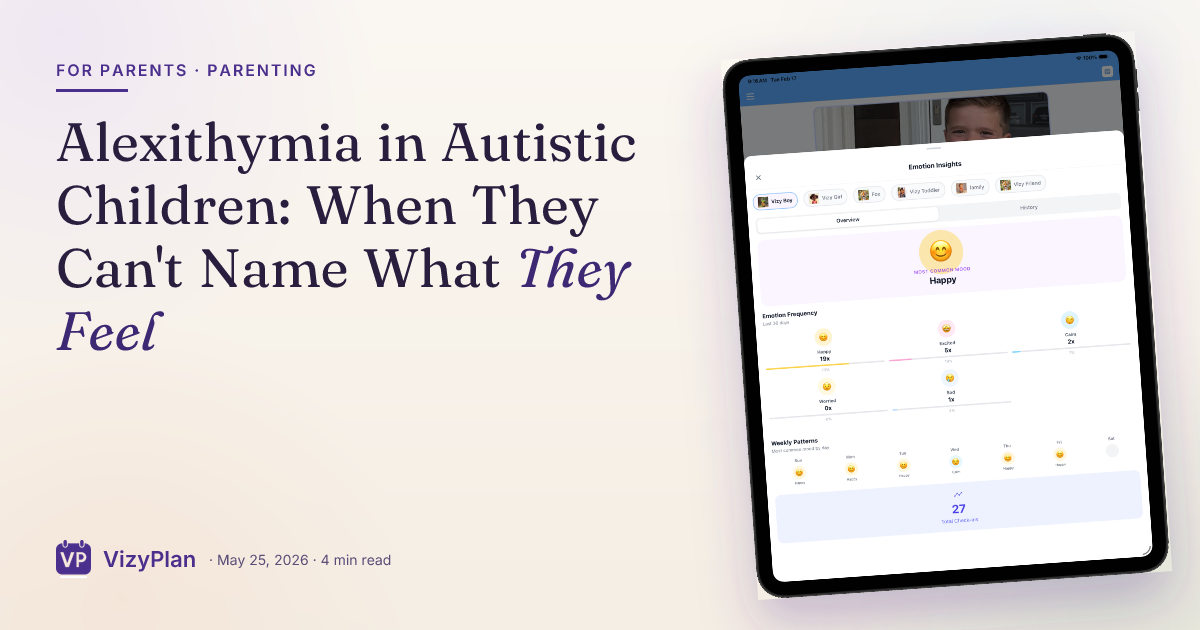
How do you feel? lands as a blank stare. Your child clearly feels something, but cannot name it. The missing word for what is happening here is alexithymia, and it shows up in roughly half of autistic kids. Here is what helps build the translation step.
May 25, 2026
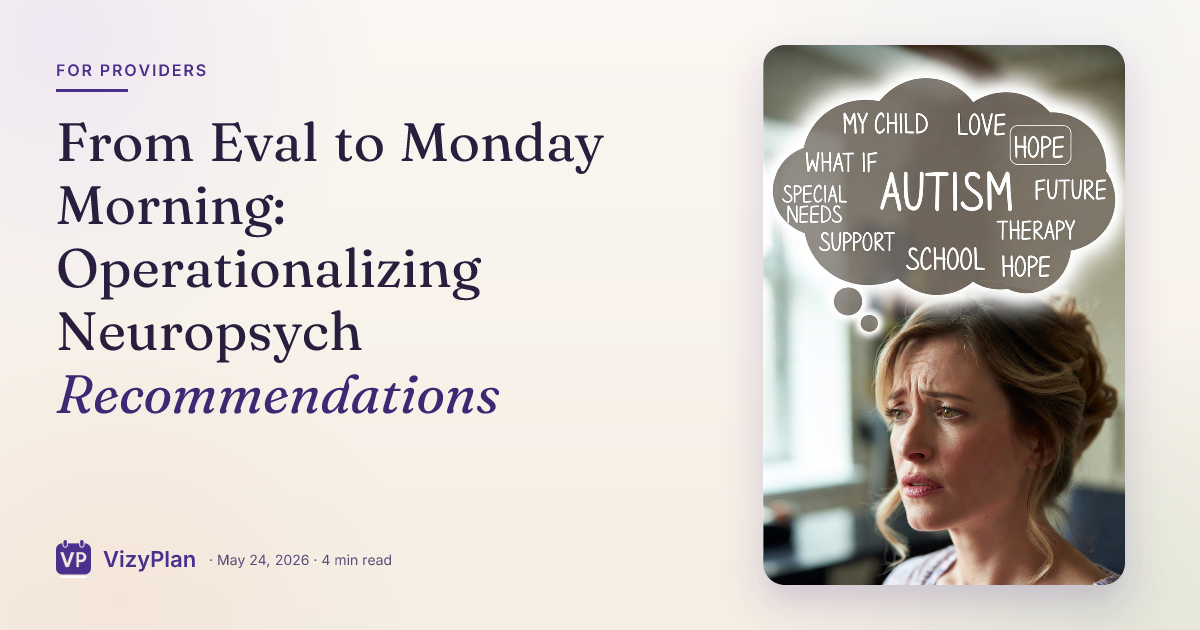
Neuropsych eval recommendations are only as useful as Monday morning. Written for the neuropsychologist whose families come back six months later and have not implemented anything. Here is the operationalization gap and how visual planning helps close it.
May 24, 2026
That tiny correction at the dinner table that sent your kid spiraling for an hour. If you have wondered whether the response was disproportionate, rejection sensitive dysphoria is the term you may be looking for. Here is what clinicians say.
May 24, 2026
A sensory diet home program that survives the car ride home is the difference between an evidence-based practice in the clinic and a notebook on the kitchen counter. Written for the OT building home programs that families actually run.
May 23, 2026
That sudden withdrawal, the loss of skills you knew your child had. If you have wondered whether this is regression or just a hard week, the term you may be searching for is autistic burnout in kids. Here is what the research says and what helps.
May 23, 2026
The speech therapy carryover gap is the structural reason a beautifully designed home program never gets implemented. Written for the SLP whose families did not do the worksheet. Here is what the literature says and what we built to help.
May 22, 2026
The school year ends and the structure holding your autistic child together disappears overnight. Here is what the research says about the summer routine cliff and what helps before it arrives.
May 22, 2026
This is the autism morning routine case study I wish someone had handed us the week after diagnosis. One family. Six months. What changed, what did not, and what we learned about building the day in pictures.
May 21, 2026
AI images autism safety is the first question every smart parent asks before uploading a photo of their child. We asked it about our own son first. Here is what we found and what we will not do.
May 20, 2026
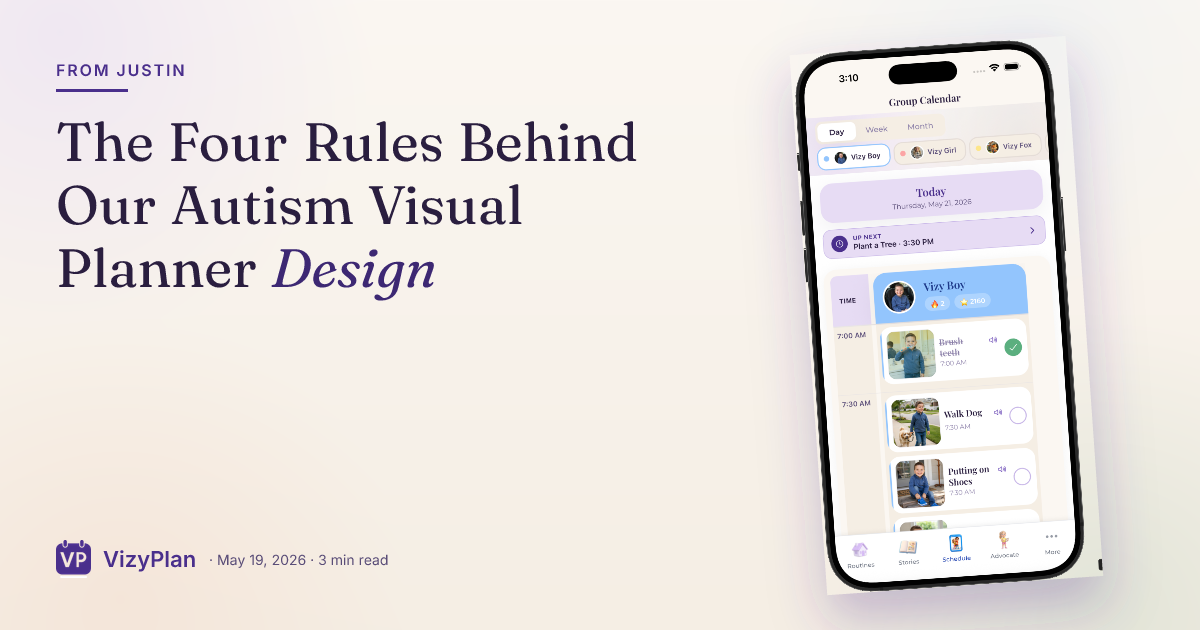
Before we decided what to build into VizyPlan, we decided what NOT to build. Four design rules grade every feature, anchored in the visual supports literature and what worked for our own family.
May 19, 2026
An autism sticker chart alternative that celebrates effort instead of scoring compliance. Built so the wins stay visible and the misses stay quiet.
May 18, 2026
Planning the day should not be the hardest part of the day. Here is the autism morning routine help we built for our own kitchen floor at 6 a.m.
May 17, 2026
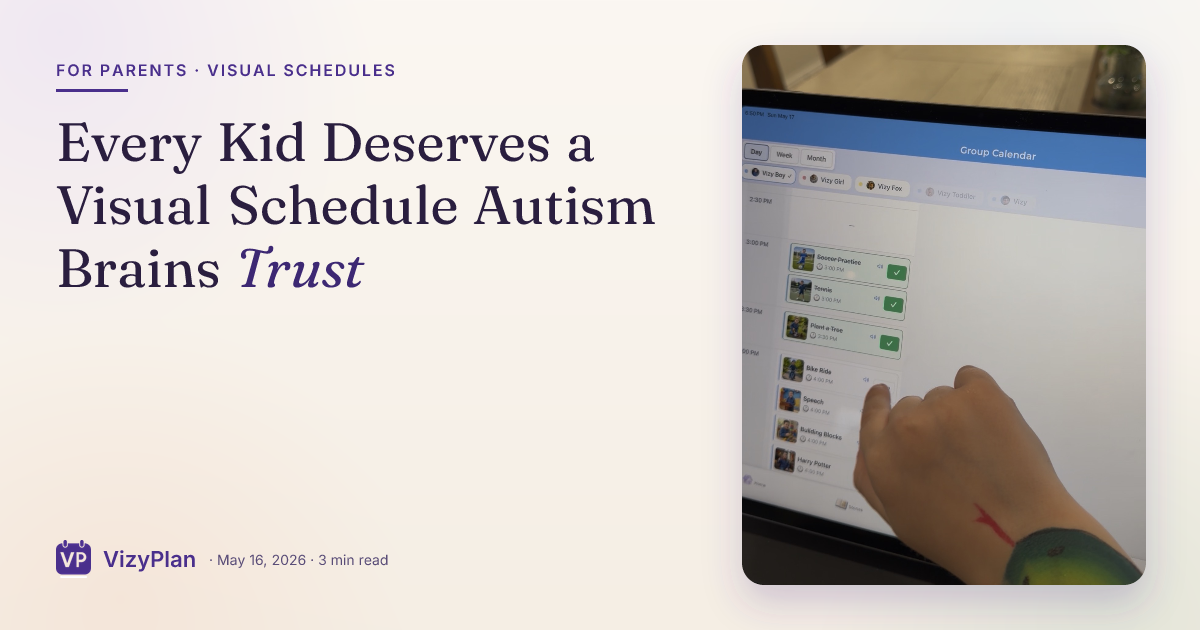
A visual schedule autism kids will actually follow uses photos of their own world, not generic clip art. Here is why personalized images change the day.
May 16, 2026
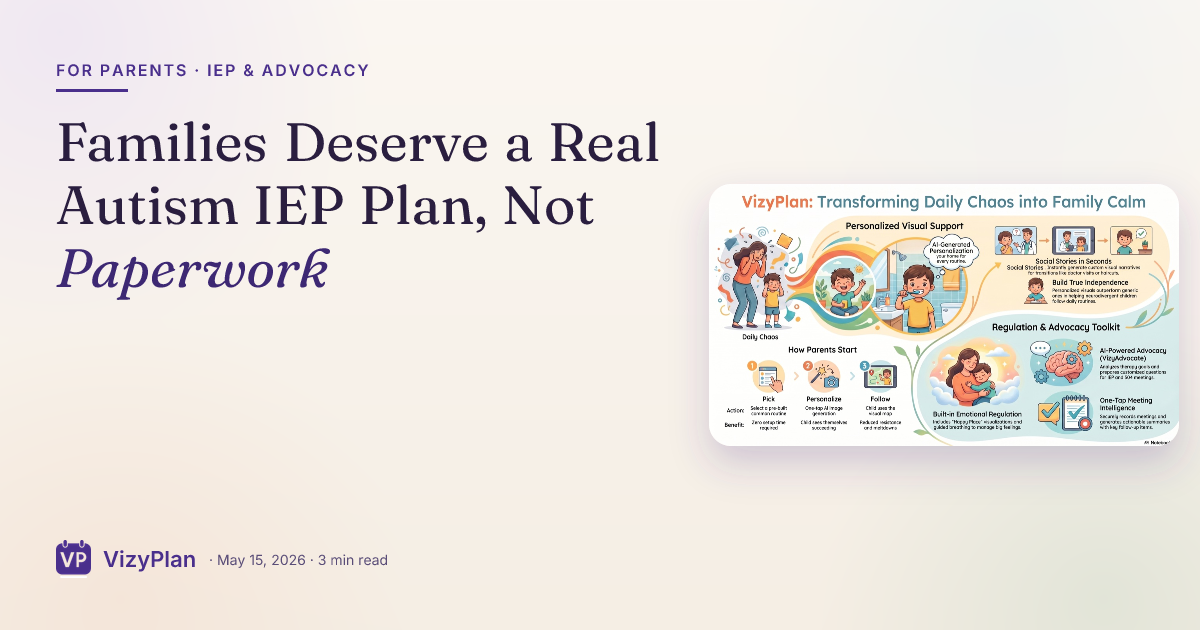
An autism IEP plan should live in your pocket, not in a drawer. Here is how we turned the wall of paperwork into a plan a parent can actually carry.
May 15, 2026
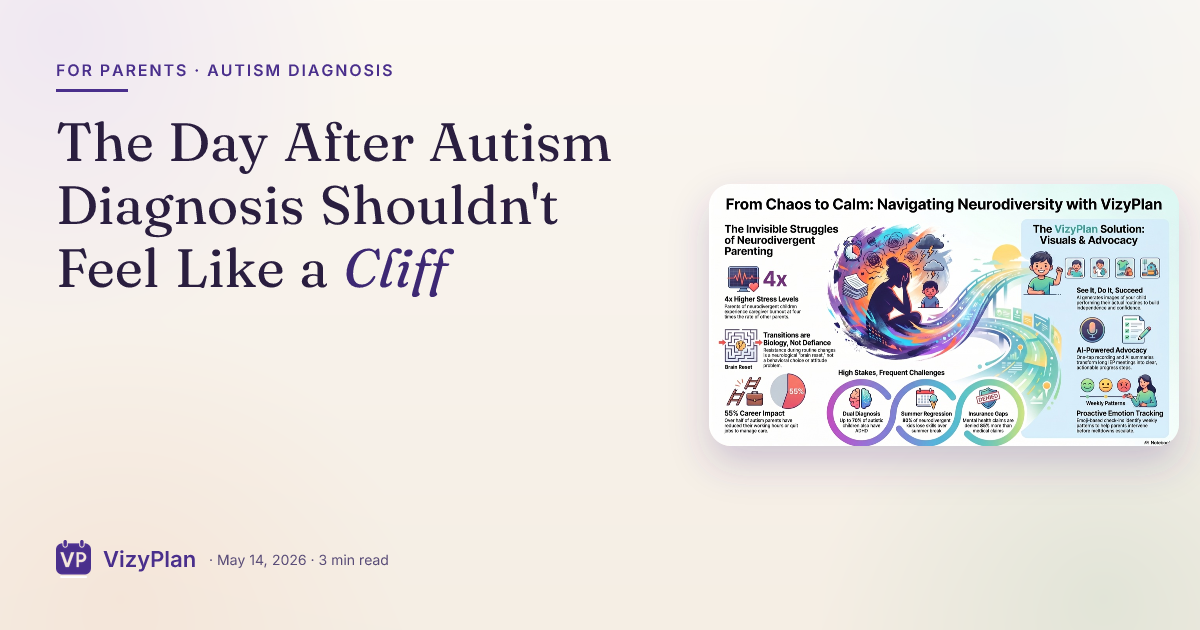
The day after autism diagnosis should not feel like a cliff. Here is the first week we wish someone had handed us, built from what we needed when we lived it.
May 14, 2026
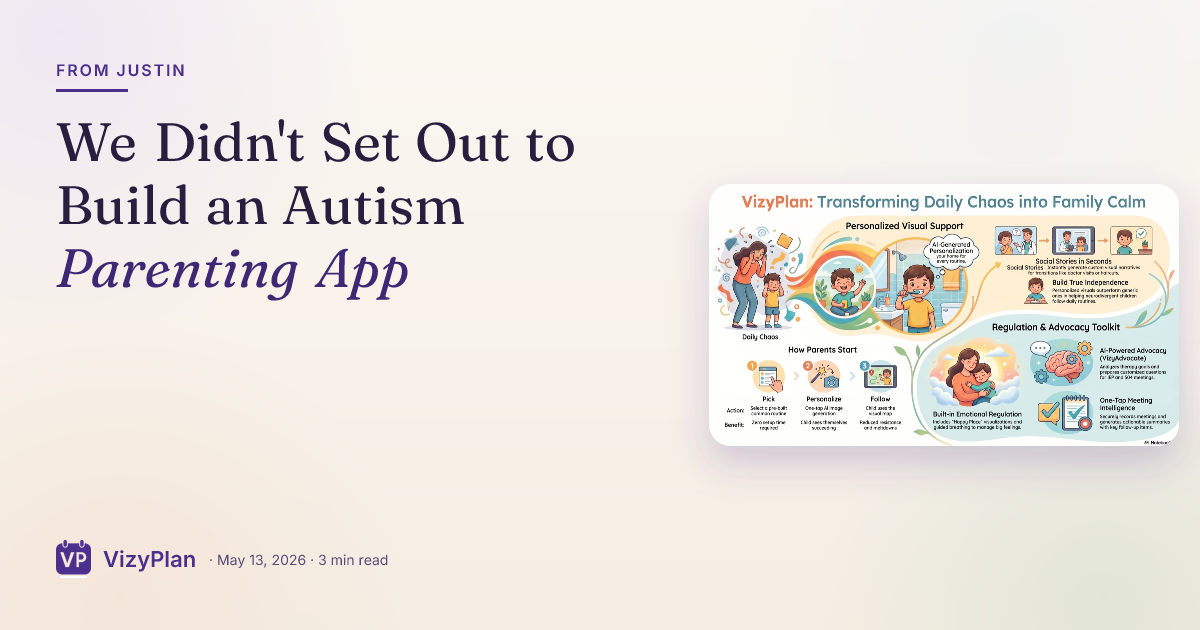
We did not set out to build an autism parenting app. We set out to help our own son. Here is the why behind every screen in VizyPlan and the family it came from.
May 13, 2026
Building autistic child morning routine independence is not a strict schedule or a sticker chart. It is a visible map your child can run without you. Here is how it actually works.
May 12, 2026
The grief after an autism diagnosis is real, common, and rarely named. It is not grief for your child. It is grief for the parenting path you imagined. Here is how to move through it.
May 11, 2026

Birthday parties for autistic kids are a sensory landmine. Crowds, songs, sugar, surprises, balloons. Here is the preview that turns the meltdown into a memory worth keeping.
May 10, 2026
Sleep deprivation in autism families is not the same as new-parent tired. It compounds for years and rewires what is possible. Here is what the research says and what helps.
May 9, 2026
Your autistic child meltdown at the dentist is not bad behavior. It is six sensory inputs your child cannot escape, in a room they cannot leave, with a stranger in their mouth. Here is the fix.
May 8, 2026
When grandparents do not believe autism is real, the conflict lands on top of everything else you are already carrying. Here is how to protect your child without setting the family on fire.
May 7, 2026
First day of school anxiety in autistic kids is not nerves you can pep talk through. It is the brain bracing for a complete reset. Here is a week-before plan that actually works.
May 6, 2026
Why autistic kids resist transitions has nothing to do with attitude. It is biology. Here is what is actually happening in their brain and the three things that move the needle.
May 5, 2026
Death is abstract. For an autistic child who relies on routine and concrete language, preparing them for a loss is one of the hardest transitions a parent has to navigate. Here is what actually helps.
May 4, 2026
Dads come pre-loaded for fix mode. Provider, protector, problem solver. But your autistic son is not a problem to solve. The shift from fix to support is the one that finally lets you see how beautiful his mind already is.
May 3, 2026
Specific scripts, phrases, and procedural rights parents can use when they disagree at the IEP table, plus the one sentence that protects every request.
May 2, 2026
A practical, step-by-step recipe for writing a social story your autistic child will actually engage with, including the one ratio rule that makes the difference.
April 30, 2026
A morning routine for an autistic child is built on sensory regulation, visual structure, and the night before. Here is the parent playbook that actually holds.
April 29, 2026
Your child quotes Bluey instead of asking for snacks. They sing songs before they say words. They speak in long phrases that sound like memorized scripts. There is a name for that, and it is not a problem to fix.
April 26, 2026
Autism Acceptance Month fills your feed with blue puzzle pieces and hashtags. But what does acceptance actually look like inside your house, on a Tuesday, when your child is melting down and dinner is burning?
April 25, 2026
The end of the school year brings a tidal wave of change. For neurodivergent children, losing the structure of school can trigger anxiety, regression, and meltdowns. Here is how to prepare them before the last bell rings.
April 24, 2026
Drowning is the leading cause of death for children with autism who wander. As summer approaches, here is what the research says and what you can do to keep your child safe around water.
April 23, 2026
Your occupational therapist mentioned a sensory diet and you nodded along. But what does that actually look like at home? Here is a practical, room-by-room guide to building sensory input into your daily routine.
April 22, 2026
Your child came home and said the words that break your heart. Loneliness in neurodivergent children is painfully common and deeply misunderstood. Here is how to help.
April 21, 2026

Your child is not lazy, defiant, or unmotivated. Their brain processes tasks differently. Understanding executive function changes everything about how you support them.
April 20, 2026

Therapy waitlists for autism services are longer than ever. But waiting does not mean doing nothing. Here are research-backed strategies you can start at home today while you wait for that call.
April 19, 2026
Registration deadlines are hitting now. Your child needs more preparation than a packing list. Here is how to set them up for a summer camp experience that works, from intake conversations to visual pre-teaching to what to do when the first day feels impossible.
April 18, 2026
The teacher says your child is fine at school. Then they walk through the front door and everything falls apart. That gap between school behavior and home behavior has a name. It is called masking, and it is costing your child more than anyone realizes.
April 17, 2026

Your child melts down from hunger but says they are fine. They have an accident even though you just asked if they needed the bathroom. This is not defiance. It is interoception, the sense most people have never heard of.
April 16, 2026

You have been told your child should be able to calm themselves down by now. The science says something different. Self-regulation is built through co-regulation first, and for neurodivergent children, that timeline looks nothing like the charts suggest.
April 15, 2026
Your child repeats lines from movies, echoes your questions back, or scripts entire conversations from memory. That is not broken language. That is language working differently.
April 14, 2026
The diagnosis is not the hard part. The hard part is Monday morning, when nobody is coming to help and you have to figure out what life looks like now.
April 13, 2026
Whether it is kindergarten, a mid-year move, or a new classroom, here is how to prepare your neurodivergent child for one of the biggest transitions they will face.
April 12, 2026
A parent guide to evaluating whether your child's IEP goals are truly individualized, appropriately ambitious, and aligned with who your child actually is.
April 11, 2026
Up to 80% of neurodivergent children lose skills over summer break, and recovery can consume the entire fall semester. Here is how to prevent it.
April 10, 2026
VizyPlan is proud to be a water table sponsor at the 2026 Autism Superhero 5K at Polar Park in Worcester, MA. This cause is personal for us.
April 9, 2026
Bedwetting affects up to 30% of autistic children. It is not a behavior problem and it is not their fault. Here is the science behind why it happens and what actually helps.
April 8, 2026
Your child is not being destructive. Sensory chewing is a neurological need that serves a real purpose. Here is the science behind why children chew and evidence-based strategies that work.
April 7, 2026
Nearly 63% of parents report behavioral regression when routines break down. The neuroscience behind why it happens, what it actually means, and how to bring your child back.
April 6, 2026
Almost 80% of autism parents say stigma makes holidays harder. Learn how to navigate overstimulation, relatives who do not understand, and the expectations that follow your family to every gathering.
April 5, 2026
A meta-analysis of 52 studies found siblings of disabled children face elevated anxiety and depression. Learn how to see the child you might be looking through.
April 4, 2026
Research shows 88% of autistic children stim regularly. Learn which stims to support, which ones signal concern, and practical strategies for keeping your child safe and regulated.
April 3, 2026
Mental health claims are denied 85% more often than medical claims. Learn your rights under parity law, how to appeal step by step, and why families who fight back win almost half the time.
April 2, 2026
Up to 95% of autistic children have sensory differences. Learn why their brain cannot tune out clothing the way yours does and what the neuroscience says actually helps.
April 1, 2026
Social stories work in therapy but fall apart at home. Research shows why the session-to-home gap exists and what SLPs, parents, and families can do to close it.
March 31, 2026
Your autistic child is not just being picky. Research shows 64% have atypical oral sensory processing. Learn the neuroscience behind safe foods and what actually helps expand eating.
March 30, 2026
ABA therapy is being cut across the country. If your child lost hours or is on a waitlist, here is what the research says you can do at home to maintain progress.
March 29, 2026
When your child resists everything, even things they want to do, it may not be defiance. Learn what the PDA profile looks like, why traditional strategies backfire, and what actually helps.
March 28, 2026
Up to 80% of autistic children have sleep problems. Learn what the science says about why, what actually works, and what the latest research reveals about melatonin safety.
March 28, 2026
Research shows 41% of autism content on TikTok is inaccurate. Learn how to spot misinformation, evaluate online advice, and find evidence-based resources you can actually trust.
March 27, 2026
A parent guide to IEP meeting preparation, from understanding the documents to knowing your rights and walking in with confidence.
March 26, 2026
From visual schedules to emotion recognition and smarter IEPs, artificial intelligence is quietly reshaping how families support autistic children every day.
March 24, 2026
When your child with autism graduates high school, most services disappear overnight. Here is what every family needs to know about the services cliff and how to prepare before it hits.
March 23, 2026
Autism is at the center of a national debate. Here is what actually matters for your family right now, no matter where you stand.
March 22, 2026
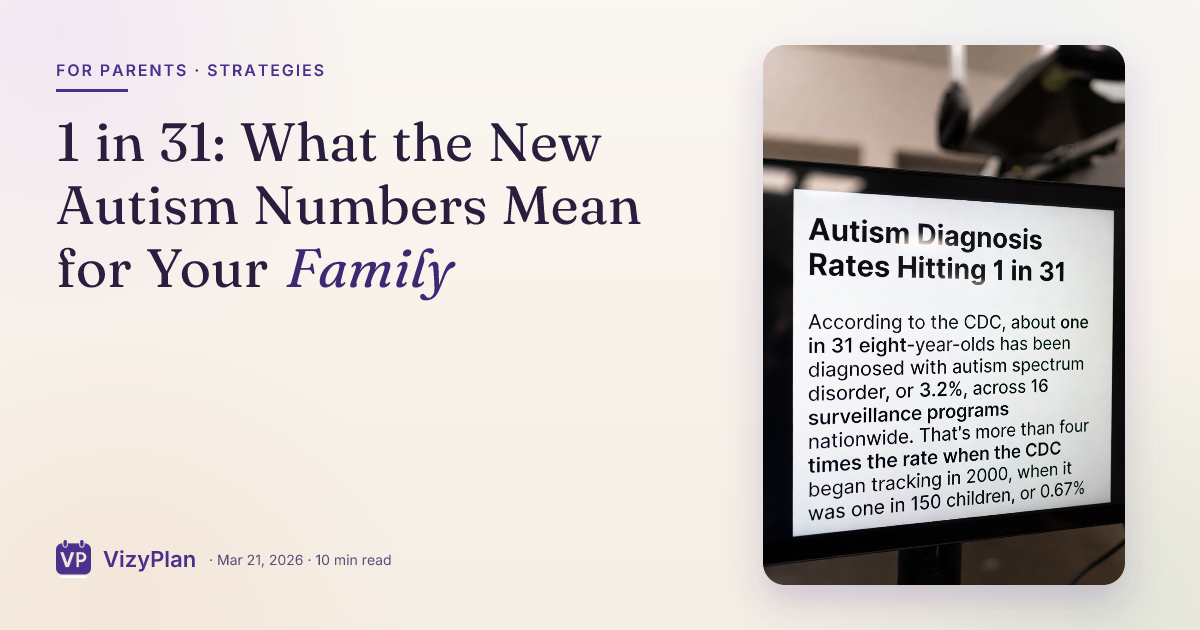
The CDC now reports 1 in 31 children has autism. What is driving the increase, what it means for services and schools, and what families should do right now.
March 21, 2026
Research-backed benefits of pets for children with autism and ADHD, which animals work best, and how to introduce a pet using visual supports and gradual exposure.
March 20, 2026
A parent guide to funding autism therapy and services. Federal programs, grants, insurance mandates, tax benefits, and lesser-known resources that can save your family thousands.
March 19, 2026
The neuroscience behind screen time meltdowns in neurodivergent children, and practical strategies to make turning off the tablet less explosive for everyone.
March 18, 2026
Evidence-based strategies for helping neurodivergent children navigate birthday parties, whether you are attending someone else's celebration or hosting your own sensory-friendly event.
March 17, 2026
The real reasons dating feels impossible when you are raising an autistic child alone, and the research-backed strategies that help you find connection without guilt.
March 16, 2026
40% of autism parents pull away from friends after diagnosis. Why friendships fade, what research says about the toll of isolation, and practical ways to rebuild your circle.
March 15, 2026
Research shows 63% of autistic children have significant food selectivity. Why it happens, what actually helps, what makes it worse, and when picky eating crosses into something that needs professional support.
March 14, 2026
The diagnosis changes everything and nothing at the same time. A research-backed guide to the emotions, the providers, the insurance, the support systems, and the first steps that actually matter after your child is diagnosed with autism.
March 13, 2026
Research shows 68% of autistic children display aggression toward caregivers. Evidence-based strategies for understanding why it happens, responding safely in the moment, and building proactive systems that reduce aggressive episodes over time.
March 12, 2026
55% of parents of autistic children have reduced their hours or quit a job. Here is what working parents of neurodivergent kids actually face and the strategies that help.
March 11, 2026
Research shows children told about their diagnosis early develop stronger self-identity and better mental health. Here is how to have the conversation at every age.
March 10, 2026
Autistic children are nearly twice as likely to start puberty early. Learn how hormonal changes affect sensory processing, emotional regulation, and executive function, and how to prepare your child with visual supports.
March 9, 2026
Nearly half of autistic children attempt to elope. Learn why wandering happens, how to prevent it, and what to do if your child goes missing.
March 8, 2026
Up to 70% of autistic children also have ADHD. Here is what the dual diagnosis means and how to support a child living with both.
March 7, 2026
The science behind why stay-at-home moms of autistic children experience combat-level stress, and the practical strategies that actually help.
March 6, 2026
Neurodivergent children grieve differently. Learn why grief looks unusual in autistic and ADHD children and how to support them through the loss of a family member.
March 5, 2026
Research shows 80% of autistic girls are undiagnosed at 18. Learn why autism and ADHD look different in girls and the signs parents should watch for.
March 4, 2026
From occupational therapy to speech therapy to play-based approaches, understanding which therapies help neurodivergent children and what each one actually looks like in practice.
March 3, 2026
Restaurants combine every challenge neurodivergent children face into one setting: sensory overload, unfamiliar food, long waits, and social pressure. Research-backed strategies to make dining out possible for your family.
March 2, 2026
Research shows neurodivergent children face unique challenges during divorce, from routine disruption to transition anxiety between homes. Evidence-based strategies for building consistency across two households using visual supports.
February 27, 2026
Your child is burning up with fever but cannot tell you what hurts. The medicine tastes wrong. The routine is gone. Here is how to care for a sick neurodivergent child when nothing in the parenting playbook applies.
February 26, 2026
Your child came home quiet again. No eye contact, no stories about recess. Research shows neurodivergent kids are bullied up to 3 times more often, and the signs look different than you might expect.
February 24, 2026
"He just needs more discipline." Your mother-in-law said it at dinner, again. Here is how to educate extended family, set boundaries without burning bridges, and protect your child when relatives do not get it.
February 23, 2026
Another snow day. The kids are climbing the walls, screens are the only thing keeping the peace, and you can feel the meltdown building. Here are the OT-approved strategies that actually work when your neurodivergent family is trapped indoors.
February 22, 2026
Your child was fine all break. Now school is back and suddenly there are stomachaches, meltdowns, and morning battles. Here is why the return hits neurodivergent kids 47x harder and exactly what to do about it.
February 21, 2026
A practical guide to choosing the right OT, SLP, or behavior therapist for your neurodivergent child, including what to look for, what to avoid, questions to ask, and how to know when it is time to switch.
February 20, 2026
Understand the real differences between 504 Plans and IEPs, when each is appropriate for children with autism or ADHD, and how to advocate for the right support at school.
February 19, 2026
Parents of neurodivergent children experience stress at 4x the rate of other parents. Research-backed strategies to recognize burnout, protect your wellbeing, and build systems that support your whole family.
February 18, 2026
Moving beyond deficit-based thinking to recognize and nurture the special interests, unique perspectives, and remarkable abilities of neurodivergent children.
February 17, 2026
How anxiety shows up differently in autistic and ADHD children, and visual strategies including worry scales, calm-down sequences, and grounding techniques that help.
February 16, 2026
Evidence-based strategies for teaching safety rules, stranger awareness, road safety, and emergency protocols to children with autism and ADHD using visual supports.
February 15, 2026
How to build life skills and independence through household chores using visual task analysis, backward chaining, and structured support for neurodivergent children.
February 14, 2026
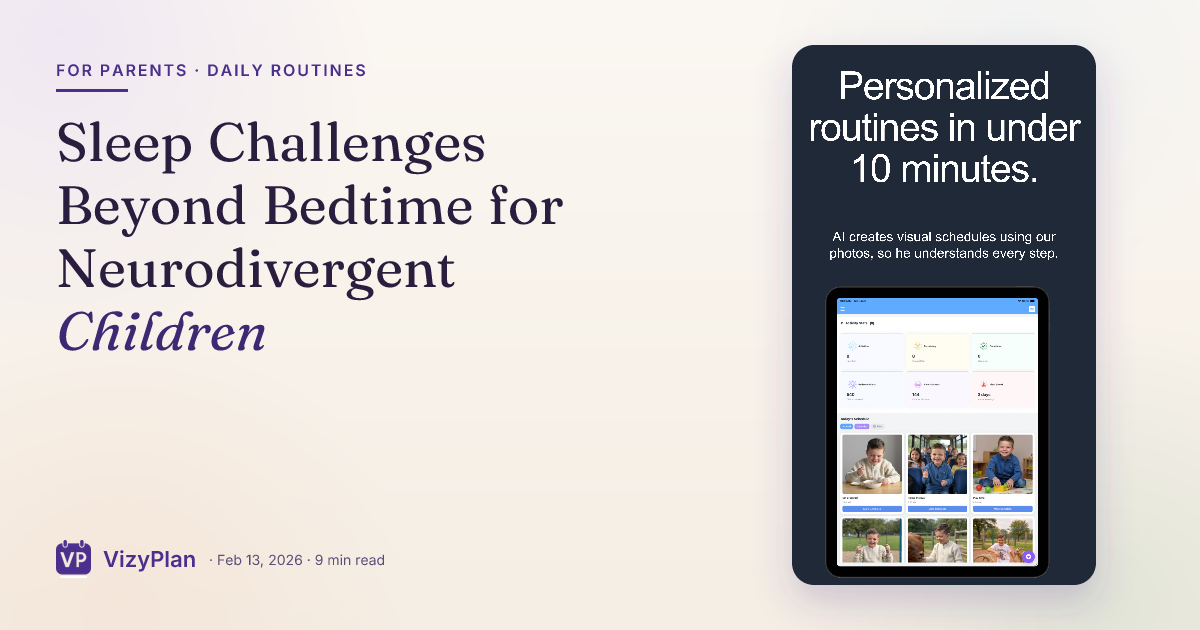
Beyond bedtime routines: addressing night waking, sleep anxiety, early morning rising, and other sleep challenges common in children with autism and ADHD.
February 13, 2026
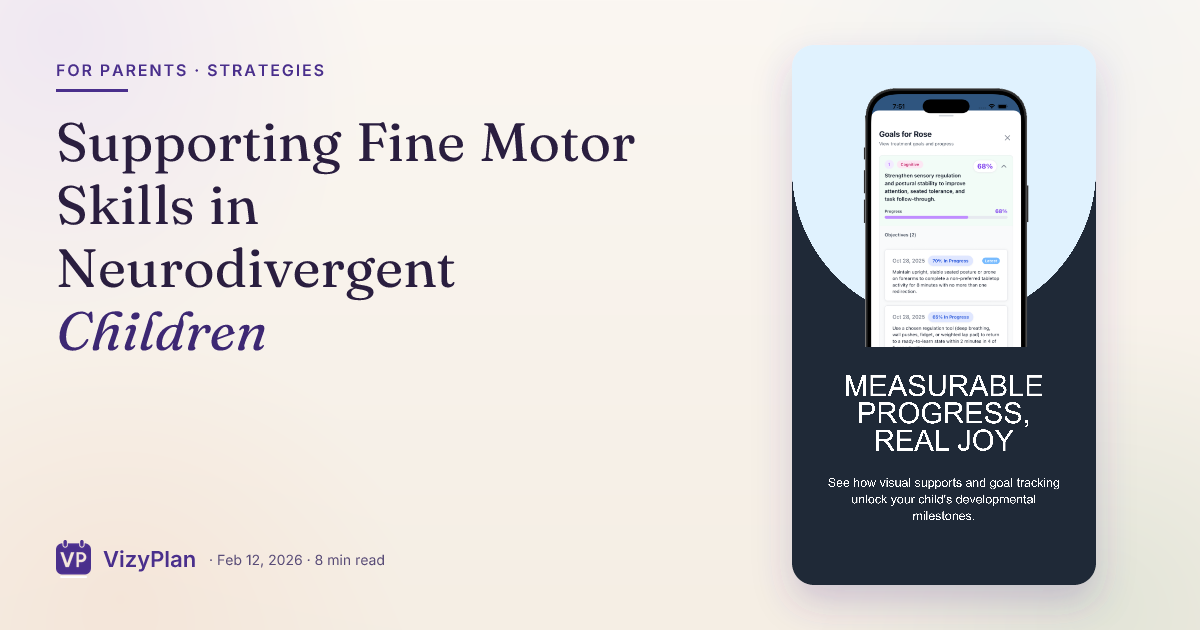
Practical strategies for helping neurodivergent children develop fine motor skills and handwriting, including visual guides, adaptive tools, and occupational therapy approaches.
February 12, 2026
Research shows nature exposure reduces ADHD symptoms and supports sensory regulation in autistic children. Here are practical ways to bring the outdoors into your routine.
February 11, 2026
How to help your autistic or ADHD child navigate the stress of moving to a new home, from preparation weeks in advance to settling into the new environment.
February 10, 2026
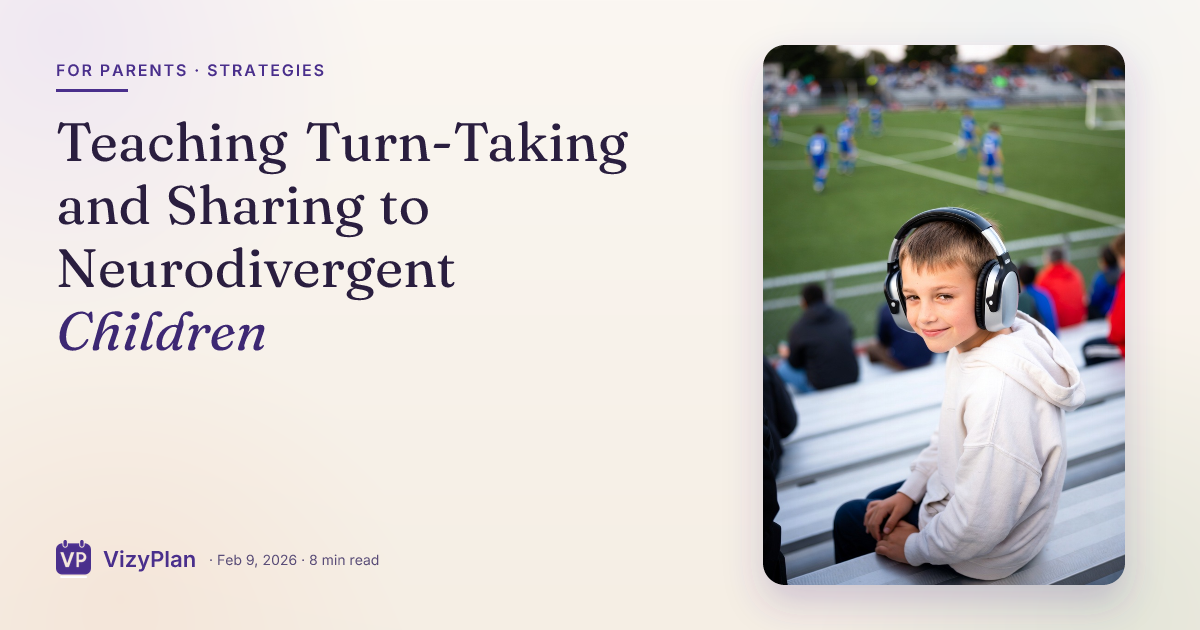
Evidence-based approaches to teaching turn-taking and sharing skills to children with autism and ADHD using visual supports, structured games, and social stories.
February 9, 2026
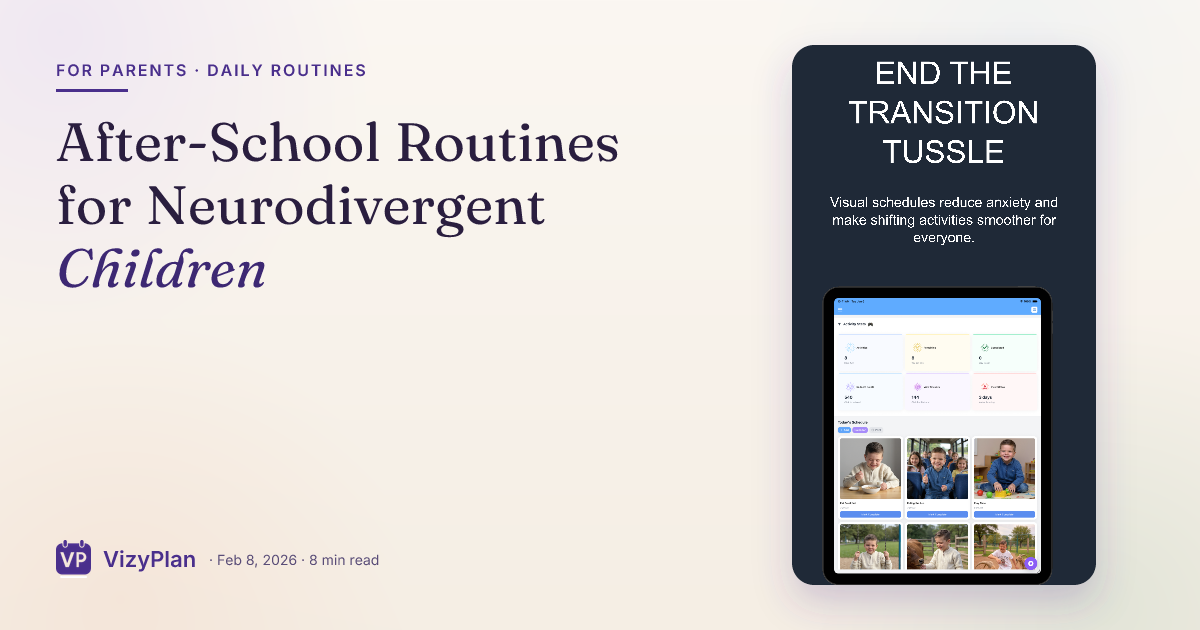
How to create smooth school-to-home transitions for neurodivergent children, including managing after-school meltdowns, decompression time, and visual afternoon schedules.
February 8, 2026
Why waiting is uniquely challenging for children with ADHD and autism, and research-backed strategies including visual timers, wait cards, and structured practice.
February 7, 2026
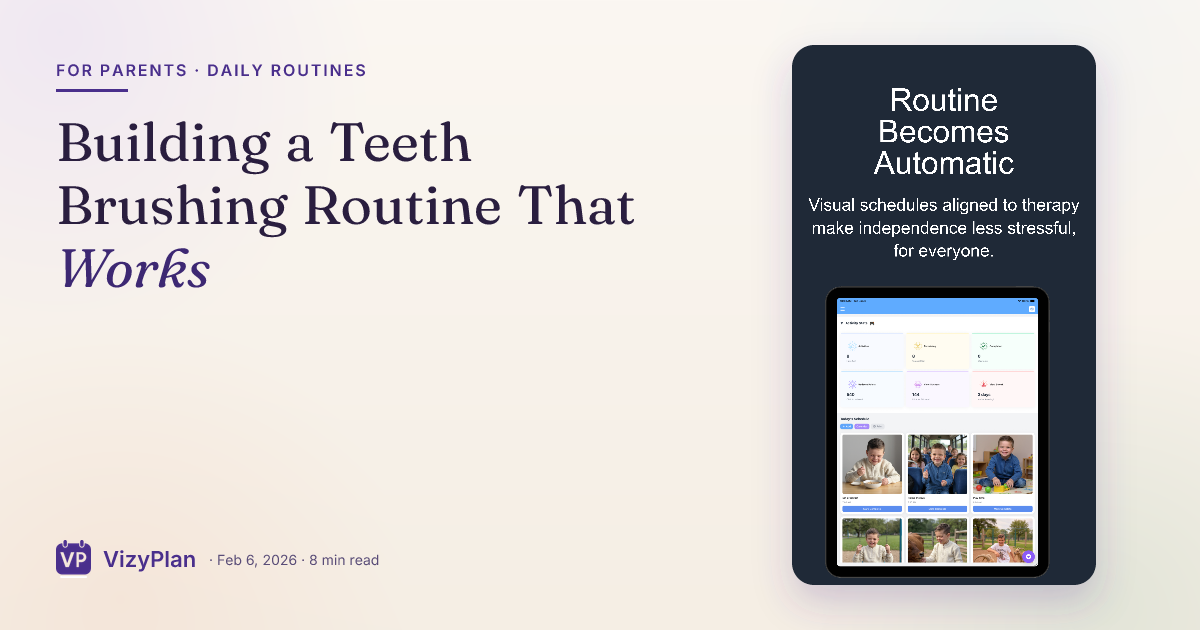
Evidence-based strategies for overcoming teeth brushing challenges in children with autism and ADHD, from sensory accommodations to visual step-by-step guides.
February 6, 2026
Practical strategies for making haircuts less stressful for children with autism and ADHD, including desensitization techniques, visual preparation, and sensory accommodations.
February 5, 2026
Evidence-based strategies for making getting dressed easier for neurodivergent children, including sensory-friendly clothing, visual dressing sequences, and reducing morning decision fatigue.
February 4, 2026
Evidence-based strategies for making bath time, hair washing, toothbrushing, and grooming easier for neurodivergent children through sensory accommodations and visual supports.
February 3, 2026
Practical strategies for making grocery store trips and errands manageable for neurodivergent children, including sensory toolkits, visual shopping lists, and gradual exposure techniques.
February 2, 2026
How to build self-advocacy skills in neurodivergent children through self-understanding, communication scripts, emotion literacy, and daily practice with visual supports.
February 1, 2026
Practical strategies for making playdates and social events successful for neurodivergent children, from preparation and interest-based socializing to sensory breaks and celebrating wins.
January 31, 2025
Evidence-based strategies for preparing neurodivergent children for school, including visual schedules, social stories, morning routines, and classroom accommodations.
January 30, 2025
Practical strategies for helping autistic and ADHD children navigate the arrival of a new sibling, from pregnancy preparation through the first months at home.
January 29, 2025
Research shows neurodivergent children engage more deeply with visual routines when they see themselves in the images. Here is why personalized visuals outperform generic ones.
January 28, 2025
Evidence-based strategies for potty training children with autism and ADHD, including visual schedules, sensory accommodations, and reward systems that actually work.
January 27, 2025
Practical strategies for managing screen time with neurodivergent children, including setting boundaries, preventing meltdowns during transitions, and using screens as effective tools.
January 26, 2025
Practical strategies to help neurodivergent children navigate holidays, birthdays, and special events with less stress and more enjoyment for the whole family.
January 25, 2025
Practical strategies for successful family travel with neurodivergent children, from preparation weeks before departure to managing unexpected changes on the road.
January 24, 2025
Practical strategies to reduce mealtime stress and support neurodivergent children who struggle with food textures, routines, and sensory sensitivities.
January 23, 2025
Discover how connecting your child's emotions to specific activities reveals patterns that transform meltdowns into manageable moments.
January 22, 2025
Discover how to help your child maintain emotional regulation during transitions and what to do when dysregulation happens between activities.
January 21, 2025
Learn how social stories help autistic children understand new situations, navigate social expectations, and feel prepared for life's challenges.
January 21, 2025
What started as a personal project has become something so much bigger. VizyPlan uses custom AI-generated images to support neurodivergent learners in visualizing routines and seeing themselves succeeding.
January 20, 2025
Discover proven strategies and visual supports to transform chaotic bedtimes into peaceful, predictable routines for neurodivergent children.
January 19, 2025
Learn effective strategies and visual supports to help children with autism move between activities with less anxiety and resistance.
January 18, 2025
Explore how visual tools help neurodivergent children identify, understand, and manage their emotions more effectively.
January 17, 2025
Practical strategies and visual supports to help neurodivergent children complete homework with less stress and greater independence.
January 16, 2025
Learn how to design daily routines that accommodate sensory sensitivities and help children with sensory processing differences thrive.
January 15, 2025
Discover why visual schedules are one of the most effective tools for helping autistic children understand routines and reduce anxiety.
January 14, 2025
Learn how to use First-Then boards to help your child understand expectations and complete tasks with less resistance.
January 13, 2025
Practical strategies to make mornings smoother and less stressful for families navigating ADHD.
January 12, 2025
Discover how AI image generation creates personalized visual supports that help children see themselves succeeding in their daily routines.
January 11, 2025
Help your child build an internal sanctuary through visualization, mindfulness, and personalized calm-down strategies that work for their unique brain.
January 10, 2025
Learn how to create effective reward systems that motivate your child, build positive habits, and celebrate progress without creating dependency.
January 9, 2025
Learn how to leverage visual documentation, progress tracking, and collaborative tools to strengthen partnerships with your child's therapists, teachers, and care team.
January 8, 2025
Discover how to use visual supports to help your neurodivergent child develop independence in daily tasks while building confidence and reducing dependence on prompts.
January 7, 2025
Practical strategies for nurturing healthy sibling relationships when one or more children in the family are neurodivergent.
January 6, 2025
Learn how choice boards give neurodivergent children a voice, reduce power struggles, and build decision-making skills through visual options.
January 5, 2025
Learn to identify the emotional, sensory, and situational cues that signal your child is heading toward a meltdown, and how to intervene before it escalates.
January 4, 2025
Help your child feel prepared and reduce anxiety around medical appointments with visual supports, social stories, and proven preparation strategies.
January 3, 2025
Start your free 7-day trial. You will see the difference in the first routine.
Try anonymously, no email or credit card · $6.99/month after trial