
Every autism parent knows the interest. It might be trains, dinosaurs, elevators, weather systems, or a single video game your child could narrate for hours. The old clinical language called these restricted interests and treated them as something to ration. A growing body of research, and a generation of autistic adults, say that framing gets it backwards. Special interests are not the distraction from learning. They are the engine of it, for both parents and providers.
Why special interests are so powerful
A special interest is where an autistic child is most engaged, most regulated, and most competent. That is not a small thing. Engagement is the precondition for learning, and an interest delivers it for free. The connection runs deeper through monotropism, the theory that autistic attention flows as a deep tunnel toward fewer things. The interest is that tunnel. Working with it rather than against it means teaching with the current instead of fighting it, which is far less exhausting for everyone.
How parents can use the interest
- Build routines around it. Make the beloved thing the reward and the anchor of the day, so the hard steps lead somewhere your child wants to go.
- Teach through it. Counting train cars, reading dinosaur books, and writing weather reports are math, literacy, and writing wearing a costume your child loves.
- Let it regulate. When the world is too much, the interest is often the fastest road back to calm. Protect it as a tool, not just a treat.
How providers can use the interest
For clinicians, a special interest is a ready-made source of motivation and a bridge to harder goals. Embed it in reinforcement, in social stories, and in the materials you choose. A child who will not label flashcards will happily label every planet. The same interest can become a social bridge, since shared passion is one of the most natural ways autistic kids connect, a point we explore in the double empathy problem. Using interests this way fits squarely inside neurodiversity-affirming practice.
The shift is simple to say and powerful in practice. Stop treating the interest as the problem and start treating it as the path. The deep focus your child already brings is the most renewable source of motivation you will ever find.
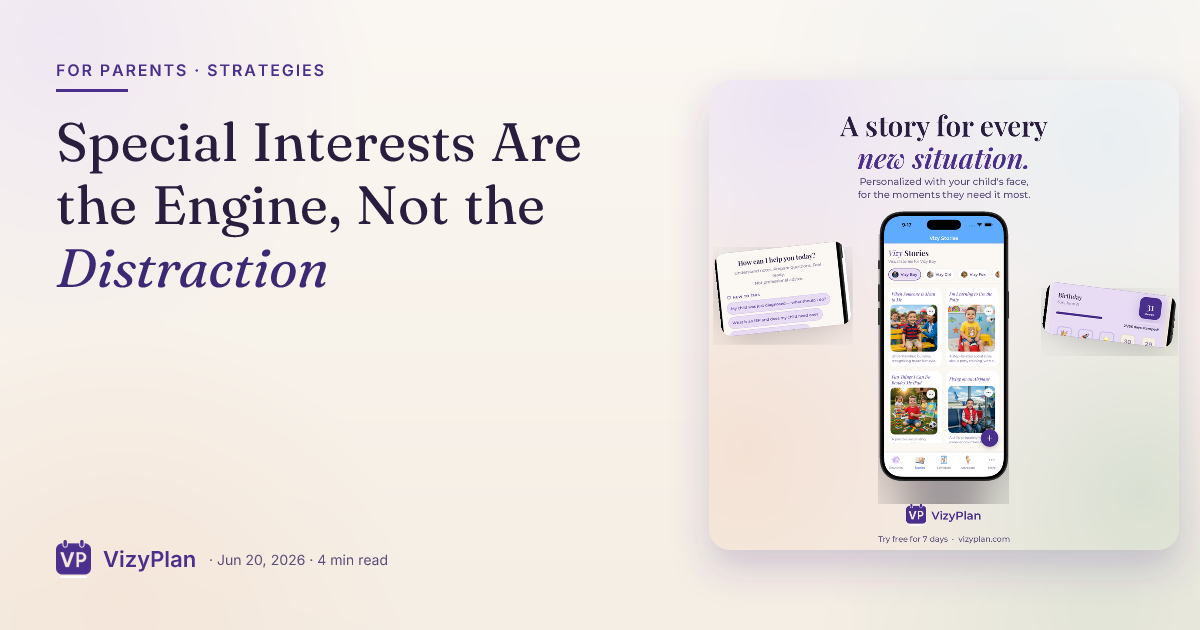
VizyPlan was built by an autism dad whose son lit up when his own world showed up in his day. Build the interest into the routine, the story, and the reward, so learning rides on the thing your child already loves.
Enjoying this article?
Get practical tips and insights delivered to your inbox — no spam, ever.
Download VizyPlan and start your 7-day free trial today. Build the day around what your child loves most. Just $6.99/month after your trial, no credit card required upfront.
VizyPlan was built by an autism dad who needed something that did not exist. Start your free trial.