
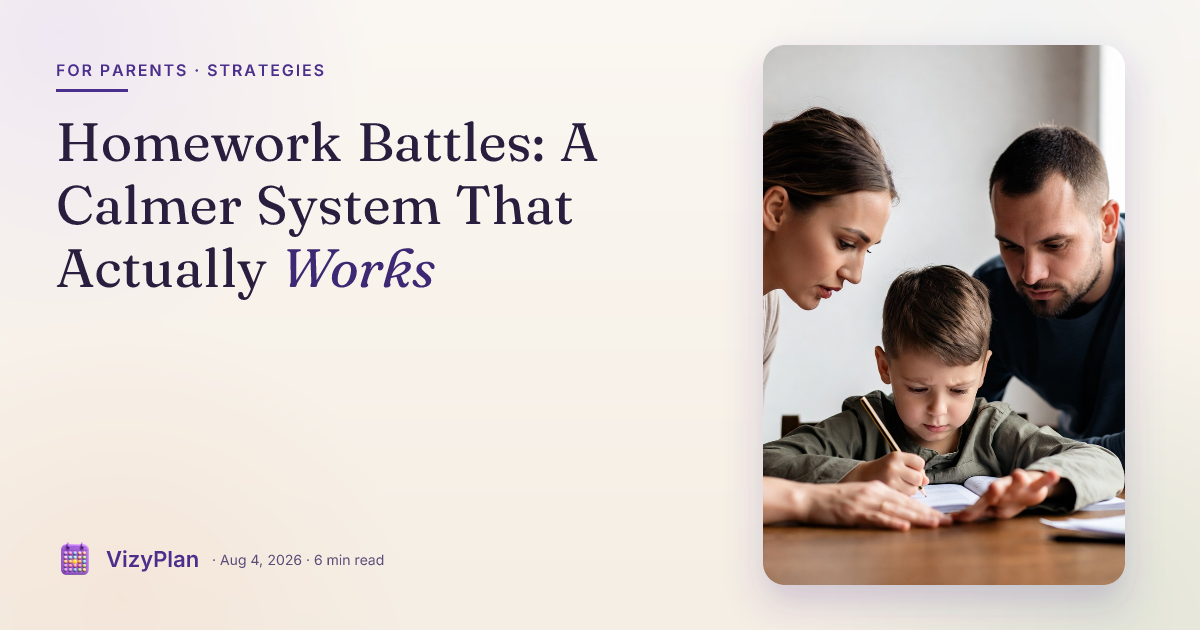
Twenty minutes of math takes two hours and ends with somebody crying, and it is not always the child. Homework battles are the most reliably miserable part of the school year, and the reason they resist all the obvious fixes is that the obvious fixes target motivation. Homework battles are almost never about motivation. They are about starting, remembering, and timing, three things that live in executive function and get depleted by exactly the kind of day your child just had.
What the research says about homework battles
Homework problems in ADHD are well documented and well measured. A study of 579 children with ADHD published in School Mental Health validated the Homework Problems Checklist and found the problems get worse with grade level, with fourth graders showing significantly more homework problems than first graders at moderate effect sizes. Children who also had a learning disability showed significantly more homework problems than children with ADHD alone.
Two things follow from that. First, homework difficulty is not a phase that gets outgrown; it escalates as independent management demands rise. Second, the problem is measurable, which means it is fixable with structure rather than pressure.
And structure does work. A randomized clinical trial of the Family-School Success intervention found significant effects on homework performance, the quality of the family-school relationship, and parenting behavior. A separate intervention for adolescents reported the share of homework assignments turned in rising from 69 percent to 86 percent. None of those studies made anybody try harder. They changed the system around the work.
The five things that are actually breaking
Starting. Task initiation is its own skill and it is the one most often mistaken for laziness. A child sitting next to an unopened folder is usually not refusing, they are stuck at the ignition step. Our post on body doubling covers the single most effective fix for that.
Knowing what the work is. A child who recorded the assignment wrong or not at all cannot start something they cannot define. That is a materials-and-recording problem, not a work-ethic problem.
Timing. Homework usually lands during the exact hour when a child who masked all day has the least left. Our post on after-school restraint collapse explains why 3:30 is the worst hour of the day for demanding tasks.
Duration. "Do your homework" has no visible end. A child with poor time perception hears an open-ended demand, and our post on time blindness covers why a visible timer changes behavior more than a verbal deadline.
The parent as enforcer. The moment homework becomes a relationship issue, the cost of resisting drops and the cost of complying rises. Getting your voice out of the middle is worth more than any reward chart.
Enjoying this article?
Get practical tips and insights delivered to your inbox — no spam, ever.
A homework system worth trying this year
- Buffer first, work second. Sixty to ninety minutes of nothing after school. Food, movement, no questions. Work that starts after recovery finishes faster than work that starts at 3:15.
- Fix the same time and the same place. A routine removes the nightly negotiation about when. The decision should have been made in August, not at 4:40 each day.
- Make the work visible before it starts. Lay out exactly what has to be done tonight, as a short list your child can see and cross off. Three visible items beat one vague obligation.
- Use a visible clock, not a verbal one. A timer your child can watch, set to a length they agreed to. Fifteen minutes on, five off, works for more kids than an hour block.
- Sit nearby doing your own quiet task. Not helping, not checking. Presence solves task initiation for an enormous number of children, and it costs you nothing but the chair.
- Stop at the agreed time even if it is unfinished. Then email the teacher. A note that says we worked twenty-five focused minutes and got halfway is real information the school can act on. Two hours of misery is not.
Talk to the teacher in September, not in November
The most underused move in the whole homework conversation is asking the school to reduce the load. Most teachers will adjust when a parent reports, calmly and specifically, that twenty minutes of assigned work is taking ninety at home. That is not a favor. It is exactly the kind of data an IEP or 504 team is supposed to act on, and our post on 504 plans versus IEPs covers where a homework accommodation belongs.
Reasonable asks include a reduced problem set, extended time, permission to submit typed work, or a cap on nightly minutes with a parent signature covering the rest.
Let the system carry the structure, not your voice
The goal is a homework hour that runs on something other than you repeating yourself. A visible sequence, a visible timer, a visible finish line.
VizyPlan was built by an autism dad and an autism mom who is a licensed speech-language pathologist so the after-school hour can have a shape your child can see, including the part where it ends. Our post on executive function and visual sequences covers why a sequence outperforms a reminder.
Homework should cost your family twenty minutes and not your evening. If it is costing your evening, the assignment is the thing that should change.
Download VizyPlan and start your 7-day free trial today. Give the after-school hour a shape your child can see, including the finish line. Just $6.99/month after your trial, no credit card required upfront.
VizyPlan was built by an autism dad and an autism mom who is a licensed speech-language pathologist who needed something that did not exist. Start your free trial.