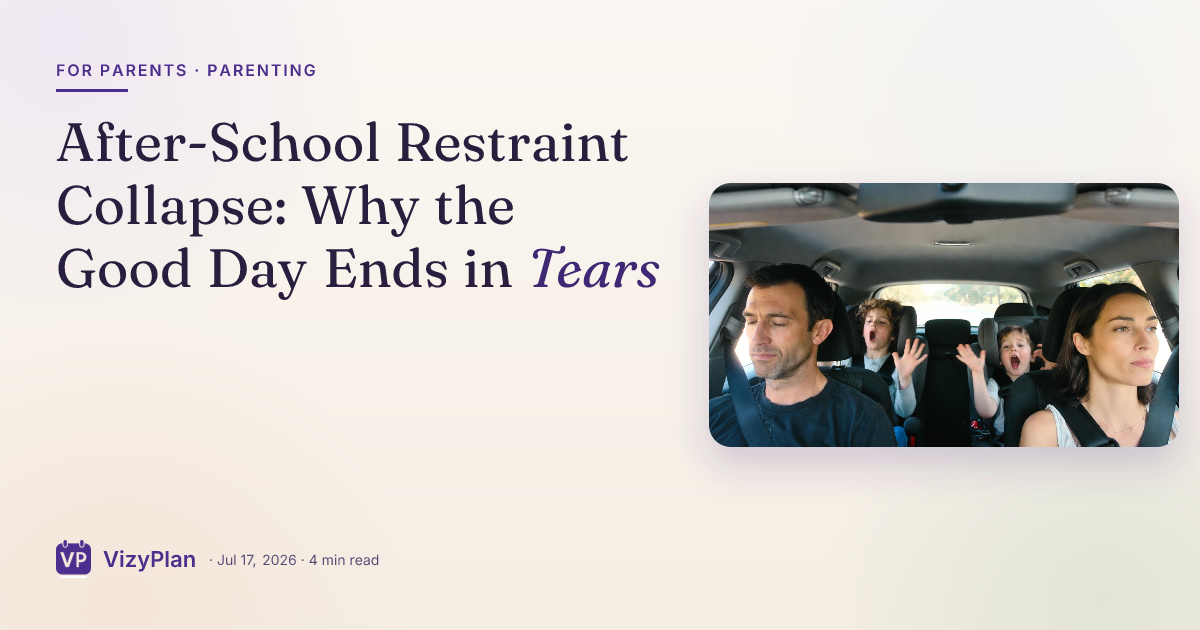
The note from the teacher says your child had a wonderful day. Cooperative, focused, no problems at all. Forty minutes later they are on the kitchen floor screaming because the wrong cup came out of the cabinet. After-school restraint collapse is the name parents use for that pattern, and if you have lived it you know its particular loneliness, because the version of your child everyone else sees is not the one you are holding at 3:30.
Being honest about the term
There is no clinical diagnosis called after-school restraint collapse. The phrase was coined by a parenting counsellor, not a research team, and it does not appear in the DSM or in peer-reviewed literature. Nobody has measured how many autistic kids experience it, and anyone quoting a percentage is inventing one. The pattern is parent-observed. But every ingredient in it is independently evidenced, which is a sturdier place to stand than a borrowed statistic.
What builds up to after-school restraint collapse
The clearest piece is masking. In a study of 733 autistic children and teens in Autism Research, camouflaging predicted internalizing symptoms including anxiety, depression, and somatic complaints. A meta-analysis of 5,897 autistic participants found camouflaging moderately correlated with anxiety, depression, and lower wellbeing. Both are correlational, and the review authors are careful that causal direction is not established.
There is a baseline load worth naming too. A meta-analysis of 31 studies found 39.6 percent of autistic youth met criteria for at least one anxiety disorder. A full school day is not merely tiring for a child carrying that. It is expensive.
Why the teacher genuinely is not seeing it
A latent profile analysis of 194 autistic children in Autism found one group of 40 children whose teachers rated their adaptive skills notably higher than their parents did. The study documents discrepant perceptions across settings rather than proving a cause, but the disagreement between you and the school is a known phenomenon, not a failure of your credibility.
Autistic burnout is the related concept with real depth behind it. A qualitative study in Autism in Adulthood defined it as chronic exhaustion and reduced tolerance to stimulus arising from a mismatch between expectations and support. That work was done with autistic adults, so apply it downward carefully. The useful part is the recovery factors named: time off, reduced expectations, permission to unmask.
Enjoying this article?
Get practical tips and insights delivered to your inbox — no spam, ever.
What actually helps at 3:30
- Front-load food and quiet before conversation. Questions about the day can wait an hour.
- Drop the demands for the first thirty minutes. No homework, no chores, no debrief.
- Let the stims out. Unmasking is a recovery mechanism, not misbehavior.
- Make the after-school sequence predictable. The same three steps every day removes one more decision.
- Stop treating the collapse as the report card. The meltdown is the cost of the good day, not proof it was fake.
No trial has tested a decompression period after school. The advice above applies the masking and burnout literature sensibly. It is not a proven protocol.
Predictability lowers the price of the landing
An after-school routine your child can see, rather than one arriving as spoken demands, takes pressure off the moment they have least left to give. Our post on autistic burnout warning signs in kids goes deeper.
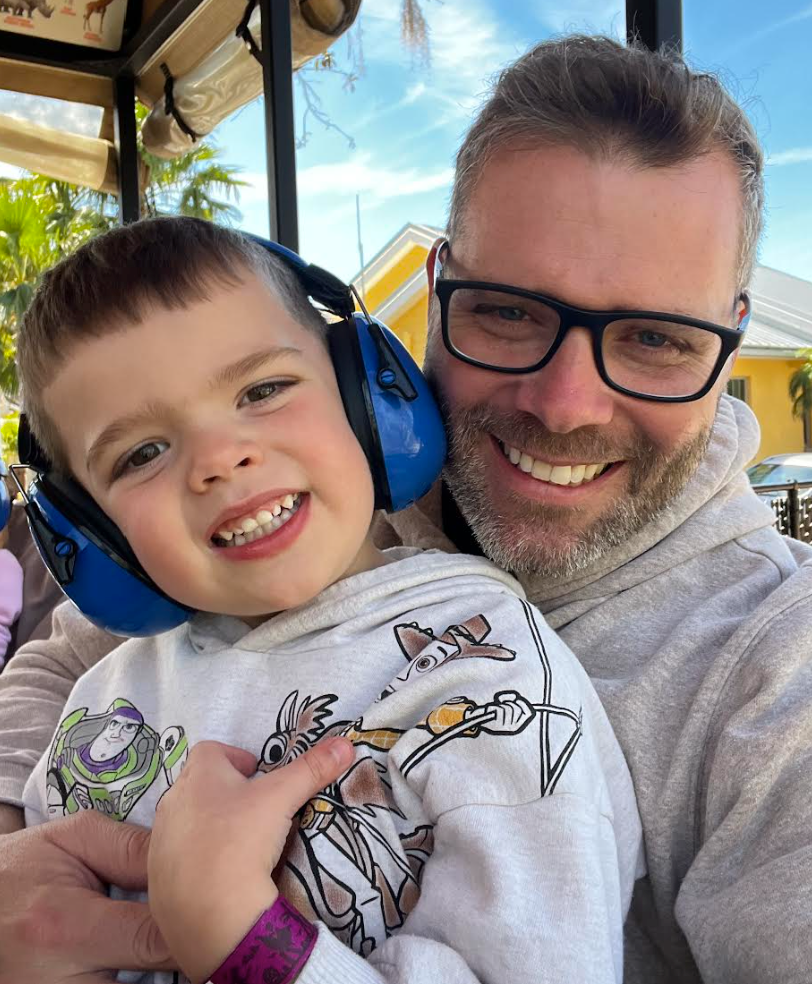
VizyPlan was built by an autism dad and a licensed speech-language pathologist so the hardest part of the afternoon runs on photos of your own child instead of on your voice.
Download VizyPlan and start your 7-day free trial today. Give the after-school hour a shape your child can see coming. Just $6.99/month after your trial, no credit card required upfront.
VizyPlan was built by an autism dad and a licensed speech-language pathologist who needed something that did not exist. Start your free trial.