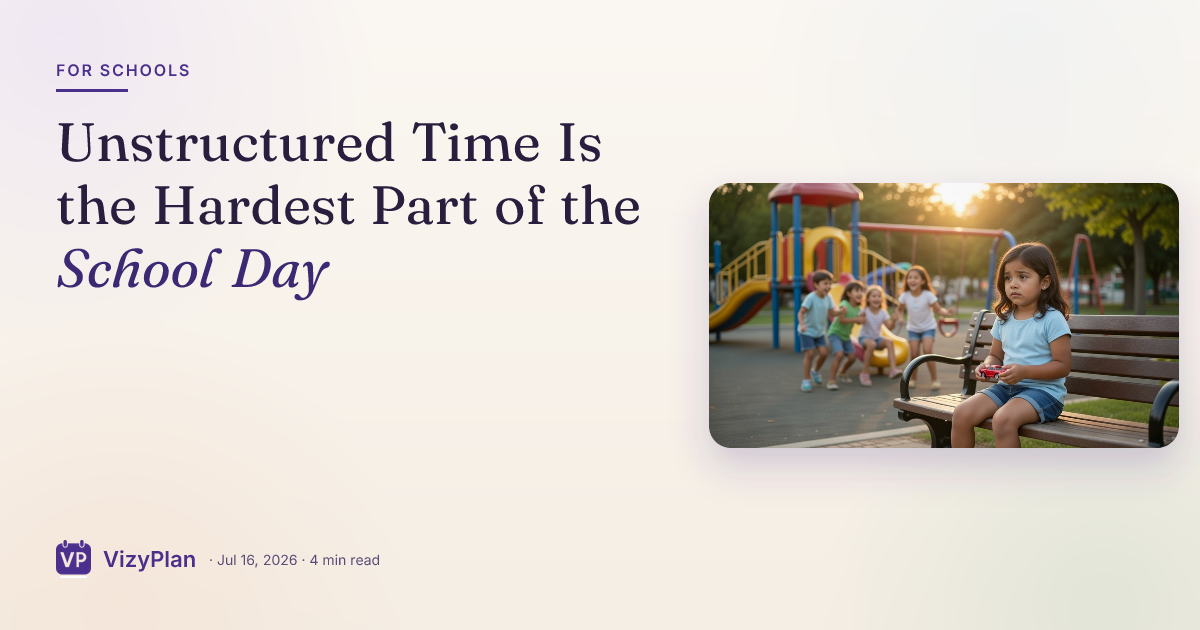
You plan every academic minute. The reading block is sequenced, the math rotation is timed, the transitions are scripted. Then the bell rings and an autistic student walks into the two least structured hours of the day with no plan at all. Unstructured time is where inclusion most often quietly fails, and recess and lunch are where a small amount of structure buys more than almost anything else you could do.
Half the class is not really in the class
The most sobering finding comes from a study of 79 children with autism matched against 79 peers across 30 schools in the Journal of Child Psychology and Psychiatry. Only about 48 percent of the autistic children participated in their classroom's social networks, and disconnection grew more pronounced in later elementary grades. The detail that should change how teachers read a playground: those children were not necessarily rejected more than their peers. They were accepted less. Nobody is being cruel. They are simply not being included, which is harder to see and easier to leave alone.
The children notice. In a matched-groups study in Child Development, autistic children reported more loneliness and poorer friendship quality than matched peers, even though all reported having at least one friend.
Unstructured time needs a plan, not just supervision
Researchers running a structured recess program said it plainly: playgrounds are generally unstructured, producing little social engagement for children with autism, and mere inclusion in general education classrooms is not enough. Their program raised peer engagement from 0 to 34 percent of observed intervals at baseline to 54 to 87 percent. A separate peer-mediated recess package raised total communications from 9 to 35 percent of intervals to 77 to 85 percent, and it included pre-recess priming, the same mechanism that helps transitions. Both studies were small, so treat exact numbers as illustrative.
Noise matters too. An integrative review reports auditory stimuli are the most significant barrier to classroom engagement for autistic students. No study has measured cafeteria sensory load specifically, so nobody can give you a decibel number, but a room with three hundred children and hard surfaces is the loudest place in the building.
Enjoying this article?
Get practical tips and insights delivered to your inbox — no spam, ever.
Light structure that actually helps
- Give the block a plan the student can see. One or two named options beat an open field.
- Prime before the bell. A thirty-second preview of recess does real work.
- Set up an activity, not a buddy assignment. Shared games create reasons to interact that do not depend on small talk.
- Offer a quieter alternative to the cafeteria. A smaller room is an accommodation, not a punishment.
- Watch acceptance, not rejection. The student nobody is unkind to and nobody includes is the one to look for.
Predictability travels
Our post on the sensory-friendly classroom builds out the rest of the day.
VizyPlan was built by an autism dad and a licensed speech-language pathologist so a student can see what is coming next, in photos of their own world, at school and at home.
Share VizyPlan with your families so the predictable parts of the day follow the student home. The 7-day free trial lets a family try it first. Just $6.99/month after, no credit card required upfront.
VizyPlan was built by an autism dad and a licensed speech-language pathologist who needed something that did not exist. Explore VizyPlan.