The hardest session on your caseload is not the difficult one. It is the last one. The family is grateful, the data looks good, and everyone quietly wonders whether any of it holds in six months. Discharge planning is the piece of practice most likely to get improvised at the end, and the piece most likely to decide whether the work lasted. Done well, it does not begin when goals are met. Discharge planning begins at intake.
Generalization is programmed, never assumed
The field settled this almost fifty years ago. Stokes and Baer's foundational 1977 paper in the Journal of Applied Behavior Analysis argued generalization must be actively programmed rather than treated as a byproduct of training, and gave the default approach a name that still stings: Train and Hope. A skill mastered in your therapy room is evidence about your therapy room. Whether it shows up at the kitchen table on Saturday has to be engineered on purpose.
Discharge planning is about function, not just mastery
ASHA's guidance on when to end services sets a bar higher than a completed goal list. Services end when goals are met, skills are age and culturally appropriate, and there is no ongoing impact on function. At discharge, the clinician is expected to put a home program or care-partner strategies in place to maintain skills, and to tell the family which signs should bring them back. The same guidance frames the work as beginning at the start of services.
The caregiver is the maintenance plan
If you want a mechanism that outlives the authorization, it is the parent. A meta-analysis of 33 randomized trials in PLoS One found parent-mediated intervention improved child self-regulation, social skills, expressive language, and symptom severity, while parent distress fell. Honesty matters here: the same analysis found no significant gains in adaptive behavior, receptive language, or joint attention.
Durability is uneven too. A long-term follow-up tracked families one to five years out and found social-impairment gains held while improvements in problem behavior and parenting stress did not. Some gains coast. Some need refueling.
Enjoying this article?
Get practical tips and insights delivered to your inbox — no spam, ever.
Fade on a schedule you wrote down
- Write the exit criteria at intake. Name what done looks like in functional terms before the first goal is trained.
- Program the last setting first. Train in the environments the child actually lives in.
- Fade prompts deliberately and individually. A 2024 single-case evaluation with one learner found the most effective fading condition was not the predictable one, a reminder to assess per child rather than apply a house method.
- Hand the parent the running of it. Shift from clinician-run to parent-run while you are still in the room to correct it.
- Leave a re-entry trigger. Tell the family in plain words which changes should prompt a call back.
Leave behind something that runs itself
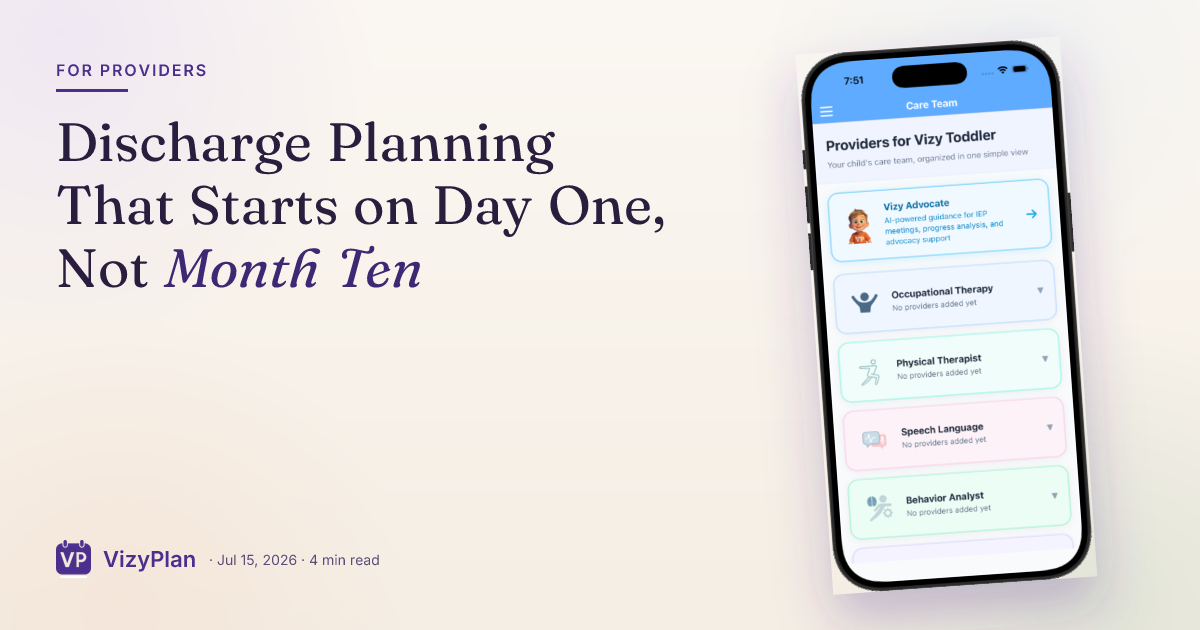
A home program only matters if it survives the week it was handed over. A visual routine the family already uses gives your fading plan somewhere to live. Our guide to closing the clinic-to-home generalization gap covers the handoff in more detail.
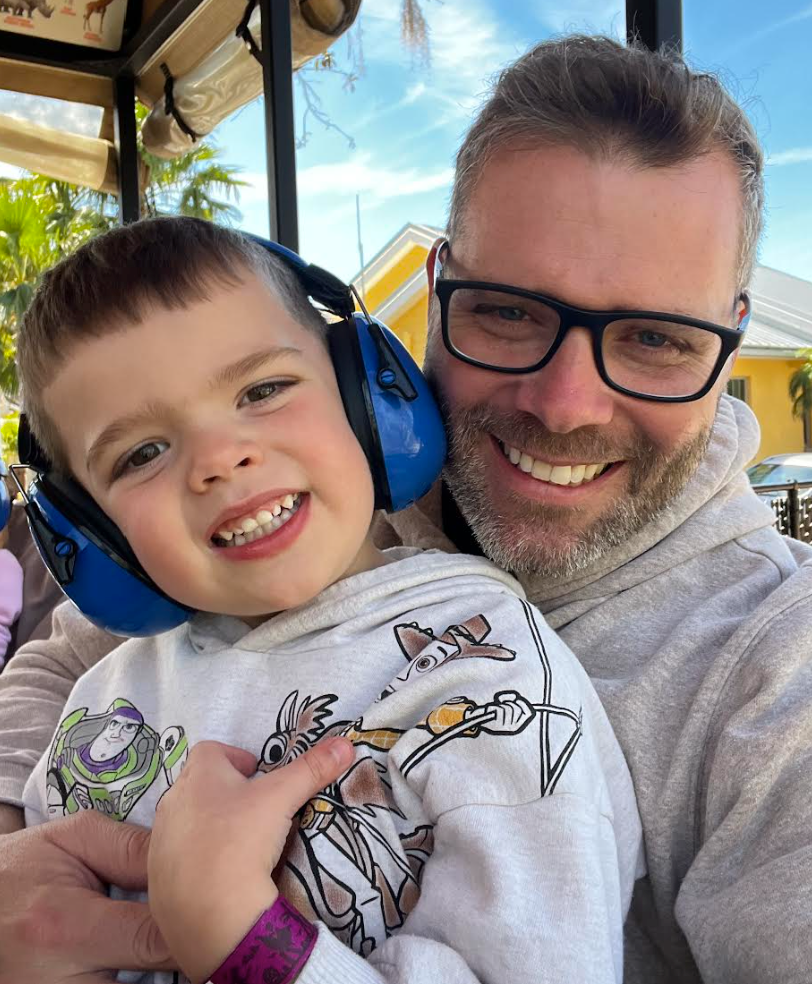
VizyPlan was built by an autism dad and a licensed speech-language pathologist so the structure you build in therapy keeps running at home after discharge.
Share VizyPlan with your families so the gains you built survive the last session. The 7-day free trial lets a family try it first. Just $6.99/month after, no credit card required upfront.
VizyPlan was built by an autism dad and a licensed speech-language pathologist who needed something that did not exist. Explore VizyPlan.