Ask an autistic student which class is hardest and a surprising number will not say math. PE class for autistic students stacks three demands in one period: a body that may not coordinate the way the lesson assumes, the loudest room in the building, and games built on fast social rules. Winter makes all three more frequent, because the weather moves PE indoors and into the gym nearly every day.
None of that means the student dislikes movement. Usually the student dislikes the version of movement the gym is offering.
Why PE class for autistic students is harder than it looks
Start with the body. A 2020 analysis of the SPARK cohort in Physical Therapy found that 86.9% of autistic children aged 5 to 15 screened as at risk for a motor coordination impairment, based on a parent-reported questionnaire. Motor differences are not part of the formal autism criteria, so they often go unnoticed on a student's paperwork. A student who cannot yet catch, skip or switch direction quickly is not refusing the drill. The drill is simply ahead of the body.
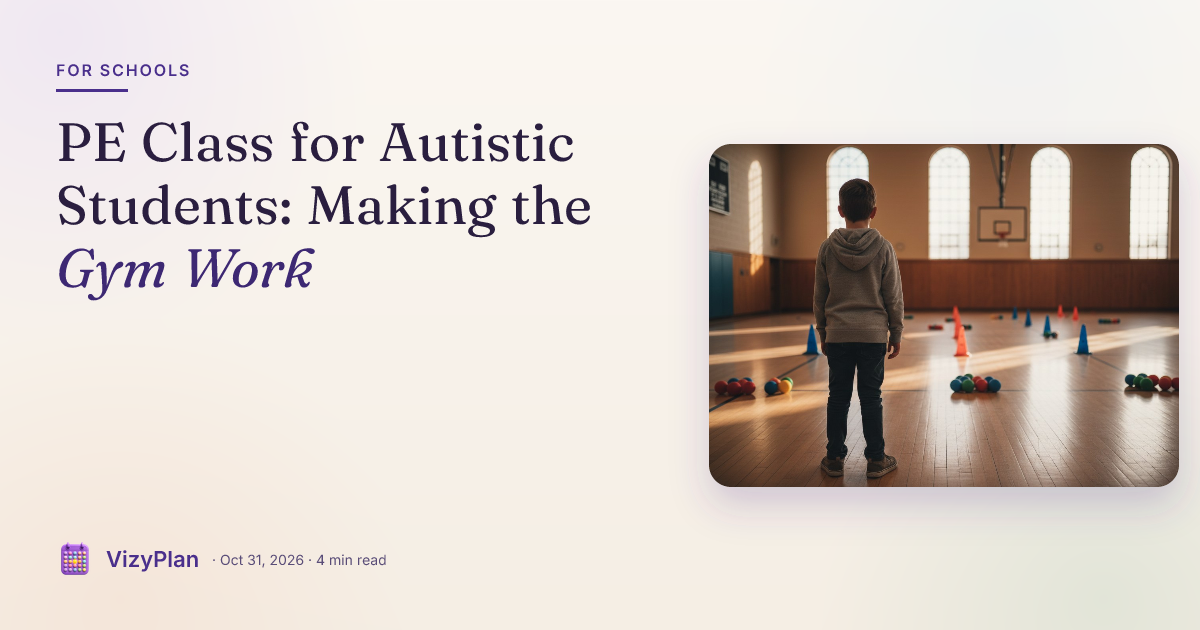
Then add the room. Hard floors, high ceilings and bare walls make a gym echo, and whistles, bouncing balls and thirty voices all reflect back at once. For a student with sound sensitivity, the gym can be overwhelming before the lesson starts. The locker room adds changing in front of peers, tight space, strong smells and very little adult supervision.
Finally, team games. Picking teams publicly, fast rule changes and the social sting of a dropped pass carry more risk for an autistic student than for anyone else in the class.
The upside is real, which is why PE class for autistic students is worth the effort. A 2020 meta-analysis of 12 studies in the International Journal of Environmental Research and Public Health found that physical activity programs improved social interaction, communication and motor skills in autistic children and adolescents. The gym is one of the best places in school for those gains, if the student can stay in it.
A PE class for autistic students plan for the whole team
- Post the lesson as visual station cards. One card per station, a picture of the movement, and a number of reps or seconds. A student who can see the whole period does not have to decode verbal instructions shouted across an echoing room.
- Run the same warm-up every class. A fixed warm-up, in the same order, at the same spot on the floor, gives the student a predictable first five minutes and a clear signal that PE has started.
- Assign teams privately and in advance. Picking captains in front of the class costs every student something and costs autistic students the most. Teams can be posted on a card or set by the teacher before the bell.
- Offer a real role for students who cannot join the game yet. Scorekeeper, equipment manager, timer or referee assistant keeps a student inside the activity and learning the rules from the edge before playing in the middle.
- Turn the volume down where you can. A hand signal instead of a whistle, foam balls instead of rubber, ear defenders that are normal and available, and a quieter corner of the gym for stations.
- Give the locker room a plan. An earlier changing time, a private space to change, or permission to come to school in PE clothes removes the hardest five minutes of the period for many students.
- Ask whether adapted PE belongs in the IEP. Under IDEA, physical education is part of the definition of special education, and specially designed PE written into an IEP must be provided. An adapted physical education evaluation can clarify whether a student needs a modified program, extra support in general PE, or a separate class.
Enjoying this article?
Get practical tips and insights delivered to your inbox — no spam, ever.
Where the team fits
Making PE class for autistic students work should not fall on the PE teacher alone. The OT can explain the student's motor profile, the special educator can share the visual supports already working in the classroom, and the family can say which sounds and situations are hardest. Our guide to recess and lunch for autistic students covers the other unstructured parts of the day, and setting up a sensory friendly classroom has noise ideas that transfer straight to the gym. For the social side of team games, making friends at school is a useful read for the whole team.
A student who spends PE keeping score in December can be playing in March. The gym does not have to be quiet or perfect. The gym has to be predictable enough to walk into.
VizyPlan was built by an autism dad and an autism mom who is a licensed speech-language pathologist so the warm-up, the stations and the locker room plan can be a picture routine a student sees at home before PE day.
Share VizyPlan with your families so PE day is rehearsed before the student walks into the gym. The 7-day free trial lets a family try it first. If it helps, keep going for $6.99/month or $59.99/year.
VizyPlan was built by an autism dad and an autism mom who is a licensed speech-language pathologist who needed something that did not exist. Explore VizyPlan.