A lockdown drill asks a class to do three things at once: move quickly, stay silent, and wait without knowing how long. Lockdown drills and autistic students can be a hard combination for exactly that reason, because sudden change, unclear duration and enforced stillness are the parts of a school day many autistic students find hardest.
The good news is that a drill is rehearsable, and rehearsal is where most of the stress comes out.
What the guidance says about lockdown drills and autistic students
The National Association of School Psychologists, the National Association of School Resource Officers and Safe and Sound Schools publish joint best practice guidance on these drills, last updated in 2022. The guidance recommends that schools consider students' developmental levels, prior trauma and special needs when planning, include parents in those conversations, train staff to recognize stress reactions, and leave time afterward to debrief.
State guidance goes further for autistic students specifically. A Delaware guide for educators notes that sensory overload during safety drills can cause significant anxiety and may lead to outbursts during and after the drill, and that most autistic students need significant practice with the concrete steps. The same guide recommends writing emergency procedures into the IEP or 504 plan.
Research on drill anxiety is mixed. A Georgia Tech analysis of social media posts found a rise in language about anxiety and stress in the 90 days after drills, while a 2022 study of one New York district found students who did repeated drills reported less fear over time. The practical takeaway is the same either way: how a drill is run matters.
A practical plan for the classroom
The steps below are a starting point for lockdown drills and autistic students in any grade, adjusted to each student's communication and sensory profile.
- Tell the story before the drill. A short picture story, read a few days ahead and again that morning, should say what happens in plain words: the announcement, the lights going off, the walk to the spot, sitting quietly, and the all clear. Our guide to fire drills for autistic students uses the same approach.
- Show the hiding spot as a photo. A picture of the exact corner of the room, with the student's place marked, removes the guesswork. Practice walking there on an ordinary day when nothing else is happening.
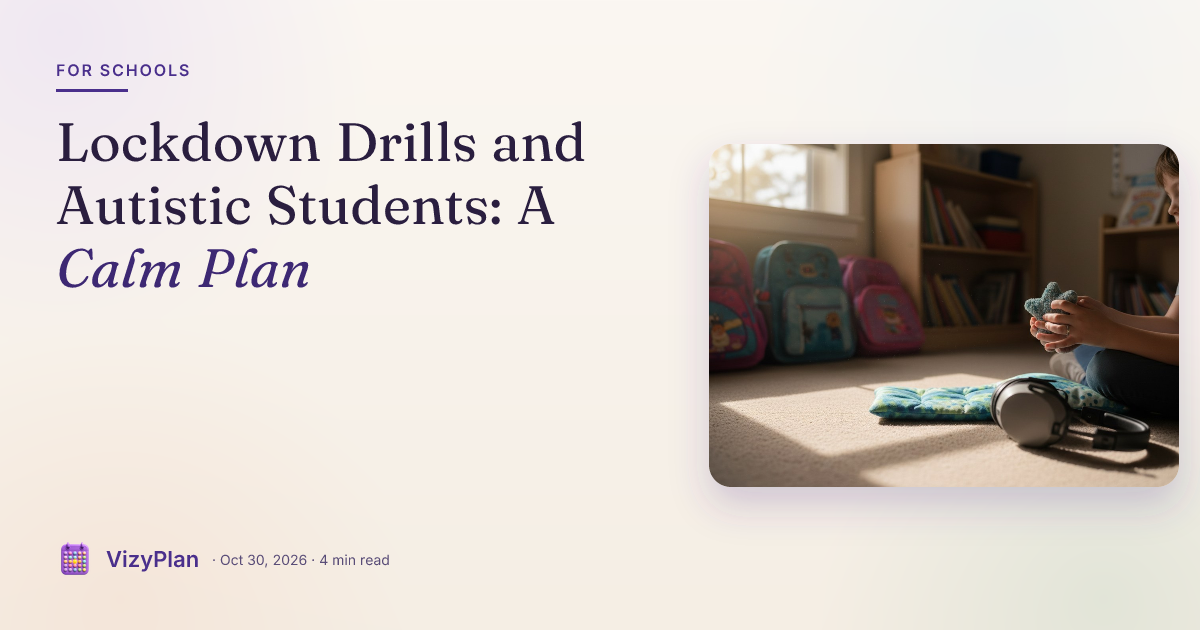
- Pack a quiet kit. A silent fidget, a weighted lap pad or a familiar small object gives hands something to do. Noise-canceling headphones can help with the announcement, and a visual timer or a simple countdown card helps with the waiting.
- Assign one adult to one student. For a student who may vocalize or try to leave, name a specific staff member in advance, decide where that adult sits, and agree on the calming script they will use. Elopement risk deserves its own plan, and our post on wandering and elopement safety covers the basics.
- Tell the family ahead of time. A short note with the date and the picture story lets parents read it at home, and gives them a chance to share what helps their child settle.
- Debrief right after. Five quiet minutes, the same story with a last page that says "the drill is over and everyone is safe," and a preferred activity. Watch for delayed reactions later in the day.
Enjoying this article?
Get practical tips and insights delivered to your inbox — no spam, ever.
Put it in the IEP or 504 plan
Lockdown drills and autistic students are best handled through a written individual emergency plan rather than improvised on the day. The plan should name the support adult, the location, the sensory supports, how the student communicates distress, and how the family is notified. School safety guidance warns against simply exempting a student from drills, because the student still needs to know what to do in a real event. Practice with supports is the goal, not avoidance.
Most students get steadier with each calm repetition. Lockdown drills and autistic students can coexist safely when the drill is predictable, the adult is familiar, and the ending is always the same.
VizyPlan was built by an autism dad and an autism mom who is a licensed speech-language pathologist so a drill can be a picture story a student has seen before the announcement ever plays.
Share VizyPlan with your families so the drill story gets read at home too. The 7-day free trial lets a family try it first. If it helps, keep going for $6.99/month or $59.99/year.
VizyPlan was built by an autism dad and an autism mom who is a licensed speech-language pathologist who needed something that did not exist. Explore VizyPlan.