
Every provider has run the session where nothing lands, and the explanation arrives at pickup: he was up from 2 until 5. Sleep coaching for autism parents is not outside the scope of an SLP, OT or BCBA. Sleep is the variable sitting underneath every goal on the plan, and the family is already asking you about it.
Sleep coaching for autism parents does not require becoming a sleep specialist. You need a short protocol, a simple data sheet and a clear sense of where your role ends.
Why sleep coaching for autism parents belongs in therapy
Sleep problems are common enough to assume rather than screen for occasionally. Reviews put sleep problems at 50% to 80% of autistic children, and a 2021 multicenter survey found sleep disorders in 67.4% of autistic children compared with 51% of typically developing peers. Bedtime resistance, sleep anxiety and delayed sleep onset were the most frequent problems reported.
The guidance points the same direction every time. The Autism Treatment Network practice pathway and the 2020 American Academy of Neurology guideline on sleep in autistic children both name parent education in behavioral strategies as the first-line approach. Behavioral first-line guidance is good news for therapists, because routines, visual supports, data collection and caregiver coaching are already the core of the work.
Format matters less than content. In a 2014 randomized trial of 80 autistic children with delayed sleep onset, parent sleep education cut time to fall asleep on actigraphy from about 58 minutes to about 40, and individual and group delivery worked equally well. An earlier trial found that handing parents a pamphlet alone did not improve sleep latency, and parents said they wanted specific examples. Sleep coaching for autism parents works when someone walks through the plan with them, which is exactly what a session does.
Sleep coaching for autism parents: a four week protocol
- Ask three sleep questions at intake and every review. What time does the child fall asleep, what time do they wake, and how many nights a week is there a night waking. Write the answers down so you have a baseline.
- Start a two week sleep diary before changing anything. Bedtime, lights out, time asleep, wakings, wake time and anything unusual that day. A diary turns "bedtime is terrible" into a pattern you can actually coach, and the ATN and AIR-P Sleep Tool Kits include free versions families can print.
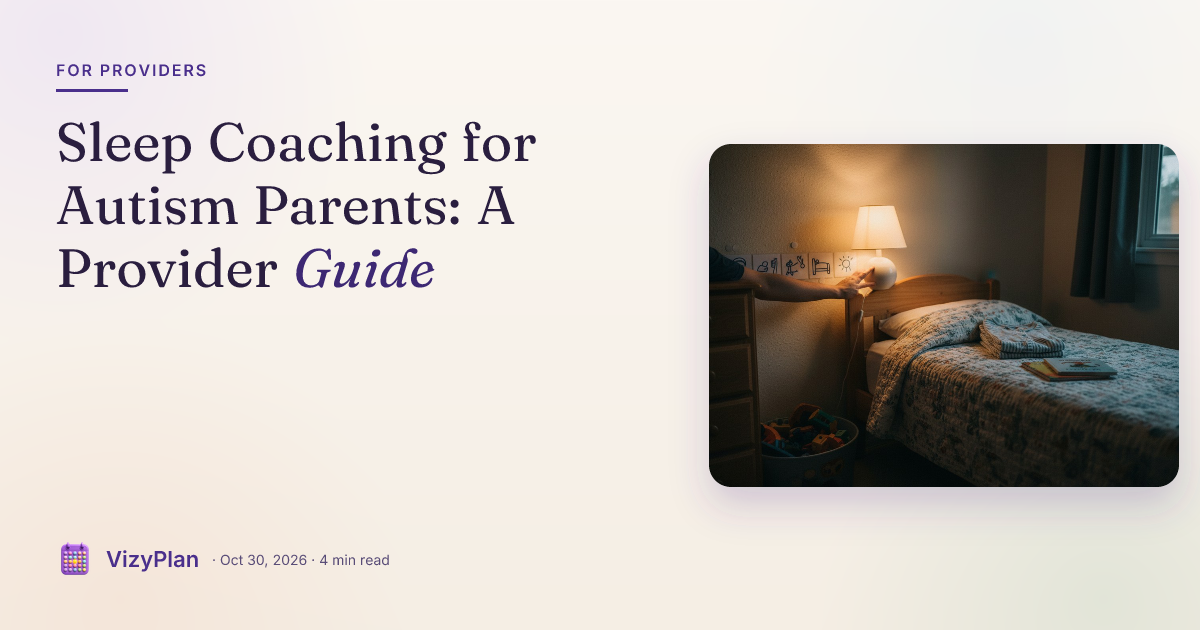
- Build the bedtime routine as a visual sequence in session. Four to six steps, the same order every night: bath, pajamas, teeth, two books, lights out. Let the child help choose the pictures, then practice the sequence during the day when nobody is tired.
- Anchor the wake time first. A consistent wake time, including weekends, is often easier for families to hold than a perfect bedtime, and it gives the body clock a fixed point to organize around.
- Move screens and high demand out of the last hour. Coach the family to shift tablets, homework and rough play earlier, and to end the evening with the calmest steps on the sequence.
- Review the diary together every two weeks. Look for one change at a time. If sleep onset shortened, keep going. If nothing moved after a month of consistent routine, that is useful information for the referral.
Enjoying this article?
Get practical tips and insights delivered to your inbox — no spam, ever.
Where your role ends
Some patterns need a medical conversation, not more coaching. Snoring, gasping or pauses in breathing at night, a sudden change in sleep, suspected seizures, or reflux and pain at bedtime all go to the pediatrician. Families will often ask you about melatonin. The answer from a therapist is simple and consistent: that is a question for the child's pediatrician, who can look at the full medical picture. The AAN guideline itself places medication after behavioral strategies and after contributing medical issues are addressed.
Good sleep coaching for autism parents ends with a handoff. Bringing the sleep diary to that appointment gives the pediatrician two weeks of real data instead of a tired parent's best guess, which is one of the most useful things you can hand a family.
For families who want the home side in plain language, share our parent guide on autism and sleep problems and what actually helps. If you are building a broader caregiver plan, our parent coaching guide for the first six weeks shows where sleep fits alongside everything else.
VizyPlan was built by an autism dad and an autism mom who is a licensed speech-language pathologist so the bedtime sequence you build in session can be the same picture routine the family follows at home every night.
Share VizyPlan with your families so the bedtime routine you coach looks the same at home every night. The 7-day free trial lets a family try it first. If it helps, keep going for $6.99/month or $59.99/year.
VizyPlan was built by an autism dad and an autism mom who is a licensed speech-language pathologist who needed something that did not exist. Explore VizyPlan.