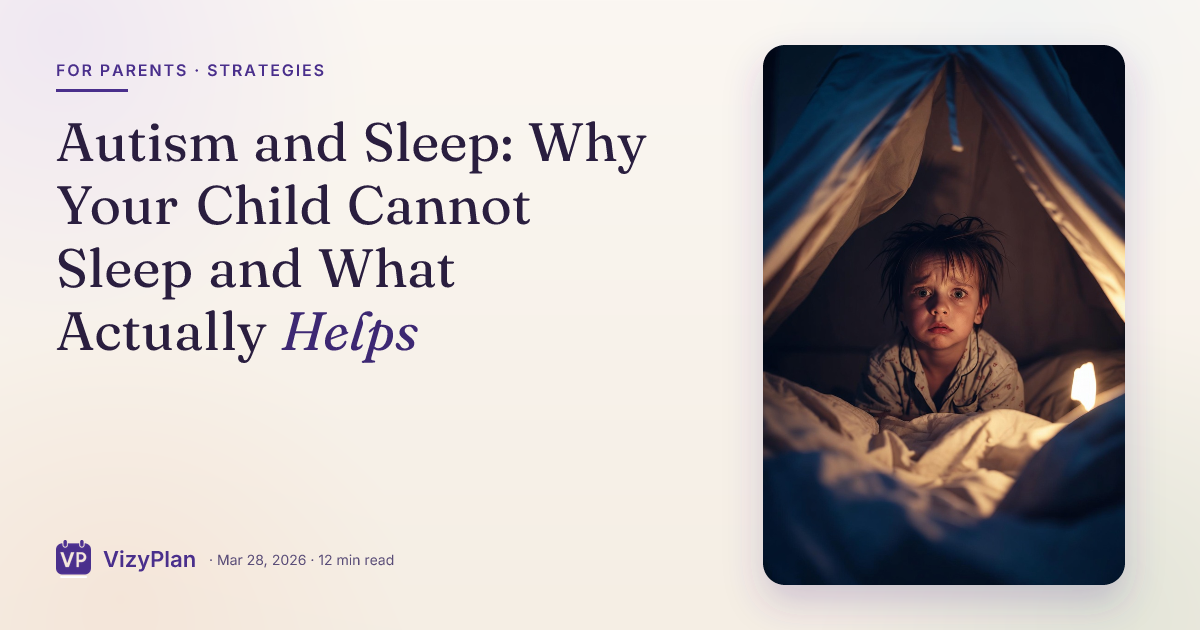
It is 11:30 PM and your child is still awake. You have done the bath. You have read the books. You have dimmed the lights and played the white noise and laid next to them until your own eyes closed. And they are still staring at the ceiling, wide awake, while you are barely functioning.
You are not imagining how much harder this is than what other families describe. Research confirms that 50 to 80% of autistic children experience significant sleep problems, compared to 20 to 30% of neurotypical children. Some studies put the number even higher, with up to 86% of autistic children experiencing at least one sleep difficulty daily. Your child is not being difficult. Their brain is wired differently when it comes to sleep, and understanding why is the first step toward finding what actually helps.
The Science Behind Why Autistic Children Struggle With Sleep
Standard sleep advice assumes a brain that produces the right chemicals at the right time, processes sensory input without distress, and transitions smoothly from alertness to rest. The autistic brain often does none of these things in the way sleep advice expects.
Their Melatonin Works Differently
Melatonin is the hormone that tells your brain it is time to sleep. In autistic children, the system that produces and regulates melatonin operates on a different schedule. Research published in Frontiers in Neurology found that autistic children experience their dim light melatonin onset, the point when the body starts producing sleep-signaling melatonin, approximately one hour and seventeen minutes later than neurotypical children. Their bodies are not receiving the biological signal to feel sleepy at the time you need them in bed.
Some autistic individuals have what researchers describe as a "flat melatonin curve," meaning their bodies never produce the normal nighttime spike of melatonin that triggers drowsiness. This is not a behavioral problem. It is a hormonal difference linked to mutations in genes that regulate melatonin production and metabolism.
Their Circadian Rhythms Are Shifted
A groundbreaking 2025 Mendelian randomization study published in the journal Autism provided the first genetic evidence that the relationship between sleep and autism runs deeper than anyone expected. Using data from over 85,000 participants, researchers demonstrated that late chronotype, a biological tendency toward later sleep and wake times, has a causal relationship with autism. This is not just correlation. The genetic analysis shows that disrupted sleep patterns are woven into the neurobiology of autism itself.
Mutations in circadian regulatory genes including CLOCK, BMAL1, PER, and CRY have been associated with autism spectrum disorder. Your child's internal clock is not simply running late. It is built differently.
Sensory Processing Turns Bedrooms Into Battlegrounds
The pillow feels wrong. The sheets are scratchy. The room is too quiet or not quiet enough. A car drove by outside and now they are fully alert again. For children with sensory processing differences, the bedroom itself can be a minefield of sleep-disrupting stimulation.
A scoping review published in the journal Sleep found that tactile sensitivity alone explained 24% of the variance in total sleep disturbance scores among autistic children. Touch hypersensitivity shows the strongest relationship with sleep problems of any sensory domain, more than sound, light, or any other input. This means that for many autistic children, the physical experience of being in bed is the primary barrier to falling asleep.
The relationship works in both directions. Poor sleep worsens sensory processing, and worsened sensory processing makes it harder to sleep. Families can get trapped in a cycle where each bad night makes the next one worse.
Anxiety Keeps Their Nervous System on High Alert
Anxiety was associated with every type of sleep problem researchers measured: bedtime resistance, sleep-onset delay, reduced sleep duration, sleep anxiety, and night wakings. Children with autism who have both anxiety and sensory over-responsivity are particularly vulnerable to sleep difficulties because their nervous system is in a state of chronic hyperarousal.
When your child lies in bed and cannot turn their brain off, that is not a choice. Their hypothalamic-pituitary-adrenal axis, the body's stress response system, is dysregulated in ways that researchers have found are shared between insomnia and autism. The same neurobiological pathway that contributes to their anxiety during the day keeps their nervous system activated at night.
What Poor Sleep Does to Your Child (and Your Family)
Understanding the consequences of poor sleep is not meant to add to your worry. It is meant to validate what you already know: sleep matters enormously, and the effects you are seeing in your child and in yourself are real and documented.
It Worsens Core Autism Traits
A 2024 systematic review examining 26 studies found consistent associations between sleep problems and increased aggression, hyperactivity, emotional dysregulation, and social withdrawal in autistic children. Sleep deprivation does not just make children tired. It worsens the very challenges that define their daily experience.
Here is what surprised researchers most: when parents received sleep education and their children started sleeping better, the improvements extended beyond sleep. Children also showed reduced repetitive behaviors. Sleep intervention may actually address core features of autism, not just the tiredness on top of them.
In a study of over 2,500 children, those getting less than seven hours of sleep had significantly higher severity scores for social communication difficulties and emotional regulation challenges. Dr. Dara Manoach, Professor of Psychology at Harvard Medical School, explains that "critical aspects of learning and memory occur during sleep." The brain consolidation that happens during sleep is not optional. It is when the neural connections built during the day get strengthened or pruned, a process essential for attention, memory, and sensory processing.
It Is Breaking Parents Too
This part rarely gets enough attention. Research shows that caregivers of autistic children average just 6.4 hours of sleep per night, below the recommended minimum of seven hours. Over half, 54.8%, report obtaining insufficient sleep.
The consequences are severe. Parents of autistic children with sleep problems show significantly higher levels of anxiety and depression compared to parents whose autistic children sleep well. A 2023 study found that among caregivers of autistic children, symptoms of excessive fatigue and insomnia co-occurred at a rate of 46%, suggesting that parent sleep deprivation and the child's sleep problems feed each other in a devastating cycle.
Among caregivers surveyed, 41.6% experienced moderate burden and 33.8% experienced high burden. If you feel like you are running on empty and barely holding things together, the research says you are not exaggerating. The toll of chronic sleep deprivation on top of the demands of neurodivergent parenting is measured and documented.
The Melatonin Question: What Every Parent Needs to Know
If your child has sleep problems, someone has probably suggested melatonin. Maybe your pediatrician recommended it. Maybe another parent swore by it. Maybe you bought gummies at the drugstore and hoped for the best. Here is what the latest research says.
It Can Help, But the Details Matter
Melatonin supplementation does have research support for autistic children. A clinical trial of prolonged-release melatonin found that after 13 weeks, children slept an average of 57.5 minutes longer per night compared to just 9 minutes with placebo. Real-world data shows 86% improvement in sleep onset and 54% improvement in sleep duration.
The most effective dosing range appears to be 1 to 5 milligrams, administered 30 minutes before the desired bedtime. A randomized controlled trial found that combining melatonin with cognitive behavioral therapy produced greater improvements than either approach alone. Dr. Beth Malow, a sleep neurologist at Vanderbilt University, emphasizes that melatonin works best when combined with behavioral strategies, not as a standalone solution.
But There Are Serious Safety Concerns
A 2025 systematic review published in JAMA Network Open revealed alarming findings. The FDA tested 110 melatonin products marketed for children and found that actual melatonin content ranged from 0% to 667% of what was listed on the label. That means some products contain no melatonin at all while others contain nearly seven times the stated dose.
The consequences are showing up in emergency rooms. Melatonin poisoning cases in children rose from zero in 2000-2001 to over 10,500 by 2017-2021, representing 63% of all pediatric supplement poisonings during that period. Emergency department visits for melatonin exposure doubled between 2019 and 2022. Child-friendly gummy formulations accounted for nearly half of accidental ingestion cases.
Because the FDA classifies melatonin as a dietary supplement rather than a drug, there are no standardized manufacturing requirements, no required dosing accuracy, and no oversight of what actually ends up in the bottle. Another troubling finding: 40 to 50% of children prescribed melatonin continued using it for two to three years, exceeding the recommended one to two year duration.
This does not mean melatonin is never appropriate. It means that if you use it, purchase pharmaceutical-grade products when possible, start with the lowest effective dose, and work with your child's doctor rather than guessing.
What the Research Says Actually Works
The American Academy of Neurology and leading sleep researchers agree: behavioral interventions should be the first approach before medication. A 2025 meta-analysis published in the journal Autism confirmed that behavioral and psychological interventions, physical activity, and somatosensory sleep interventions all significantly improve sleep in autistic children.
Enjoying this article?
Get practical tips and insights delivered to your inbox — no spam, ever.
Build a Predictable Wind-Down Routine
A study using an ABAB reversal design found that visual bedtime schedules showed positive treatment effects with increased routine compliance that maintained over time. The routine itself matters less than its consistency. Twenty to thirty minutes of calming, predictable steps signals to your child's brain that sleep is approaching.
The key is making the routine visible. When your child can see what comes next, anxiety about bedtime decreases because the uncertainty disappears. VizyPlan lets you build a visual bedtime routine with personalized images of your child doing each step, which makes the routine feel familiar and concrete rather than abstract.
Address Sensory Needs Before They Derail Sleep
Since tactile sensitivity is the strongest sensory predictor of sleep problems, start there. Experiment with different sheets, pajama fabrics, and blanket weights. Some children need compression, like a fitted sheet pulled tight or a compression sleep garment. Others need less contact, preferring loose clothing and lightweight covers.
Room environment matters enormously. Temperature, lighting, and sound all contribute to whether the bedroom supports sleep or fights it. Some children sleep better with white noise or a fan. Others need complete silence. Blackout curtains help light-sensitive children, while a dim nightlight may reduce sleep anxiety for others.
About weighted blankets: despite their popularity, a randomized controlled trial found no significant objective improvement in sleep quality for autistic children using weighted blankets. Subjective reports from families were more positive, with some noting improved morning mood and faster sleep onset. They may help your child feel calmer, but they are not a research-backed sleep solution on their own.
Cut Screens Before Bed (But Do Not Eliminate Them Entirely)
Blue light from screens disrupts circadian rhythms, and research shows this effect is particularly significant for autistic children given their existing sensory processing differences. Studies consistently find that total screen time, pre-bedtime use, gaming, and social media all correlate with poorer sleep quality in autistic individuals.
The recommendation from sleep specialists: end screen time at least one hour before bed. But researchers also note that for neurodivergent children, screens can serve important functions including social connection, anxiety reduction, and learning. The issue is specifically pre-bedtime use and blue light exposure, not screens during the rest of the day. Charge devices outside the bedroom overnight.
Get Moving During the Day
A meta-analysis of randomized controlled trials found that regular exercise improves sleep quality, reduces how long it takes to fall asleep, and improves sleep efficiency in autistic individuals. Daytime physical activity and outdoor time with natural sunlight exposure help regulate the circadian rhythm that is often shifted in autistic children.
Avoid vigorous activity within an hour of bedtime, but do not underestimate how much difference a physically active day makes for a physically restless night.
Track What Is Actually Happening
One of the most powerful things you can do is start tracking your child's sleep patterns alongside their daytime activities, emotions, and sensory exposures. What you think is causing the sleep problems may not match what the data reveals.
VizyPlan lets you track your child's emotions and activities throughout the day, revealing patterns that connect daytime experiences to nighttime sleep quality. Maybe the days with afternoon meltdowns are also the nights with the worst sleep. Maybe certain foods, activities, or transitions consistently precede difficult nights. Without data, you are guessing. With data, you are making informed decisions.
Consider Professional Sleep Support
If behavioral strategies alone are not enough, cognitive behavioral therapy adapted for insomnia in autistic children shows remarkable promise. A pilot study found that after eight sessions of CBT, 85% of autistic children no longer met criteria for insomnia one month after treatment ended. That is a striking success rate for a non-medication approach.
When seeking professional help, look for providers familiar with autism-specific sleep challenges. A general pediatric sleep specialist who does not understand sensory processing or anxiety in autism may default to strategies that do not account for your child's neurology. Ask specifically about their experience with neurodivergent children.
The Nutritional Factors Nobody Mentions
Research has identified several nutritional connections to sleep that are particularly relevant for autistic children, many of whom have selective eating patterns.
Iron supplementation showed significant improvement in nighttime restlessness at 6 milligrams per kilogram per day in research studies. This is especially relevant for autistic children with restricted diets who may not get adequate iron from food. A simple blood test can determine whether your child's iron levels are contributing to their restless sleep.
Tryptophan and 5-HTP supplementation showed 84% improvement in parasomnia symptoms, including nightmares and night terrors, in a study of 165 children. This is relevant because tryptophan metabolism is known to be dysregulated in autism.
These are not miracle supplements. But if your child has selective eating and persistent sleep problems, discussing nutritional assessment with their pediatrician is worth the conversation.
Why This Problem Does Not Go Away on Its Own
Unlike neurotypical children, who tend to outgrow sleep difficulties, sleep problems in autism are persistent. Research shows they are less likely to improve with age without intervention. The biological underpinnings, melatonin differences, circadian gene mutations, sensory processing challenges, do not resolve on their own.
This is not meant to discourage you. It is meant to encourage you to take sleep seriously as a treatable medical issue rather than a phase your child will grow out of. Dr. Beth Malow states plainly: "Sleep issues are highly treatable" when evidence-based approaches are applied.
The good news is that treating sleep problems has cascading benefits. Better sleep improves behavior, emotional regulation, learning, social communication, and reduces repetitive behaviors. Better child sleep improves parent sleep, which improves parent mental health, which improves the entire family dynamic.
Where to Start Tonight
You do not need to overhaul everything at once. Start with what the research says has the most impact:
- Address tactile sensitivity in the bedroom. Experiment with pajamas, sheets, and blankets until you find what your child's skin can tolerate. This single change addresses the strongest sensory predictor of sleep problems.
- Create a visible wind-down routine. Twenty to thirty minutes, same steps every night, posted where your child can see it. Reduce demands and stimulation during this window.
- Cut screens one hour before bed. This is the most evidence-based screen recommendation for sleep.
- Start tracking. Document bedtime, wake time, night wakings, and what happened during the day. Patterns will emerge within two to three weeks.
- Talk to your pediatrician about a full evaluation including iron levels, sensory assessment, and whether a sleep specialist referral makes sense.
You have been fighting this battle in the dark, sometimes literally, and the exhaustion is real. But the research is clear: sleep problems in autism are treatable, and addressing them improves virtually every other challenge your family faces during the day.
Your child is not choosing to keep you up all night. Their brain is working against them, and now you know why. That knowledge is the foundation for every strategy that follows.
VizyPlan helps you build visual bedtime routines, track sleep patterns alongside daily emotions and activities, and identify the triggers that are stealing your child's rest. Start your free trial and bring science-backed structure to your family's hardest hours.