Your child refuses to walk into school. The teacher calls it defiance. Your child melts down at the birthday party. The other parents call it a tantrum. Your child cannot focus on homework. The report card says "not trying hard enough." But you know something everyone else is missing: your child is not misbehaving. They are terrified.
Anxiety in neurodivergent children hides behind behaviors that look like something else entirely. What presents as defiance is often freeze-mode anxiety. What looks like a meltdown is frequently an anxiety-driven fight response. What appears to be distraction may be a mind racing with worry so loud it drowns everything else out. When we miss the anxiety underneath, we respond to the symptom instead of the cause, and the anxiety grows.
Research paints a striking picture. Studies published in the Journal of the American Academy of Child and Adolescent Psychiatry report that approximately 40% of autistic children meet criteria for at least one anxiety disorder, compared to about 6 to 7% of the general child population. For children with ADHD, the rate is similarly elevated, with estimates ranging from 25 to 50% experiencing clinically significant anxiety. These are not small numbers. Anxiety is one of the most common co-occurring conditions in neurodivergence.
The good news is that visual strategies offer a powerful, accessible approach to anxiety management that works with the neurodivergent brain rather than against it. When anxious thoughts are made visible, when coping strategies have a concrete form, and when the pathway from "anxious" to "calm" is laid out step by step, neurodivergent children gain genuine tools for managing their inner experience.
How Anxiety Looks Different in Neurodivergent Children
Anxiety in neurodivergent children often does not match the textbook presentation, which means it gets missed or misinterpreted.
Anxiety can look like rigidity. An autistic child who insists that everything happen exactly the same way every time may be managing underlying anxiety through control. Sameness is a regulatory strategy. When the routine breaks, the anxiety that sameness was containing floods to the surface and manifests as a meltdown or shutdown.
Anxiety can look like avoidance. A child who refuses to go to school, will not try new foods, or resists any new activity may not be "oppositional." They may be avoiding situations that trigger unbearable anxiety. The avoidance is self-protective, not defiant.
Anxiety can look like aggression. The fight response in the anxiety cycle can manifest as hitting, throwing, or verbal aggression. For children who cannot articulate "I am terrified right now," the anxiety exits as explosive behavior that gets treated as a disciplinary issue rather than an emotional regulation crisis.
Anxiety can look like physical symptoms. Stomachaches, headaches, nausea, and toileting accidents can all be physical manifestations of anxiety. If your child consistently complains of stomach pain before school but feels fine on weekends, anxiety is a likely contributor.
Anxiety can look like ADHD symptoms. Racing thoughts, inability to focus, restlessness, and difficulty sitting still are symptoms shared by both anxiety and ADHD. In children who have both conditions, untreated anxiety can amplify ADHD symptoms significantly.
The Worry Scale: Making Anxiety Visible
One of the most effective visual tools for anxiety management is the worry scale, sometimes called a feelings thermometer.
How it works. A visual scale from 1 to 5 (or 1 to 10) with corresponding colors and descriptions helps your child identify and communicate their anxiety level. Level 1 might be "calm and relaxed" (green), level 3 might be "worried, stomach feels funny" (yellow), and level 5 might be "everything feels too much, cannot think" (red).
Why it works for neurodivergent children. Many neurodivergent children have difficulty with interoception, the ability to identify internal body states. They may go from "fine" to "complete meltdown" with no apparent middle ground. The worry scale teaches them to recognize the middle stages, where intervention is most effective, before they reach crisis level.
Build it together. Let your child choose the colors, the descriptors, and the coping strategies associated with each level. Ownership increases engagement. VizyPlan's emotion tracking feature provides a built-in framework for this type of emotional check-in, giving your child a consistent visual tool for identifying where they are on the scale throughout the day.
Use it proactively. Check in with the worry scale before anxiety-provoking situations, not just during them. "We are going to the dentist in one hour. Where are you on the worry scale right now?" This proactive use catches anxiety early when it is most manageable.
Visual Calm-Down Sequences
When anxiety escalates, verbal instructions ("Just calm down!") rarely work. Visual sequences provide a concrete path from anxious to regulated.
Enjoying this article?
Get practical tips and insights delivered to your inbox — no spam, ever.
Create a step-by-step calm-down routine. A visual card or poster showing a sequence of calming strategies gives your child something to follow when their thinking brain is offline:
- Take three deep breaths (picture of breathing)
- Squeeze your hands tight, then release (picture of fists)
- Name five things you can see (picture of eyes)
- Name four things you can touch (picture of hands)
- Drink some water (picture of water)
Personalize the strategies. Not every calming strategy works for every child. Some children are calmed by deep pressure (a weighted blanket or a tight hug). Others need movement (jumping, running, or rocking). Some need sensory input (cold water on hands, a crunchy snack). Build a calm-down sequence using strategies your child actually responds to. VizyPlan's visual schedule feature lets you create personalized calm-down routines with images your child recognizes and connects to.
Practice when calm. The time to learn a calm-down sequence is NOT during a panic attack. Practice the sequence daily during calm moments so that when anxiety hits, the routine is familiar and automatic. Think of it like a fire drill: you practice when there is no fire so that the response is ready when there is.
Make calm-down kits portable. A small bag with a laminated visual calm-down card, a fidget toy, noise-canceling headphones, and a stress ball can travel with your child to school, appointments, and outings. Having the tools available when anxiety strikes, rather than only at home, dramatically increases their usefulness.
Grounding Techniques Made Visual
Grounding techniques pull attention from anxious thoughts back to the present moment. Visual adaptations make these techniques accessible to neurodivergent children.
The 5-4-3-2-1 technique with visual prompts. A card showing: 5 things I see (with eye icon), 4 things I touch (hand icon), 3 things I hear (ear icon), 2 things I smell (nose icon), 1 thing I taste (mouth icon). This sensory grounding exercise redirects attention from internal worry to external reality.
Breathing exercises with visual guides. Square breathing (breathe in for 4 counts, hold for 4, breathe out for 4, hold for 4) works well with a visual trace-along square. Flower breathing (breathe in like smelling a flower, breathe out like blowing a pinwheel) uses imagery that makes the abstract concrete.
Body scan with a visual body map. A simple outline of a body where your child colors in where they feel the anxiety (tight stomach, tense shoulders, clenched jaw) builds body awareness and makes the abstract feeling of anxiety tangible and addressable.
Reducing Anxiety Through Predictability
For many neurodivergent children, the most effective anxiety management is prevention through predictability.
Visual schedules reduce uncertainty. When your child can see what is happening today, the ambient anxiety of "What is coming next?" decreases. VizyPlan's daily visual schedule provides this predictable framework, reducing the cognitive load of uncertainty that feeds anxiety.
Preview new situations with social stories. Before any new or potentially anxiety-provoking situation, walk through it visually. What will it look like? What will happen? What will your child do if they feel anxious? This preparation converts the terrifying unknown into a somewhat familiar sequence of events.
Build in transition warnings. Abrupt changes trigger anxiety. Providing visual countdown warnings before transitions ("Five minutes until we leave," "Two minutes until we leave") gives your child time to prepare psychologically rather than being ambushed by change.
Create "what if" plans. For children who worry about what could go wrong, having a visual plan for those scenarios can be profoundly reassuring. "What if the fire alarm goes off at school?" Here is the plan, in pictures, step by step. When the fear has a response plan, it loses much of its power.
Anxiety does not have to control your child's life. With visual tools that make feelings tangible, coping strategies concrete, and daily routines predictable, neurodivergent children develop genuine capacity for managing the worry that comes with experiencing the world differently.
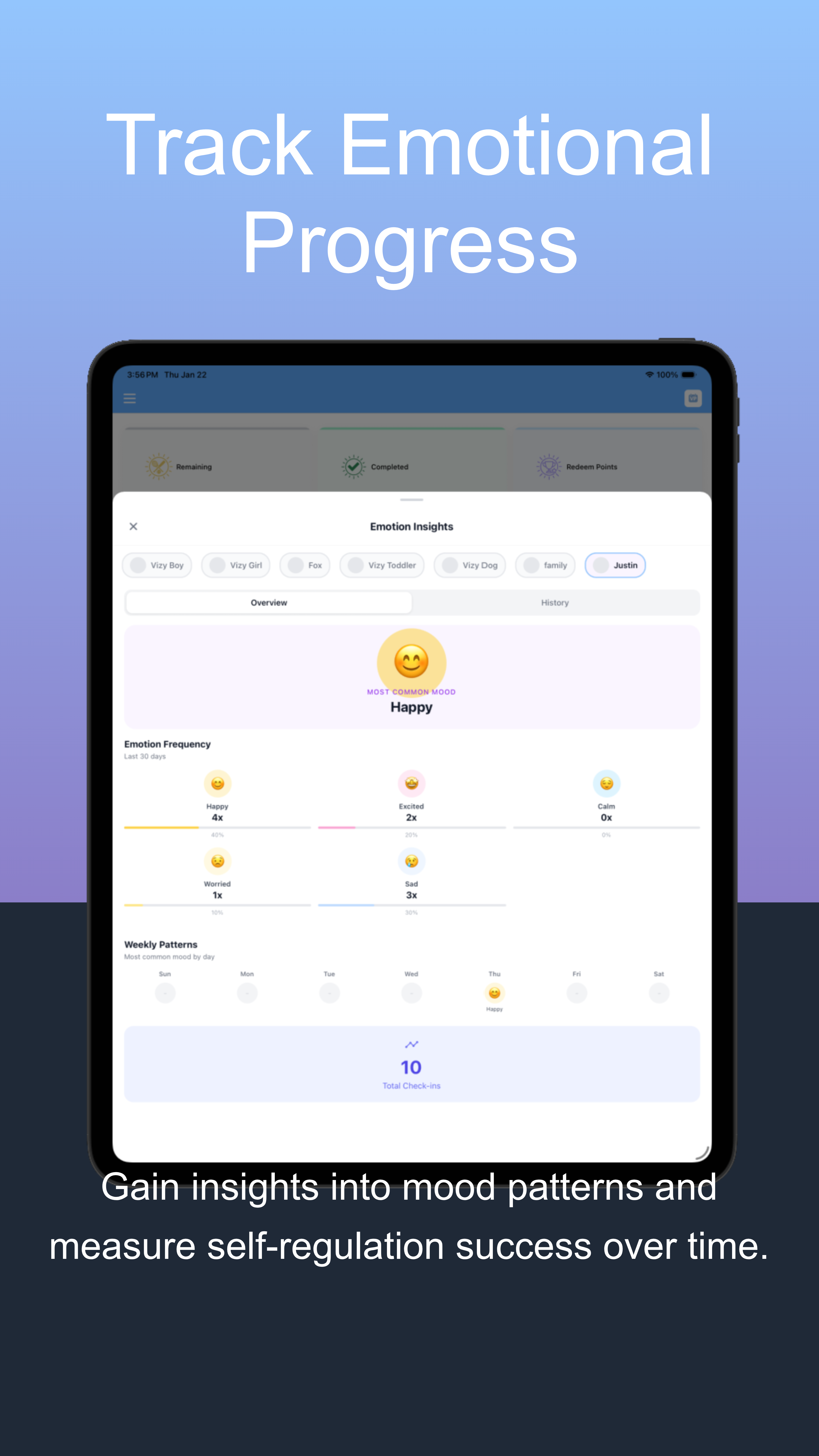
Download VizyPlan and start your 7-day free trial today. Build visual calm-down routines, track anxiety patterns with emotion tracking, and create the predictable daily structure that reduces anxiety at its source. If it helps, keep going for $6.99/month or $59.99/year.