So much of the conversation around neurodivergence focuses on challenges, deficits, and things that need to be fixed. Therapy goals target weaknesses. School reports highlight what your child cannot do. Well-meaning advice centers on closing gaps between your child and their neurotypical peers. It is easy to internalize this deficit framing until it becomes the lens through which you see your own child.
But here is what that lens misses: your child's brain is not broken. It is different. And that difference comes with genuine, remarkable strengths that deserve recognition, nurturing, and celebration.
The neurodiversity paradigm, which frames neurological differences as natural human variation rather than pathology, has gained significant traction in both research and clinical practice. Studies increasingly recognize that the same neurological wiring that creates challenges in certain contexts produces extraordinary abilities in others. The child who struggles with small talk may have an encyclopedic knowledge of marine biology. The child who cannot sit still may have physical energy and creativity that peers cannot match. The child who has meltdowns at the grocery store may perceive patterns and details that everyone else misses.
This article is not about ignoring challenges. It is about ensuring that strengths get at least as much attention, recognition, and support as the difficulties do.
The Science of Neurodivergent Strengths
Research on the strengths associated with autism and ADHD is growing and compelling.
Special interests are a superpower, not a symptom. Autistic special interests, the deep, passionate, sustained focus on specific topics, have traditionally been viewed as a symptom to be managed. Current research tells a different story. Studies show that special interests reduce anxiety, increase happiness, provide motivation for learning, and build expertise that can translate into academic and professional success. A longitudinal study published in Autism Research found that special interests contribute positively to quality of life and can serve as pathways to meaningful careers and social connections.
Pattern recognition is enhanced. Research on perceptual processing in autism has consistently found superior performance on tasks requiring attention to detail and pattern recognition. Autistic individuals often outperform neurotypical peers on visual search tasks, embedded figure tests, and pattern completion exercises. This ability to detect patterns that others miss has real-world applications in fields ranging from mathematics to music to quality assurance.
ADHD brings creative advantages. Studies on divergent thinking, the ability to generate multiple novel ideas, have found that individuals with ADHD score significantly higher than neurotypical peers on measures of creative thinking. The same neural differences that make sustained attention to routine tasks difficult appear to enhance the ability to make unusual connections, think outside established frameworks, and generate original solutions.
Hyperfocus is a valuable asset. While ADHD is often characterized by attention deficits, hyperfocus, the ability to become deeply absorbed in an engaging task, is an equally defining feature. During hyperfocus, productivity and creative output can be extraordinary. Research suggests that channeling hyperfocus toward areas of strength and interest produces outcomes that exceed what sustained but moderate attention achieves.
Honesty and authenticity. Many autistic individuals are recognized for their directness and honesty. In a world that often values social performance over genuine communication, the autistic tendency toward straightforward, authentic expression is a strength that builds trust and clarity in relationships.
Memory and knowledge depth. The ability to absorb, retain, and recall detailed information about topics of interest is well-documented in autism research. This deep knowledge, whether about train schedules, historical events, animal species, or video game mechanics, represents genuine intellectual capacity that can be channeled into academic and professional success.
Identifying Your Child's Specific Strengths
Every neurodivergent child has a unique profile of strengths. Here is how to discover them.
Observe what captivates them. What does your child choose to do when they have free time? What topics do they return to repeatedly? What activities produce the most sustained focus and the brightest expressions of joy? These natural inclinations point directly to their strengths.
Notice what comes easily. While much attention goes to what is hard, pay equal attention to what your child does effortlessly. Maybe they build complex structures with blocks. Maybe they memorize song lyrics after one listen. Maybe they notice details in pictures that you walk right past. These are not trivial observations. They are data points about how your child's brain excels.
Ask their teachers and therapists. Professionals who work with your child see them in different contexts and may notice strengths that are less visible at home. Ask specifically: "What is my child good at? What comes naturally to them? When do they seem most engaged and confident?"
Let your child tell you. Ask them what they enjoy, what they feel proud of, and what they wish they could do more of. Their self-perception of their strengths matters enormously. VizyPlan's emotion tracking can help children identify when they feel confident and happy, building awareness of the activities and contexts that bring out their best.
Nurturing Strengths Through Daily Routines
Strengths grow when they are exercised regularly and celebrated consistently.
Build strength-based activities into the visual schedule. If your child loves drawing, ensure daily drawing time appears on their visual routine. If they are passionate about dinosaurs, include a "dinosaur research" block. When strength-based activities are part of the daily schedule, they are protected from being crowded out by therapy appointments and homework. VizyPlan's visual schedule feature makes it easy to include these interest-based activities as valued parts of the day.
Use special interests as bridges to challenging tasks. A child who loves space can practice reading with books about planets. Math problems can involve dinosaur counting. Writing assignments can explore their favorite video game characters. When academic content is delivered through the channel of a special interest, engagement and retention improve dramatically.
Create opportunities for expertise sharing. Let your child teach you about their special interest. Ask genuine questions. Express authentic wonder at their knowledge. This positions them as the expert, reinforcing their sense of competence and the value of their unique knowledge.
Connect interests to community. Clubs, classes, online communities, or local groups related to your child's interests connect them with others who share their passion. A child who struggles in unstructured social settings may thrive in a robotics club or an art class where interaction is organized around a shared interest.
Reframing the Narrative
How you talk about your child's neurodivergence shapes how they feel about themselves.
Use strengths-based language. Instead of "He is obsessed with trains," try "He has an incredible depth of knowledge about trains." Instead of "She cannot sit still," try "She has amazing physical energy." The reframe does not ignore the challenge but leads with the strength.
Celebrate neurodivergent role models. Share stories of successful neurodivergent individuals who have leveraged their unique brains in remarkable ways. Knowing that their neurological wiring is shared by scientists, artists, entrepreneurs, and innovators helps children build a positive neurodivergent identity.
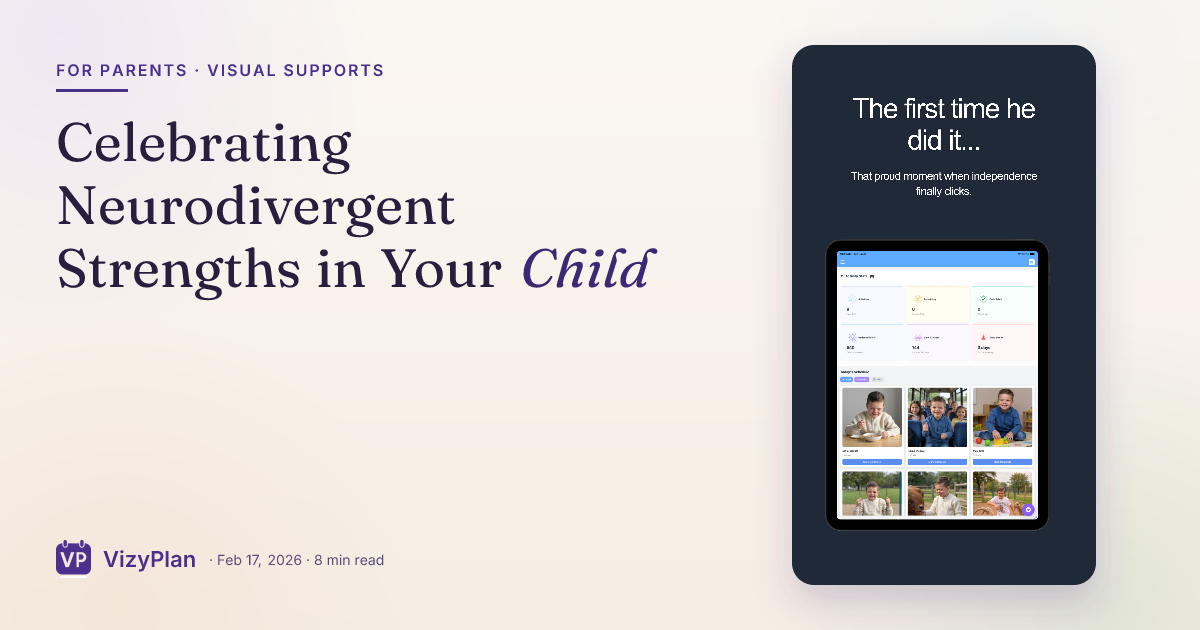
Create a visual strengths board. A physical or digital board showing your child's strengths, achievements, and proud moments provides a tangible reminder of their capabilities. Update it regularly. Include awards, completed projects, kind acts, and moments of growth. VizyPlan's reward and tracking features can serve as a digital strengths portfolio, showing your child's progress and achievements over time.
Separate the child from the challenge. "You are a creative, energetic kid who sometimes finds it hard to wait" is fundamentally different from "You are an impatient kid." Identity-first language that leads with the person, not the deficit, protects self-concept.
Supporting Strengths at School
Ensuring your child's strengths are recognized and nurtured at school is an important advocacy role.
Include strengths in IEP discussions. IEP meetings tend to focus almost exclusively on deficits and goals for improvement. Bring your child's strengths to the table explicitly. Request that strength-based goals and interest-based accommodations are included alongside remedial objectives.
Ask for opportunities to showcase expertise. A child who knows everything about ancient Egypt should have opportunities to present that knowledge, lead a class discussion, or create a project that demonstrates their depth. These moments of competence balance the many moments where school highlights what is difficult.
Connect strengths to future planning. As your child grows, help them see how their specific strengths connect to potential career paths, hobbies, and life goals. The child who can identify every bird by its call might become a biologist. The child who builds elaborate worlds in Minecraft might become an architect or game designer. Seeing a future built on their strengths provides powerful motivation.
The Bigger Picture
Celebrating neurodivergent strengths is not about pretending challenges do not exist. It is about ensuring that your child's self-concept is not built entirely on what is hard for them. Every child deserves to know what they are good at, to feel the confidence that comes from exercising their strengths, and to envision a future where their unique brain is an asset rather than a liability.
When you focus only on closing gaps, you risk communicating to your child that who they are is not good enough. When you equally invest in discovering, nurturing, and celebrating their strengths, you communicate something far more powerful: who you are is remarkable, and the world needs what you bring.
Your neurodivergent child is not a collection of deficits to be remediated. They are a whole person with a unique neurological profile that includes extraordinary strengths alongside genuine challenges. Both deserve your attention. Both shape who they will become.
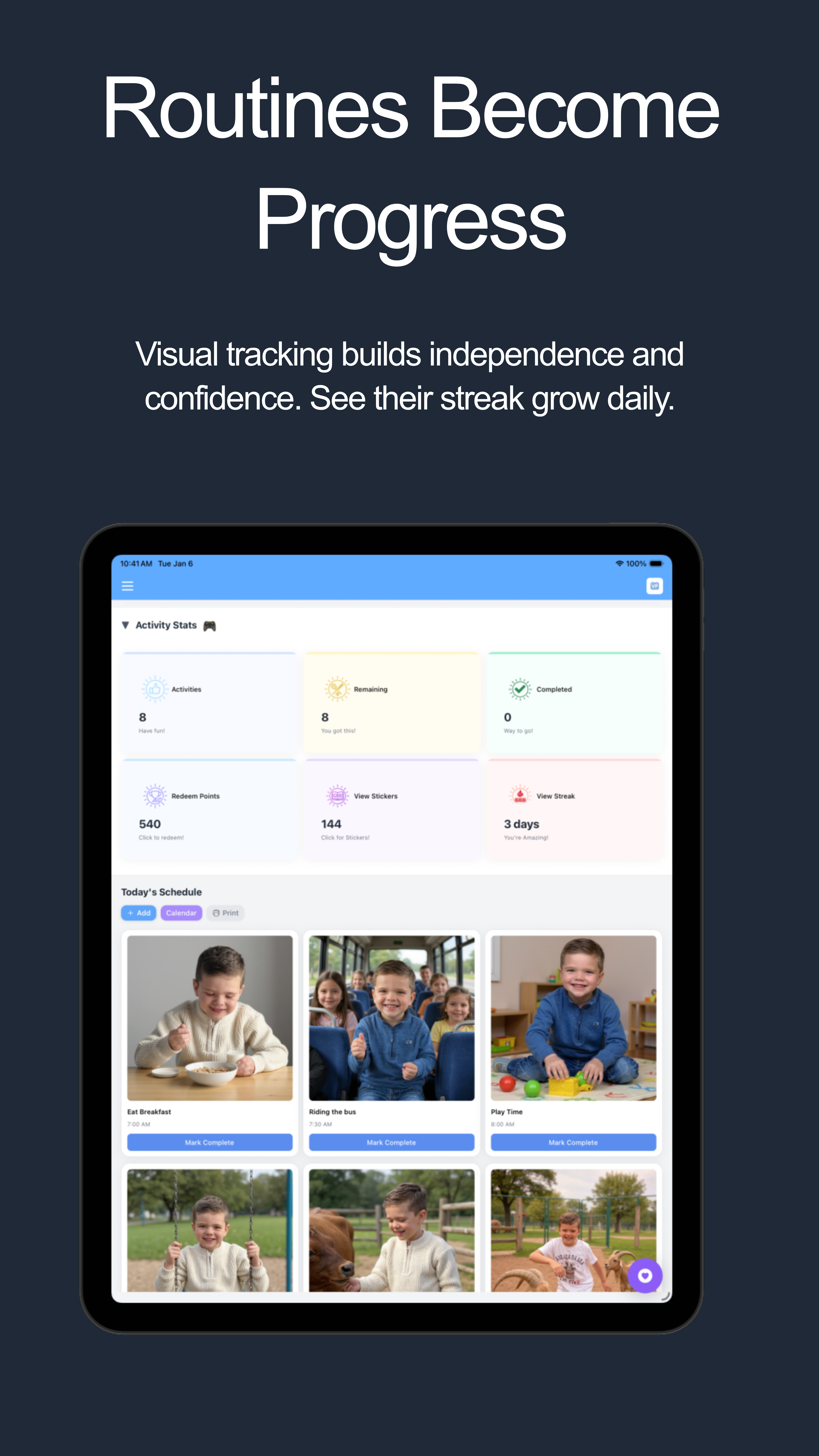
Download VizyPlan and start your 7-day free trial today. Build daily routines that celebrate your child's strengths, track emotional well-being, and create visual supports that reinforce their confidence and identity. If it helps, keep going for $6.99/month or $59.99/year.