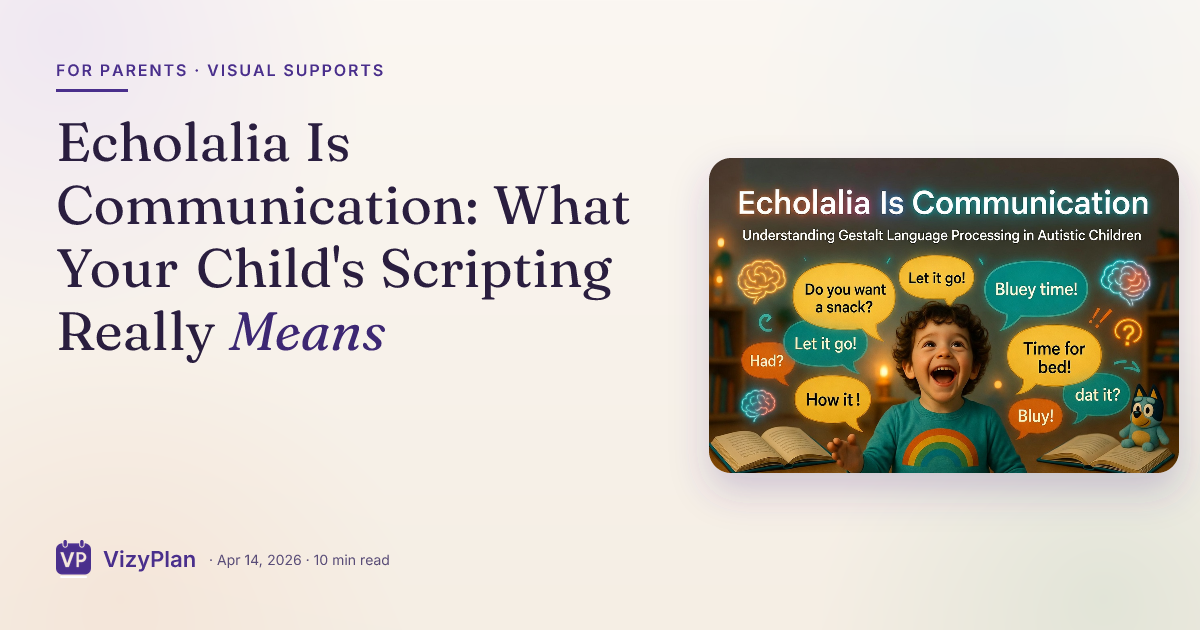
Your child says "Do you want a snack?" when they are hungry. They repeat the same line from Bluey forty times in a row. They echo your question back instead of answering it.
You have probably been told this is "non-functional language." That it needs to be redirected. That it is a sign your child is not progressing.
That framing is wrong.
Echolalia, the repetition of words, phrases, or entire scripts, is one of the most misunderstood aspects of autistic language development. And for many children, it is not a barrier to communication. It is communication.
What Echolalia Actually Is
Echolalia comes in two forms. Immediate echolalia is when your child repeats something right after hearing it. You say "Do you want juice?" and they say "Do you want juice?" back. Delayed echolalia is when they repeat something heard hours, days, or even months ago. The Bluey line they keep quoting. The phrase from a book they heard last week.
For decades, echolalia was classified as a symptom to eliminate. Therapy goals focused on reducing it. Parents were told to ignore it or redirect to "real" communication.
But research tells a different story. Barry Prizant, a leading researcher in communication and autism, identified fourteen distinct functions that delayed echolalia serves. These include requesting, protesting, affirming, labeling, calling for attention, self-directing behavior, and rehearsing. Fourteen different communicative purposes, all dismissed as meaningless repetition.
When your child quotes a movie character who is scared during a moment when they feel scared, that is not random. That is a child using the language they have to express something they do not yet have original words for.
Gestalt Language Processing: A Different Path to Language
Most children develop language analytically. They start with single words, combine them into short phrases, and build toward sentences. That is the model most speech therapy is built around.
But many autistic children develop language as gestalt processors. Instead of building up from single words, they start with whole chunks of language, long phrases or entire scripts memorized as single units, and gradually break them down into smaller, more flexible pieces.
This framework, described by speech-language pathologist Marge Blanc through the Natural Language Acquisition protocol, identifies stages of gestalt language development. In the earliest stages, a child's language is almost entirely echolalic. Those echoed phrases are their vocabulary. Over time, with support, they begin to mix and recombine pieces of those scripts into novel utterances.
A child who says "Let it go, let it go" is not just quoting Frozen. They might be telling you they want to be free of something. They want to leave. They want to stop an activity. The meaning lives in the context, not the literal words.
Why This Matters for Your Family
Understanding echolalia as communication changes everything about how you respond to your child.
It changes your reaction. Instead of redirecting scripting, you start listening to it. You pay attention to when certain scripts appear and what might be driving them. You respond to the intent behind the words, not the words themselves.
It changes your expectations. Instead of measuring your child's progress against analytical language milestones, you look for signs of gestalt language development. Are they beginning to modify scripts? Combining pieces of different phrases? Those are significant breakthroughs.
It changes therapy goals. Instead of targeting echolalia reduction, therapy can focus on supporting the natural progression from rigid scripts to flexible language. Meeting the child where they are, not where a milestone chart says they should be.
It reduces shame. Many parents feel embarrassed when their child scripts in public or echoes questions instead of answering them. Understanding that this is a valid and purposeful communication strategy removes that shame and replaces it with curiosity.
Enjoying this article?
Get practical tips and insights delivered to your inbox — no spam, ever.
What to Do When Your Child Scripts
Listen for the function. When your child echoes something, ask yourself: what might they be trying to communicate? Are they requesting? Protesting? Processing an emotion? Labeling something in their environment? The same script can mean different things in different contexts.
Respond to the intent. If your child says "Time for bed!" at 2 PM, they might be telling you they are tired, not that they think it is bedtime. Respond to what you think they mean: "You sound tired. Do you want to rest?"
Acknowledge the communication. Even when you are not sure what a script means, validate the attempt. "I hear you saying that. Tell me more." This reinforces that their communication matters, regardless of its form.
Model language at their level. If your child is in early gestalt stages, model short, meaningful phrases that they can grab and use. Instead of "Would you like me to open the door for you so you can go outside?" try "Let's go outside!" Short, functional chunks they can echo and eventually adapt.
Track which scripts appear in which contexts. Over time, patterns emerge. You might notice your child uses a specific movie line whenever they are overwhelmed. That is valuable information that helps everyone supporting your child understand their communication system.
Building on Echolalia with Visual Supports
Visual supports complement gestalt language development beautifully. When a child can see what is happening next in their routine, the need to rely solely on scripts to navigate their day decreases. The visual schedule becomes a shared reference point.
Social stories provide new scripts in a structured way. When you create a visual narrative about going to the dentist, you are giving your child appropriate language to echo for that situation. You are expanding their script library with useful, context-specific phrases.
Emotion tracking tools help connect scripting to feelings. When you can see that your child scripts more heavily during transitions or when they are anxious, you can address the underlying emotion rather than focusing on the surface behavior.
When to Seek Support
If your child primarily communicates through echolalia, a speech-language pathologist familiar with gestalt language processing can help. Not all SLPs are trained in this framework, so ask specifically about their experience with GLP and the Natural Language Acquisition protocol.
An SLP who understands gestalt processing will not set goals to eliminate echolalia. Instead, they will support your child's natural progression through the stages of gestalt language development, celebrating each step toward more flexible communication.
Your Child Is Already Communicating
The most important shift is this: your child is not failing to communicate. They are communicating in a way that the people around them may not yet understand.
Every script has meaning. Every echo carries intent. Every repeated phrase is your child using the tools they have to navigate a world that was not designed for the way their brain processes language.
Your job is not to fix their communication. Your job is to understand it.
Download VizyPlan and start your 7-day free trial today. Build visual routines that give your child new scripts for their day, track emotions and patterns to understand what their scripting is telling you, and create social stories that expand their language library with context they can use. If it helps, keep going for $6.99/month or $59.99/year.
VizyPlan was built by an autism dad who sat on his living room floor and needed something that did not exist. Now it does. Start your free trial and give your child the tools to see their day and navigate it with confidence.