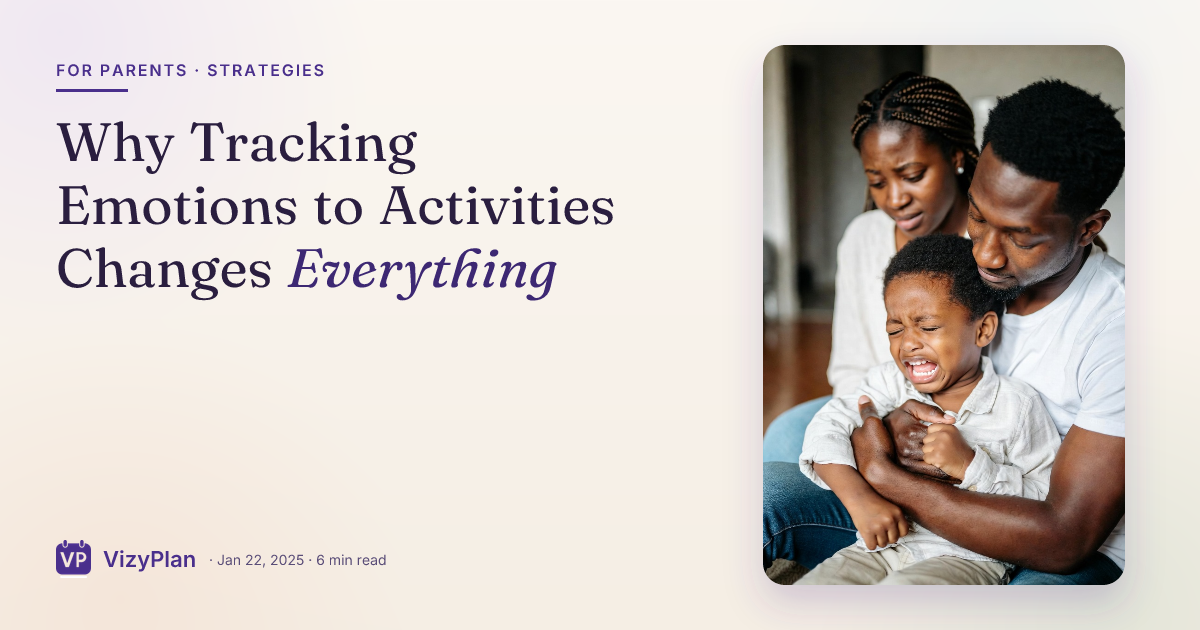
What if you could predict when your child might struggle, before the meltdown happens? For parents of neurodivergent children, understanding the connection between emotions and activities is one of the most powerful tools available. When you track how your child feels during specific parts of their day, patterns emerge that can change everything.
The Missing Link: Emotions and Activities
Most parents track behaviors. They note meltdowns, difficult moments, and challenging transitions. But behavior is the end result, what happened before the behavior is where the real insights hide.
Emotions during activities tell a different story. When you know that your child consistently feels worried during homework time, or sad after dinner, you gain actionable information. The behavior (resistance, meltdown, withdrawal) suddenly has context.
Patterns become visible over time. A single data point means little. But when you track emotions across days and weeks, you start to see which activities reliably trigger stress and which ones support regulation.
Interventions become targeted. Instead of general strategies, you can address specific activity-emotion connections with precision.
What Emotion Tracking Reveals
When families begin tracking emotions connected to activities, they often discover surprising patterns.
Time-of-day effects become clear. Many children show different emotional patterns in morning versus evening activities. A child who handles morning routines well might consistently struggle with the same tasks at night when tired.
Specific activities emerge as triggers. You might discover that it is not "transitions" generally that are hard, but specifically the transition from screen time to dinner. This precision allows for targeted support.
Positive patterns also appear. Tracking is not just about problems. You will also see which activities consistently support positive emotions, information that helps you build more of these moments into the day.
Weekly rhythms become visible. Some children have predictable patterns across the week. Monday mornings might be harder than other days. Fridays might bring more anxiety about weekend schedule changes.
How to Track Emotions to Activities
Effective emotion tracking does not require complex systems. Simple, consistent approaches work best.
Keep it simple. Track just a few basic emotions: happy, calm, worried, sad, excited. More nuanced tracking can come later once the habit is established.
Connect to specific activities. Rather than logging emotions at random times, connect them to defined activities in your child's routine: waking up, eating breakfast, getting dressed, leaving for school, homework time, dinner, bedtime.
Make it visual. For many neurodivergent children, selecting an emoji or pointing to a feeling face is easier than verbal reporting. Visual emotion check-ins during or after activities provide more reliable data.
Track consistently. Daily tracking over several weeks reveals patterns that occasional logging misses. Build emotion check-ins into your existing routines.
Involve your child when possible. Children who participate in tracking their own emotions develop greater self-awareness. Even young children can point to how they feel during different activities.
Understanding the Data
Once you have collected emotion data, interpretation becomes the key skill.
Look for frequency patterns. If your child reports feeling worried four out of five homework sessions but happy during most other activities, homework is a clear target for intervention.
Notice intensity alongside frequency. An activity that occasionally produces mild worry is different from one that consistently triggers intense distress.
Compare across time periods. Are mornings consistently harder than afternoons? Are weekdays different from weekends? These patterns inform scheduling decisions.
Watch for changes. When you implement a new support or strategy, tracking shows whether emotions around that activity improve.
Acting on What You Learn
Data without action is just information. The value of emotion tracking comes from using insights to make changes.
Modify challenging activities. If getting dressed consistently triggers worry, consider what about the activity is difficult. Is it the clothing choices? The time pressure? The transition from another activity? Target your intervention to the specific challenge.
Add support before difficult moments. When you know an activity typically brings stress, you can proactively add regulation supports before the activity begins, not after distress is already escalating.
Build on positive activities. If certain activities consistently support positive emotions, look for ways to extend or replicate these moments. What makes them work? Can elements be added to more challenging activities?
Adjust timing. Sometimes the issue is not the activity itself but when it happens. Homework immediately after school might fail while homework after a movement break might succeed. Emotion data helps you experiment systematically.
Communicate with providers. Emotion-activity data is powerful information to share with therapists, teachers, and other providers. It helps them understand your child's experience and target their support effectively.
.png)
The Role of Self-Awareness
Tracking emotions builds self-awareness in children over time.
Recognition develops. Children who regularly check in about their emotions become better at recognizing their internal states, even when not prompted.
Language grows. The vocabulary of emotions expands as children practice identifying and naming how they feel.
Anticipation becomes possible. Children who understand their patterns can eventually anticipate challenging moments and ask for support proactively.
Self-advocacy emerges. A child who knows they struggle with a particular activity can learn to communicate this and request accommodations.
Common Patterns Parents Discover
Certain patterns appear frequently when families track emotions to activities.
Transition stress. Many neurodivergent children show negative emotions around transitions between activities, regardless of what the activities are.
End-of-day depletion. Emotions often deteriorate as the day progresses, with evening routines showing more distress than morning ones, even for identical tasks.
Post-school crash. Children who mask at school often show challenging emotions during the first activities after returning home, even preferred ones.
Anticipatory anxiety. Some children show stress during activities that come just before known challenges, worry during dinner because bedtime comes next.
Hunger and fatigue effects. Activities that happen when children are hungry or tired consistently show poorer emotional outcomes than the same activities when needs are met.
Technology Makes It Easier
While emotion tracking can be done with paper and pencil, digital tools offer significant advantages.
Automatic pattern detection. Apps can analyze your data and surface patterns you might miss.
Visual reports. Seeing emotion frequency as charts and graphs makes patterns obvious at a glance.
Historical comparison. Digital tracking allows you to compare current patterns to previous weeks or months, showing progress over time.
Easy sharing. Digital reports can be shared with providers, creating a common understanding of your child's experience.
VizyPlan's new Emotion Insights feature lets you track how your child feels during specific activities, see patterns across days and weeks, and filter by individual activities to understand exactly where support is needed most.
Starting Your Tracking Journey
Begin with small, manageable steps.
Choose three to five activities. Do not try to track everything. Start with a few key activities where you want to understand emotions better.
Pick a simple emotion set. Happy, calm, worried, sad, and excited cover most experiences without overwhelming anyone.
Commit to two weeks. Give yourself enough time to see patterns before drawing conclusions.
Review data weekly. Set a specific time to look at what the data shows and consider what adjustments might help.
Celebrate insights. Every pattern you discover is useful information, even when it reveals challenges. Understanding is the first step to improvement.
VizyPlan's Emotion Insights helps you track your child's feelings across activities and discover patterns that inform better support. Start your free trial and turn emotion data into actionable insights.