
The morning didn't start at 7am. It started at 11:30pm last night, when your child was still wide awake, lying in pajamas that itched, while the rest of the house was asleep. You finally got them down a little after midnight. By the time you woke them up six and a half hours later, the morning was already lost.
This is the part nobody tells you about autism and mornings. Half the battle was decided before the sun came up. The other half is decided in the first ten minutes, before your child has eaten, before you have said anything that lands, before anyone has put on a shoe. If you have been told you just need to try a sticker chart and a kitchen timer, that advice was not built for the brain you are parenting.
A morning routine for an autistic child is a different shape than a typical morning routine. It is built on sensory regulation, predictability, and visual structure, in that order. Demands come last. Verbal instructions come last. Productivity comes last. If you have been doing it the other way around and feeling like you are losing every morning, you are not failing. The order was wrong.
This post is the one I wish someone had handed me when my son was three. He was nonverbal until age two, and our mornings were the hardest hour of our day for a long time. What follows is what the research says, what worked for us, and what to actually do tomorrow.
Why Mornings Hit Autistic Kids Harder
Mornings stack every challenge an autistic nervous system already faces, all at once, before the brain has had a chance to come online. Six things are happening under the surface, and none of them are about behavior.
Sleep biology is different. Between 50 and 80% of autistic children have significant sleep problems, compared to 20 to 30% of neurotypical children. Their dim light melatonin onset, the body signal to fall asleep, runs about an hour and seventeen minutes later than their neurotypical peers. A 2025 Mendelian randomization study in the journal Autism, with more than 85,000 participants, showed a causal genetic relationship between late chronotype and autism. Translation: many autistic kids are biologically wired to sleep later and wake later, and the 7am school bell is fighting their genome. The full breakdown lives in our autism and sleep deep dive, which is the upstream piece this post leans on.
Executive function is heavier in the morning. A 2018 meta-analysis in Molecular Psychiatry pooled 235 studies and 14,081 participants and found a moderate effect size (Hedges g = 0.48) for broad executive dysfunction in autism. Planning, working memory, cognitive flexibility, and self-monitoring are all measurably harder. A six-step morning sequence held in working memory is a heavier lift than your child can carry while also regulating sensory input and language processing.
Sensory input arrives all at once. A 2009 meta-analysis by Ben-Sasson and colleagues in the Journal of Autism and Developmental Disorders found that atypical sensory features show up in 45 to 95% of autistic children across studies, with the largest differences in under-responsivity, then over-responsivity, then sensation seeking. The differences were greatest for children ages 6 to 9. Mornings stack sensory experiences in rapid succession. Cold sheets to warm air, dark to bright light, silence to running water, soft pajamas to school clothes. A child who wakes already dysregulated will not regulate just because you asked nicely.
Transitions cost more. Asleep to awake. Bed to bathroom. Pajamas to clothes. Home to car. Car to classroom. Each shift carries a cost that builds. Our post on transition strategies for autism goes deeper, but the short version is that visual transition cues outperform verbal ones, especially when the child is tired.
Interoception fills in the gaps you assume are obvious. Interoception is the sense that tells the body when it is hungry, thirsty, cold, or needs the bathroom. Garfinkel and colleagues, writing in Biological Psychology in 2016, found that autistic individuals showed difficulty objectively detecting bodily signals while simultaneously experiencing an over-inflated perception of those sensations. "Are you hungry?" often gets a "no" that is not a lie. The body signal is not reaching the conscious brain in time. Our interoception primer covers this in depth.
Demands themselves can be the trigger. For autistic children with a demand avoidance profile, the nervous system reacts to a demand as a threat, even a small or expected one. A morning is a demand cascade. Get up, get dressed, eat, brush teeth, put on shoes, get in the car. The same routine that feels structured to one autistic child can feel like a wall to another. PDA flips the playbook.
If your child has ADHD instead of autism, our companion piece on ADHD morning routines is built for that wiring. The strategies overlap but the levers are different.
The 8 Elements of an Autism-Friendly Morning
The goal is not productivity. The goal is regulation, then movement, then a calm exit. These eight elements show up in almost every morning routine that actually works for an autistic child.
A visual schedule on the wall, eye level, in order. Photos of the steps, in the sequence they happen, posted in the same spot every day. Visuals do not require working memory. They do not require auditory processing. They just sit there, doing the cognitive work the brain does not have spare bandwidth for. Our visual schedules for autism guide is the deeper read here.
Proprioceptive input within the first ten minutes. Heavy work and deep pressure are organizing for the autistic nervous system. A bear hug. A weighted blanket squeeze. Wall pushes. Carrying a basket of laundry to the kitchen. Three minutes on a mini trampoline before getting dressed. A small dose of proprioception before the first demand can completely change the next thirty minutes. Our post on home sensory diet activities has a full menu.
First/Then for the hardest single transition. Pick the one transition that always falls apart. Not five. One. Build a first/then board for that single moment. First socks, then iPad in the car. First brush teeth, then we pick the song. Visual, concrete, and small enough to actually work.
Visual transition warnings, not verbal commands. A timer your child can see. A picture card hand-off. Holding up two fingers to mean two minutes. Anything that lets your child see the change coming without having to decode it from your voice. More on this in our piece on staying regulated during transitions.
Sensory-friendly clothes, prepped the night before. Tactile sensitivity in autism is well documented, and clothing battles can eat fifteen to thirty minutes of a morning. Lay out the outfit your child will actually tolerate, every night, in the same place. Tags cut, seams checked, fabric the kid trusts.
A predictable safe-food breakfast. Because of the interoception gap, autistic children often will not reliably tell you they are hungry, even when they are running on empty. A predictable, low-decision breakfast that the child will actually eat solves the "they refuse food at 7 and crash at 9:30" problem. One or two safe-food options, every day. New foods do not belong in the morning.
Choice within structure, never open choice. Autonomy reduces demand-avoidance threat response. Unlimited choice creates decision paralysis. "This shirt or this shirt" works. "What do you want to wear?" does not. Two options, presented visually, every time.
Co-regulation before self-regulation. Young autistic children regulate by borrowing the parent's nervous system. If you are running on three hours of sleep and your shoulders are up by your ears, your child is reading that before any verbal instruction reaches them. A calm, slow-bodied parent is part of the routine, not a luxury added on top of it. Our co-regulation post is the canonical read.
You do not need every element on day one. Pick three to start. Build from there.
Enjoying this article?
Get practical tips and insights delivered to your inbox — no spam, ever.
How to Build a Morning Routine for an Autistic Child in 7 Steps
Use these steps in order. Numbered on purpose. The order matters.
- Audit your current morning for three days. Do not change anything yet. Just watch. Note where the routine breaks. Which transition. Which sensory moment. Which demand. Most parents are surprised by what the audit reveals. The meltdown at 7:20 over shoes is often actually about the lights coming on at 6:55. You cannot fix a pattern you have not seen.
- Anchor bedtime first. The morning starts at 8pm the night before, not at 7am. Lay out tomorrow's clothes. Preview the day. Run a calm bedtime routine. If sleep itself is the upstream problem, the autism and sleep deep dive is where to spend the next thirty minutes of your reading time. A child who slept badly cannot perform a morning routine well, no matter how clever the routine is.
- Build a visual schedule with photos of your own child doing each step. Five to eight steps, eye level, same spot every day. Use real pictures of your child, not generic clipart. Children recognize themselves in their own routines, which is why personalized visuals outperform stock photos. Posted on the fridge or the bathroom mirror works for most families.
- Front-load proprioceptive input. Pick one heavy-work or deep-pressure activity and put it in the first ten minutes. A weighted blanket squeeze before getting out of bed. A morning hug that lasts ten seconds, not two. Three big jumps on the way to the bathroom. The point is regulation before demand. Make it part of the schedule so it happens every day, not just on hard days.
- Lock in a safe-food breakfast. One or two predictable options the child actually eats. The same plate, the same cup, the same spot at the table. Mornings are not the time for nutritional ambition. A child who eats the same yogurt and toast every weekday is fed and regulated, and that is a win.
- Use visual transitions, not verbal commands. A picture card hand-off. A visible timer. A laminated "all done" card. Show the change, do not announce it. Save your voice for warmth and connection, not for instructions your child's brain cannot process at 6:55am.
- Add a 2-choice autonomy moment. Pick one place in the morning where your child gets a real choice. Which shirt. Which breakfast bowl. Which song in the car. Anchor everything else. The choice is not about the shirt. It is about giving the nervous system a moment of control inside a structure your child did not pick. Especially important for kids with demand avoidance profiles.
Run the new routine for two weeks before you judge it. Autistic children often need repetition to encode a routine, and the first three days will look like nothing is working. The day 10 to 14 mark is where you usually see it click. Do not make changes mid-stream unless something is clearly harming your child. The variable you are testing is consistency.
What to Do When the Routine Falls Apart
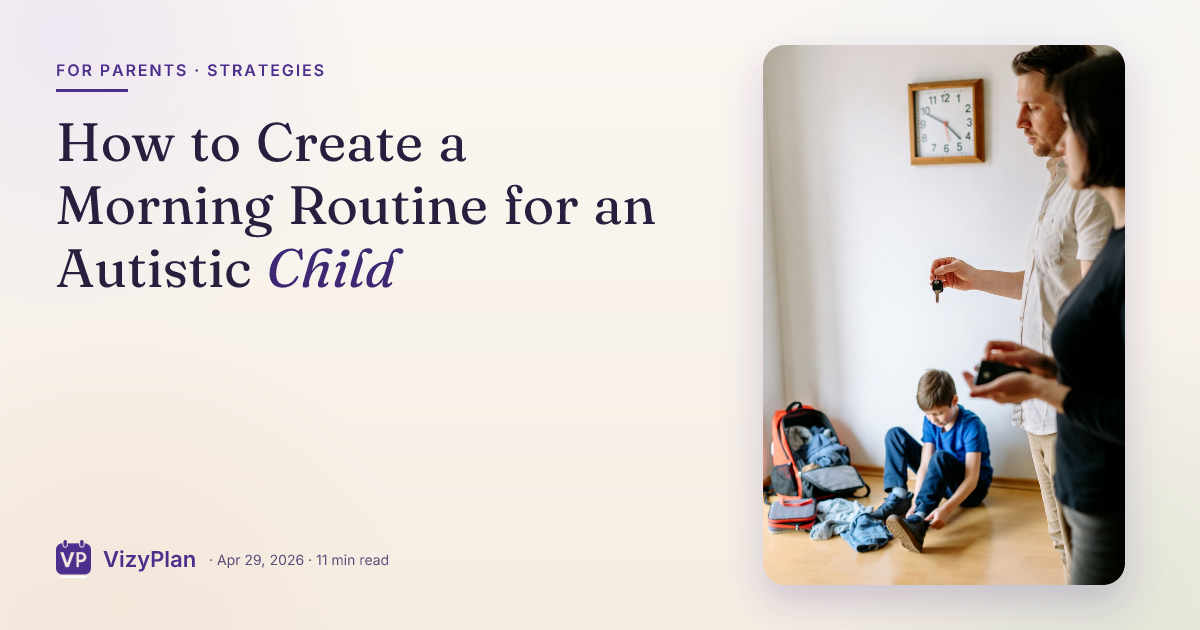
It will fall apart. Some mornings the visual schedule is on the fridge and the proprioceptive input has been delivered and the safe food is on the table and your child still ends up on the floor in one sock with their hands over their ears. That is not a failure of the routine. That is the nervous system telling you what it has today.
When the morning goes sideways, the goal is not to power through. The goal is to stop the cascade. Lower the demand load. Drop something off the list. Pickup a fork for them. Put the shoes on yourself. Skip the brushing for today. Get them safely to where they need to be and let go of the rest.
The morning is not a moral test. It is data. A meltdown over shoes on Tuesday after a 1am bedtime is not a routine problem. It is a sleep problem dressed up as a shoe problem. Note it. Try again tomorrow. Some days the answer is "we got out the door" and that is the entire win.
If your child has been holding it together at school all day and falling apart for you in the morning, that is not them being harder on you. That is them trusting you with the dysregulation they were not safe to show anywhere else. Mornings are often where the day's regulation budget gets spent before the day even starts. Our post on co-regulation is worth reading on the days that fall apart hardest, because the most useful thing you can do in those moments is slow your own body down first.
A Note from Me
The morning that taught me most of this happened when my son was about three. We had been losing every morning. I was repeating "put on your shoes" three, four, five times. He was not ignoring me. The words were just not landing. I could see it in his face.
That morning I stopped talking. I taped a strip of pictures on the fridge with our actual phone photos. Wake up. Go potty. Eat. Get dressed. Shoes. Door. I pointed to the next picture instead of saying anything. He looked at the picture. Then he did the thing.
We were out the door in fifteen minutes. No yelling. No tears. The pictures had been doing the work my voice could not. That was the morning I learned that for my son, visual structure was not a nice extra. It was the language his brain could read at 7am when nothing else could get through. We have been building from that morning ever since.
That is the shift this post is asking you to make. Not a perfect routine. A routine your child's brain can actually read.
Download VizyPlan and start your 7-day free trial today. Build a visual morning routine with personalized photos of your own child, anchor sensory regulation with proprioceptive input before the first demand, and create first/then boards for the transitions that always fall apart. Just $6.99/month after your trial, no credit card required upfront.
VizyPlan was built by an autism dad who sat on his living room floor and needed something that did not exist. Now it does. Start your free trial and give your child the tools to see their day and navigate it with confidence.