
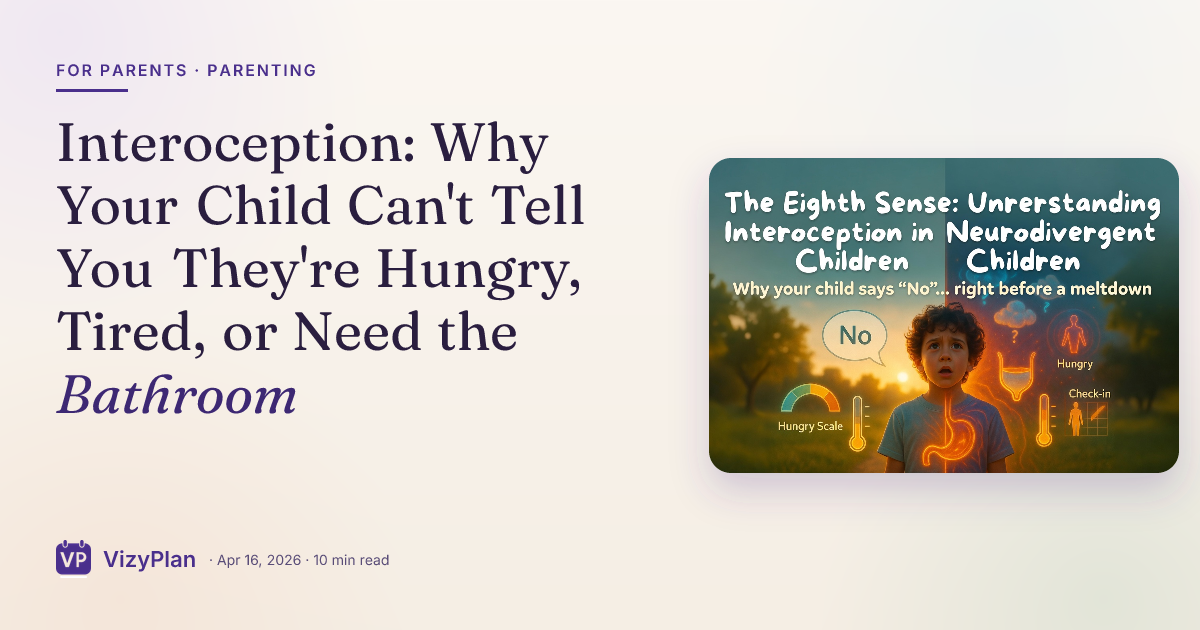
Your child has not eaten in four hours. You can see the signs. They are getting irritable, unfocused, starting to fall apart. You ask if they are hungry.
"No."
Twenty minutes later, a full meltdown. You offer food. They eat ravenously. They were starving. They genuinely did not know.
Or this: You ask your child if they need the bathroom before you leave the house. "No." Seven minutes into the car ride, an emergency.
This is not defiance. It is not lying. It is not laziness. It is a sensory processing difference called interoception, and it is one of the most overlooked factors in daily life with a neurodivergent child.
The Eighth Sense
Most people learn about five senses in school. Some know about the vestibular sense (balance) and proprioception (body position in space). But there is an eighth sensory system that rarely gets discussed: interoception.
Interoception is the ability to sense what is happening inside your body. Hunger, thirst, fullness, the need to use the bathroom, fatigue, temperature, pain, heart rate, nausea, the feeling of an emotion building. Every internal signal your body sends your brain travels through the interoceptive system.
For most people, this system works in the background. You feel hungry, you eat. You feel cold, you put on a jacket. You feel the urge to use the bathroom, you go. These signals are so automatic that you do not think about thinking about them.
For many neurodivergent children, interoception works differently. Signals may be muted, delayed, absent, or overwhelming. A child might not feel hunger building gradually. Instead, they feel nothing, nothing, nothing, then suddenly feel desperately, urgently hungry with no warning. The signal skipped "a little hungry" and went straight to "crisis."
How Interoceptive Differences Show Up
Mealtime battles. Your child says they are not hungry, refuses food, then melts down an hour later. They are not being difficult. They genuinely did not perceive hunger until it became unbearable. Or the opposite: they cannot feel fullness and eat past the point of comfort.
Toileting challenges. Potty training takes longer because the internal signal that says "your bladder is getting full" does not register until the moment is urgent. Accidents persist even in older children, not from a behavioral issue, but from a sensory one.
Temperature dysregulation. Your child refuses a coat in freezing weather or wears a winter jacket in summer. They are not being oppositional. They may not be perceiving temperature the way you do.
Emotional escalation. Emotions are interoceptive experiences. Anxiety feels like a tight chest. Anger feels like heat and tension. Sadness feels heavy. If your child cannot perceive these building physical sensations, emotions seem to arrive at full intensity without warning. There is no "I am getting frustrated." There is only the explosion.
Sleep difficulties. Recognizing tiredness requires interoceptive awareness. A child who does not feel fatigue building will not ask for rest and may fight bedtime because they genuinely do not feel tired, even when their body clearly is.
Pain insensitivity or hypersensitivity. Some children do not report injuries that should hurt. Others experience minor sensations as intensely painful. Both reflect interoceptive differences.
The Research Behind It
Occupational therapist Kelly Mahler has led research on interoception and autism for over twenty years. Her work demonstrated that interoceptive differences are directly linked to emotion regulation challenges in autistic children.
In a study using her Interoception Curriculum, a 25-week school-based intervention, researchers found statistically significant improvements in both interoceptive awareness and emotion regulation. Children who became better at noticing their body signals also became better at managing their emotions. The connection is not coincidental. You cannot regulate what you cannot feel.
This research reframes so many daily struggles. The child who "has no emotional awareness" may actually have interoceptive differences that prevent them from feeling emotions as they build. The child who "never listens to their body" may not be able to hear what their body is saying.
Enjoying this article?
Get practical tips and insights delivered to your inbox — no spam, ever.
What You Can Do at Home
Build body awareness with check-ins. At regular points throughout the day, pause and help your child notice their body. "Let's check in. How does your tummy feel? Empty, full, or somewhere in between?" Start with moments when the answer is obvious, like right before a meal, so they can connect the label with the sensation.
Use visual scales. A visual hunger scale, a visual energy meter, a visual emotions thermometer. These give your child a way to externalize internal states. Instead of needing to generate the answer from inside, they can point to where they are on a scale. Over time, this builds the internal vocabulary.
Create routine-based body breaks. Do not wait for your child to report a need. Build body-awareness moments into the daily visual schedule. After recess: body check. Before lunch: hunger check. Before bed: energy check. The routine scaffolds what interoception is not yet providing independently.
Exercise supports interoceptive awareness. Movement that increases heart rate, heavy breathing, and muscle engagement creates strong interoceptive signals that are easier for the brain to detect. Jumping, climbing, pushing heavy objects, or swinging all generate body feedback that strengthens the interoceptive pathways.
Name sensations during natural moments. When your child is out of breath from running: "Your heart is beating fast. Your chest is moving up and down. That is your body telling you it is working hard." You are teaching them the language of interoception in context.
Track patterns over time. Emotion and activity tracking across days and weeks reveals interoceptive patterns that single moments do not. You might discover your child consistently melts down two hours after eating, revealing a hunger pattern you can proactively address.
Reframing Daily Struggles
Almost every parent of a neurodivergent child has experienced the frustration of asking "Are you hungry? Do you need the bathroom? Are you tired?" and getting "No" right before the very thing they asked about becomes a crisis.
The reframe is this: your child was not lying. They were answering honestly based on what their body was telling them. And their body was not sending the signal yet, or was sending it too quietly for their brain to detect.
This does not mean you stop asking. It means you stop relying on their answer as the only data point. You pair their self-report with your observations, with routine-based check-ins, and with the patterns you track over time.
You become the external interoceptive system until theirs develops. You notice what they cannot yet notice. You intervene before the crisis, not because you are controlling, but because you are compensating for a sensory system that is still catching up.
It Gets Better
Interoception is not fixed. It develops. It can be strengthened. The research on interoception-based interventions shows measurable improvement over time. Your child's internal awareness at six is not their awareness at ten.
Every body check-in you do builds a neural pathway. Every time you help your child connect "my tummy feels empty" with "I need food," you are wiring a connection that will eventually fire without you.
It is slow. It is invisible work. Nobody sees you doing it. But it is some of the most important work you will do as a parent.
Download VizyPlan and start your 7-day free trial today. Build visual routines with built-in body check-in reminders, track emotions and patterns to reveal interoceptive trends you would miss day-to-day, and create social stories that teach your child what body signals feel like. If it helps, keep going for $6.99/month or $59.99/year.
VizyPlan was built by an autism dad who sat on his living room floor and needed something that did not exist. Now it does. Start your free trial and give your child the tools to see their day and navigate it with confidence.