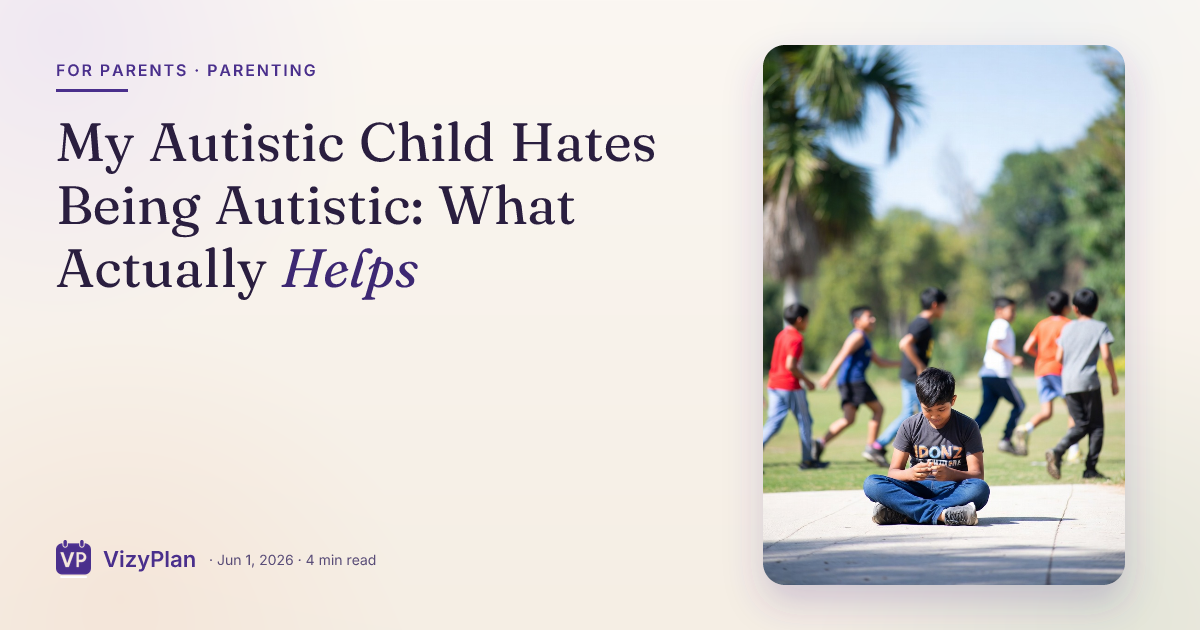
The moment lands hard. Your autistic child looks up and says, "I hate being autistic." Maybe they have just been left out at recess. Maybe a teacher asked them to "stop doing that thing with your hands." Maybe nothing visible happened at all and the wave was already building. My son is only five and we have not arrived at this moment yet, but I have heard the story from enough other autism parents to know it is coming for many of us. When "my autistic child hates being autistic" is the sentence sitting in the room, the question is not how to talk them out of it. It is how to sit with the feeling while the longer work of identity does its job underneath.
Why "my autistic child hates being autistic" is the search so many parents end up typing
The research on autistic identity in children is younger than the research on adults, but the pattern is consistent. Cooper, Smith, and Russell 2017 used social identity theory to show that positive autistic identity correlates with better self-esteem and life satisfaction in autistic individuals. Cage, Di Monaco, and Newell 2018 linked perceived autism acceptance to better mental health. Cage and Troxell-Whitman 2019 connected sustained masking to poorer mental health outcomes. The lever is the same across studies. Identity messages absorbed from a non-autistic environment cost something to carry.
When the comment lands, it is rarely about autism in the abstract. It is about a specific moment of difference your child just noticed and cannot yet explain.
What does not help
Three responses parents reach for that often miss.
- "You are just like everyone else." Untrue, and your child knows it. The reassurance dismisses the experience that prompted the statement.
- "Being autistic is your superpower." The strengths framing can land as more pressure to perform. Some autistic kids find it genuinely useful. Many find it patronizing.
- Fixing the moment with a treat or distraction. The feeling still has to go somewhere. Pushed under, it surfaces louder later.
Enjoying this article?
Get practical tips and insights delivered to your inbox — no spam, ever.
What actually helps
Sit with the statement first. "That sounds really hard. Tell me what just happened." Then narrow to the specific moment. If a peer interaction triggered it, that is the thing to work on, not autism as a category.
Anchor the conversation with autistic adults the child can see, in books, on screen, or in your own life. The story of being autistic was never going to be written by a non-autistic narrator. Pair that with the small everyday signal that says "this is my real day, and I am okay in it." Photos of your child doing their actual routines, in their actual room, with the things they actually like. Identity in kids is built less by speeches and more by the steady image of themselves living a recognizable day.
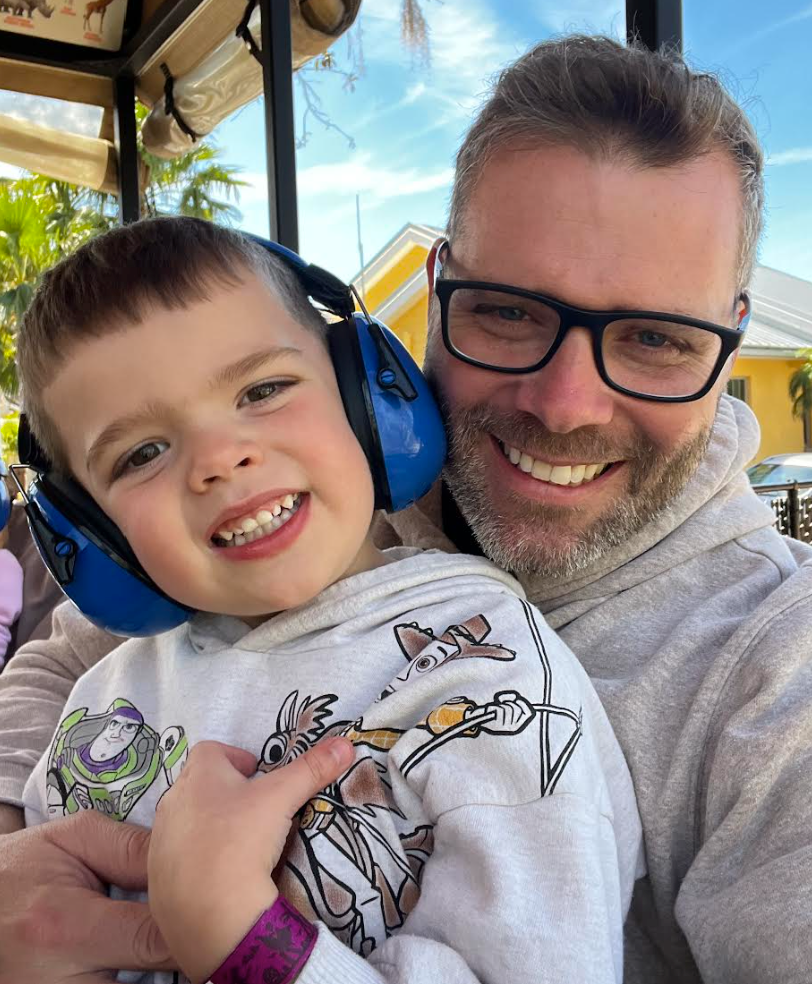
VizyPlan was built by an autism dad whose son needed to see himself in his own day. The photos are the actual child, doing the actual routine, in the actual room. Identity does not get built in a single moment. It gets built in the small recurring image of "this is me, and this is what my day looks like, and that is fine."
Download VizyPlan and start your 7-day free trial today. Build the day where your child sees themselves. If it helps, keep going for $6.99/month or $59.99/year.
VizyPlan was built by an autism dad who needed something that did not exist. Start your free trial.