

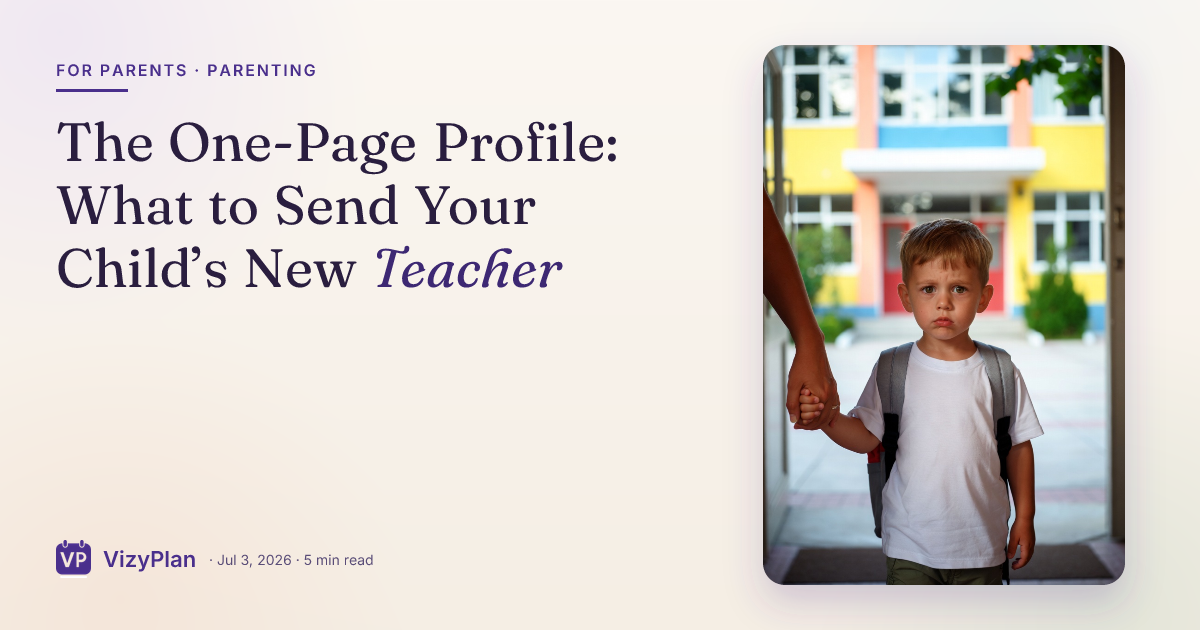
Your child's new teacher will meet a room full of students in the first week and read a stack of files an inch thick. A one-page profile is how you make sure the few things that matter most about your child rise to the top before the first hard moment. It is not the IEP. It is one page, written by the person who knows your child best, that a busy teacher can absorb in ninety seconds.
What a one-page profile is
A one-page profile came out of person-centered planning, developed by Helen Sanderson Associates after they noticed teachers rarely had time to absorb long plans but urgently needed to understand a student quickly. As Special Needs Jungle describes, the page has three parts: what people appreciate about the child, what matters to the child from their own perspective, and how best to support them. In one example, a boy's anxiety dropped simply because every teacher now knew to seat him near the door. The information already existed; the profile is what got it in front of the right people.
What to put on the page
Keep it short, specific, and honest. A teacher can act on five clear lines far more easily than five paragraphs.
- Three genuine strengths. Understood.org's free "3x3 card" suggests three strengths, three challenges, and three strategies. Lead with what your child is good at.
- What overwhelms my child. Name the real triggers, whether it is unexpected noise, being rushed, or a change in plan.
- What actually helps. List the specific moves that work, like a two-minute warning before transitions or a quiet spot to reset.
- How my child communicates. Explain what a meltdown, a shutdown, or a flat "no" is really telling the adult in the room.
- One thing that will make the first week easier. Give the teacher a single high-value action they can take on day one.
Why one page beats the whole file
Small, specific communication is not a courtesy; it changes outcomes. A meta-analysis of 77 family-school partnership studies found these partnerships significantly improved children's academic and social-emotional functioning, with two-way communication among the most effective ingredients. A strengths-based page also reframes how staff see your child. As Understood.org notes, person-centered documentation helps a team "see the child as a whole person," not a list of deficits. That shift, made before any conflict, is worth more than any single accommodation.
Enjoying this article?
Get practical tips and insights delivered to your inbox — no spam, ever.
Make it visual, and make it a two-way door
Send the profile before the year starts, and invite the teacher to add what they notice. A profile that includes a photo of your child using their home routine gives the teacher an instant picture of what consistency looks like. Our guides to preparing for the IEP meeting and easing first day of school anxiety pair naturally with a strong one-page profile.
VizyPlan was built by an autism dad and an autism mom who is a licensed speech-language pathologist, and the visual routine it creates gives you a ready-made picture of what works for your child to hand a new teacher.
Download VizyPlan and start your 7-day free trial today. Build the visual routine that shows a new teacher what works. If it helps, keep going for $6.99/month or $59.99/year.
VizyPlan was built by an autism dad who needed something that did not exist. Start your free trial.