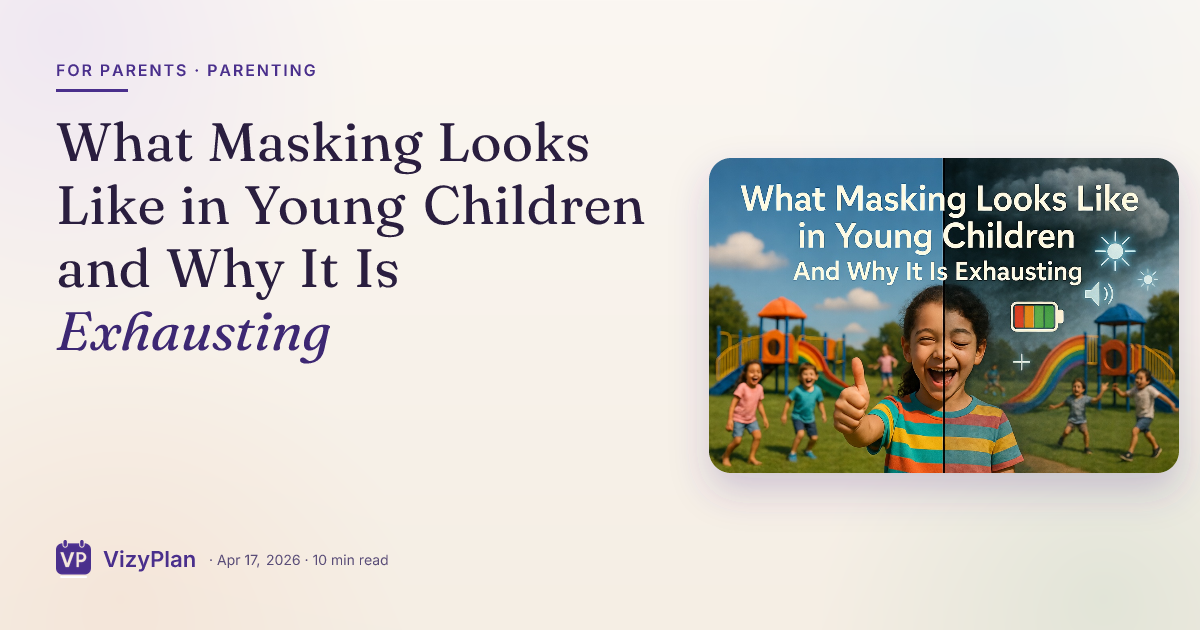
The teacher conference goes well. "They are doing great," she says. "No behavior concerns. They follow directions, play with other kids, participate in circle time."
You sit there wondering if she is talking about the same child. Because the child who walks through your front door at 3:15 PM is a different person. The shoes come off. The backpack hits the floor. And within minutes, the screaming starts. Or the shutdown. Or the hours of rigid, impossible-to-redirect behavior that lasts until bedtime.
You have tried explaining this to the school. They look at you like you are imagining things. You have tried explaining it to family. They wonder what you are doing wrong at home.
Nobody is imagining anything. And you are not doing anything wrong. Your child is masking, and the research on what this costs them is finally catching up to what you already know.
What Masking Is
Masking, sometimes called camouflaging, is the conscious or unconscious suppression of autistic traits in order to appear neurotypical. It includes suppressing stimming behaviors, forcing eye contact, imitating the social behaviors of peers, using memorized social scripts, hiding sensory discomfort, and performing emotional expressions that do not match internal experience.
Researchers define camouflaging as strategies individuals employ to mask, assimilate, or compensate for their autistic characteristics in social settings, in order to blend in or avoid stigmatization. This includes suppression of behaviors considered atypical, imitation of neurotypical behaviors, and use of social scripts to navigate social interactions.
For adults, masking has been extensively studied. The 2025 research picture is clear: camouflaging is associated with increased biological long-term stress, anxiety, depression, and burnout. But until recently, most masking research focused on teenagers and adults. The experience of young children, particularly those under ten, was largely unstudied.
That is changing. A 2026 study published in Advances in Neurodevelopmental Disorders found that camouflaging in children and adolescents predicted both internalizing symptoms like anxiety, depression, and somatic complaints, and externalizing symptoms like rule breaking and aggression, even when controlling for age, sex, and IQ.
Your child is not misbehaving at home. They are decompressing from a full day of performance.
What Masking Looks Like in Young Children
Masking in a five-year-old looks different from masking in a teenager, which is part of why it has been missed by research for so long.
The "perfect" school child. They follow every rule. They are quiet, compliant, eager to please. Teachers describe them as a model student. This is not because school is easy for them. It is because they are spending enormous energy ensuring nobody notices they are struggling.
After-school collapse. The moment they reach the safety of home, the mask drops. Everything held in all day comes out at once. Meltdowns, aggression, withdrawal, rigidity, tears. Parents describe feeling like they live with two different children.
Delayed emotional reactions. Something upsetting happens at school and they appear fine. Hours later at home, they fall apart over something unrelated. The emotion was held, not felt, during the masking period and surfaces later.
Physical symptoms. Stomachaches, headaches, fatigue, and sleep problems. The physiological cost of sustained masking shows up in the body. Research connects camouflaging to increased somatic complaints in children.
Social exhaustion. A child who seems to socialize well at school may refuse all social interaction at home or on weekends. They are not antisocial. They are depleted.
Imitation rather than initiation. Instead of playing their own way, they watch other children closely and copy. They learn the "right" way to play through observation. This looks like social development from the outside but is actually effortful performance.
Why Children Mask
Young children do not make a conscious decision to mask. It develops from repeated experiences of social feedback.
They learn quickly that stimming draws attention. That lining up toys the "wrong" way during free play makes other kids stare. That being honest about sensory overload leads to being singled out. That showing their natural way of being gets a reaction they want to avoid.
So they suppress. They imitate. They perform. And they get rewarded for it. "What a great day!" "You played so nicely!" "No problems at all!" The masking works, in the sense that it avoids negative social consequences. But the cost compounds silently.
Research published in 2025 noted that more research is needed on masking in younger children, specifically in the early school years, as this developmental period is when masking patterns solidify. The habits formed at five and six become the survival strategies that lead to burnout at fifteen and twenty.
Enjoying this article?
Get practical tips and insights delivered to your inbox — no spam, ever.
The Gender Factor
Autistic girls and women consistently score higher on camouflaging measures than boys and men. This contributes to later diagnosis, as masking hides the traits that evaluators look for.
But it also means that girls may be carrying a heavier masking burden from an earlier age. If your daughter "seems fine" at school but unravels at home, and if she has ever been described as "too social to be autistic," masking may be exactly what is happening.
How to Support a Masking Child
Believe the home behavior. The child you see at home is the real child. The school version is the performance. This does not mean school is doing something wrong. It means your child is working harder than anyone realizes to hold it together.
Create low-demand time. After school, reduce expectations. Do not immediately ask about their day, hand them homework, or schedule activities. Give them decompression time with no performance demands. Let them stim, zone out, play however they want, be messy, be loud, be themselves.
Reduce the need to mask at school. Work with the school to create accommodations that lower the masking burden. Sensory breaks. A quiet space to decompress. Permission to stim. Flexible seating. The fewer things a child has to suppress, the less they will collapse at home.
Make home a safe space for all expressions. If your child knows that every version of themselves is accepted at home, home becomes the place where the mask can safely drop. This is not indulging bad behavior. This is providing the emotional safety that makes regulation possible.
Build predictability into the day. Visual schedules reduce the cognitive load of figuring out what comes next. When a child does not have to use working memory to predict their day, that mental energy is freed up for other things. Less cognitive load means less masking demand.
Validate the effort. "School takes a lot of energy for you. I can see you are tired." Simple statements that acknowledge the invisible work of masking tell your child that you see them, even the parts they hide from everyone else.
The Long View
Masking is a survival strategy, and sometimes survival strategies are necessary. The goal is not to eliminate masking entirely, because your child will navigate neurotypical spaces their whole life. The goal is to reduce how much of it is required, increase recovery time, and ensure they have safe spaces where no mask is needed.
Tracking emotions across the day reveals the masking pattern. When you can see that school days consistently produce evening meltdowns, you have data that supports accommodation requests. When you can show that weekends with low social demand produce zero meltdowns, you have evidence that the issue is not your child's capacity, it is the cost of sustained performance.
Your child is not two different people. They are one person carrying an exhausting weight that nobody at school can see. You see it because home is where they finally put it down.
Download VizyPlan and start your 7-day free trial today. Build visual routines that reduce the cognitive load your child carries through their day, track emotions and patterns to reveal the hidden cost of masking across school and home, and create social stories that prepare them for social situations without requiring performance. If it helps, keep going for $6.99/month or $59.99/year.
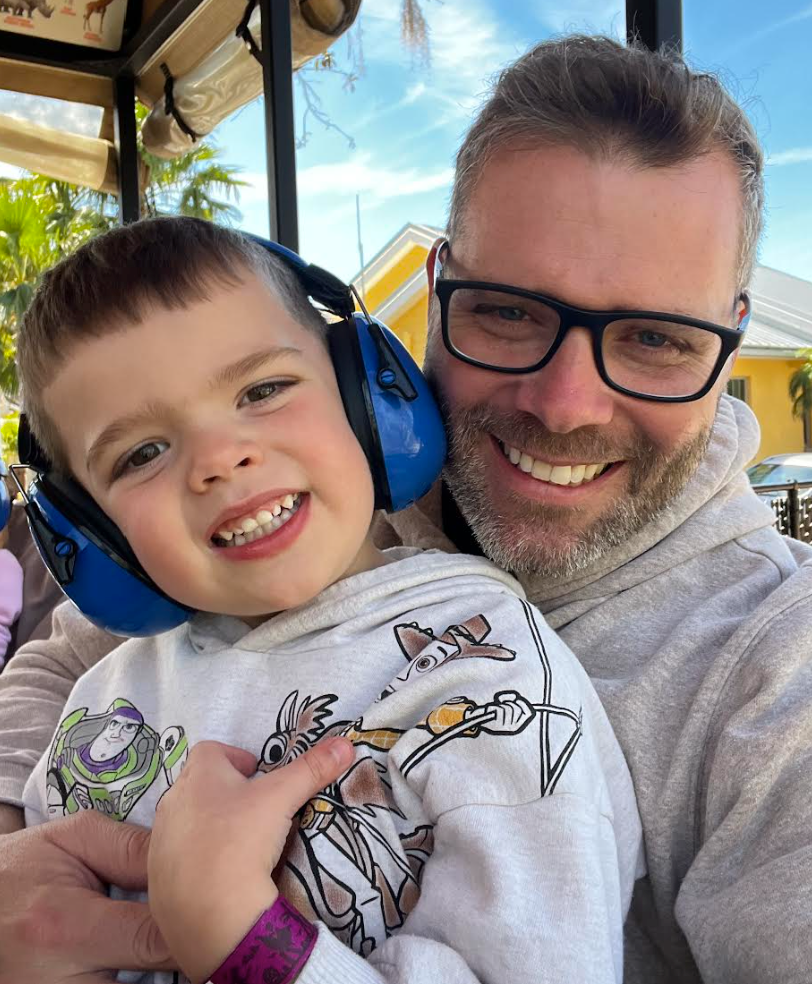
VizyPlan was built by an autism dad who sat on his living room floor and needed something that did not exist. Now it does. Start your free trial and give your child the tools to see their day and navigate it with confidence.