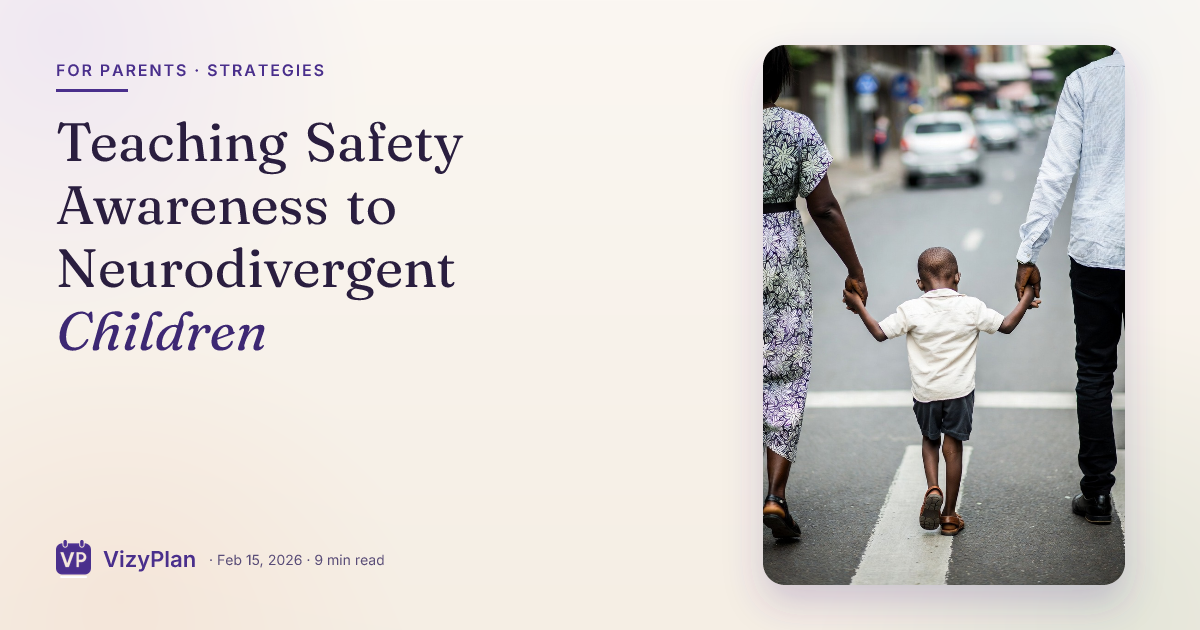
Teaching safety to neurodivergent children keeps parents up at night. The stakes feel impossibly high. You know your child may not recognize danger the way neurotypical peers do. They may run into a parking lot without looking. They may wander away from you in a crowded place. They may trust a stranger without hesitation. They may not know what to do in an emergency.
The statistics reinforce these fears. Research from the National Autism Association reports that wandering, also called elopement, affects nearly half of children with autism, with a significant percentage experiencing potentially life-threatening situations as a result. Children with ADHD face elevated risk of accidental injury due to impulsivity and reduced danger awareness.
The good news is that safety skills can be taught effectively to neurodivergent children. The approach needs to be more visual, more repetitive, more concrete, and more practiced than typical safety instruction, but the outcomes can be genuinely protective. Your child can learn to be safer in the world.
Why Safety Awareness Is Different
Understanding why standard safety instruction falls short for neurodivergent children helps you teach more effectively.
Abstract danger is hard to understand. "Strangers can be dangerous" is an abstract concept. For concrete thinkers, this instruction is confusing: the grocery store cashier is a stranger but is clearly not dangerous. The mail carrier is a stranger but comes to the house every day. Without concrete, specific rules, abstract safety warnings do not translate into protective behavior.
Impulsivity overrides knowledge. A child with ADHD may know the rule about looking both ways before crossing the street but be unable to stop themselves from chasing a ball into the road. The gap between knowing a safety rule and being able to follow it in the moment of impulse is a real and dangerous vulnerability.
Social processing differences affect stranger awareness. Some autistic children have difficulty reading social cues that signal danger. They may not detect the "off" feeling that neurotypical children get from an unsafe adult. Conversely, some autistic children may be overly trusting because social scripts they have learned ("Be polite to adults") override situational safety awareness.
Sensory seeking can create danger. A child drawn to the sensory experience of running water may approach a pool or stream without recognizing the drowning risk. A child who loves the feeling of spinning may climb to dangerous heights for vestibular input. The sensory drive can be stronger than the cognitive understanding of risk.
Elopement is driven by multiple factors. Children may wander toward something that interests them (a body of water, a favorite store, a dog), away from something distressing (a sensory trigger, a social demand), or simply due to the impulse to move without a destination in mind. Understanding your child's specific elopement triggers is essential for prevention.
Visual Safety Rules
Abstract safety rules need to be made concrete and visible.
Create visual safety rule cards. Each safety rule gets its own card with a picture and a simple statement:
- "Stop at the curb. Look left. Look right. Walk when clear." (with images of each step)
- "Stay with Mom/Dad in stores." (with an image of child near parent)
- "If lost, find a worker with a name tag." (with an image of a store employee)
- "Do not open the door for anyone when home alone."
Post rules where they apply. The road safety card goes near the front door. The kitchen safety rules go in the kitchen. The pool rules go near the swimsuit drawer. Context-specific placement reinforces the association between the rule and the situation.
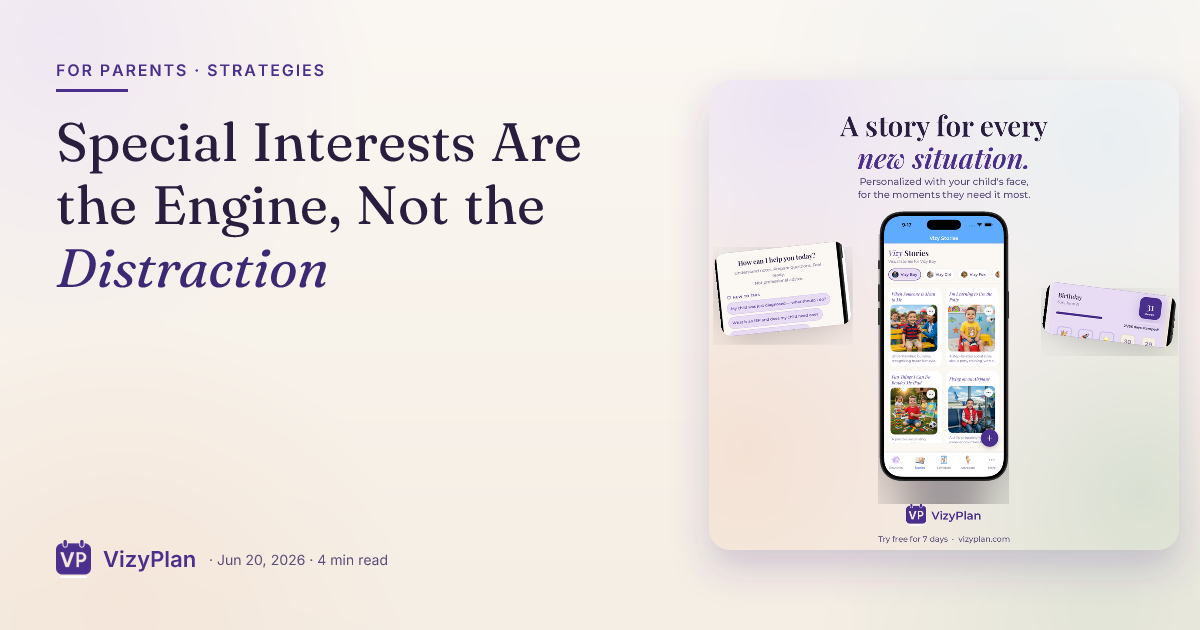
Use social stories for complex safety scenarios. VizyPlan's social story feature lets you create personalized narratives about safety situations. A story about what to do if your child gets separated from you in a store, complete with AI-generated images showing your child in a familiar store setting, makes the scenario concrete and rehearsable.
Teaching Road Safety
Road and traffic safety requires specific, repeated instruction.
Practice at real intersections. Standing at a crosswalk and physically practicing the sequence, stop, look left, look right, look left again, walk when clear, builds the motor routine alongside the cognitive rule. Verbal instruction alone is insufficient. The body needs to learn the pattern.
Use visual crossing sequences. Create a step-by-step visual card your child can reference. Over time, the external visual support becomes internalized as an automatic routine. VizyPlan's visual schedule format works well for this type of sequential instruction.
Teach traffic light meanings with visuals. Red means stop (picture of a child standing still). Green means go (picture of a child walking). Yellow means wait (picture of a child stopping). These visual associations are more reliable for concrete learners than verbal rules alone.
Practice in low-stakes environments first. Empty parking lots, quiet residential streets, and sidewalk paths all provide opportunities to practice road safety without the immediate danger of heavy traffic.
Address impulsivity directly. For children with ADHD, add a physical anchor to the road safety routine. "Put your hand on my arm before we cross" or "Touch the crossing button and count to three before stepping off the curb" adds a physical action that interrupts the impulse to dart into the street.
Stranger Safety for Concrete Thinkers
Reframe "stranger danger" into specific, actionable rules.
Replace "stranger danger" with a safety network concept. Instead of teaching your child that all strangers are dangerous (which is confusing and not actually true), build a visual "safety network" showing specific people your child can go to for help: parents, grandparents, teachers, specific neighbors. Anyone not on the network is "someone I do not go with."
Teach the "check first" rule. Before going anywhere with anyone, your child checks with a parent first. This simple, concrete rule is easier to follow than evaluating whether someone is safe. Practice the script: "I have to check with my mom/dad first."
Role-play specific scenarios. "What do you do if someone you do not know offers you candy?" Practice the response physically: shake head, say "No thank you," walk to a safe person. Repeated rehearsal builds automatic responses that do not require in-the-moment decision-making.
Teach body autonomy. "Your body belongs to you. No one touches you in ways that make you uncomfortable. If someone does, tell a safe person." Use visual supports showing the difference between safe touches (high fives, handshakes when you want them) and unsafe touches. Social stories about body boundaries are an effective tool for this sensitive topic.
Emergency Preparedness
Preparing for emergencies requires specific, practiced routines.
Teach your child their full name, address, and a parent's phone number. For non-speaking or minimally speaking children, consider an identification bracelet or a laminated card they carry. Practice reciting this information regularly until it is automatic.
Create visual fire safety routines. A step-by-step visual showing: hear the alarm, leave what you are doing, go to the door, feel the door (if hot, use another exit), go to the meeting spot. Practice this as a family regularly, just as schools run fire drills.
Practice calling emergency services. Use an old phone to practice dialing the emergency number and stating their name and address. Some children benefit from a visual script posted near the phone.
Establish a meeting spot. A specific, visible location outside your home where the family gathers during any emergency. Include this spot in your visual safety rules and reference it regularly.
Preventing Elopement
For families where wandering is a concern, prevention and preparation are both essential.
Identify triggers. Using VizyPlan's tracking features, log when and why elopement attempts happen. Is your child drawn to water? Do they run when overwhelmed? Do they wander when they see something interesting through a window? Understanding the trigger informs the prevention.
Secure the environment. Door alarms, window locks, fencing, and GPS tracking devices provide physical safeguards while you work on teaching safety awareness. These are not punishments. They are protective measures similar to childproofing a home for a toddler.
Teach "stop" as a safety command. Practice responding to the word "stop" as an immediate freeze response. Turn it into a game during calm moments (red light, green light) to build the automatic response that could prevent a dangerous situation.
Alert neighbors and community. Let nearby neighbors, local police, and school staff know that your child may wander and provide a description and photo. Many communities have programs specifically designed to support families of children prone to elopement.
Safety awareness is a lifelong learning process for all children, and neurodivergent children may need longer, more intensive instruction with more visual support. But every safety skill learned is a layer of protection that increases your child's ability to navigate the world more safely.

Download VizyPlan and start your 7-day free trial today. Create visual safety rules, social stories about emergency preparedness, and trackable routines that build your child's safety awareness over time. If it helps, keep going for $6.99/month or $59.99/year.