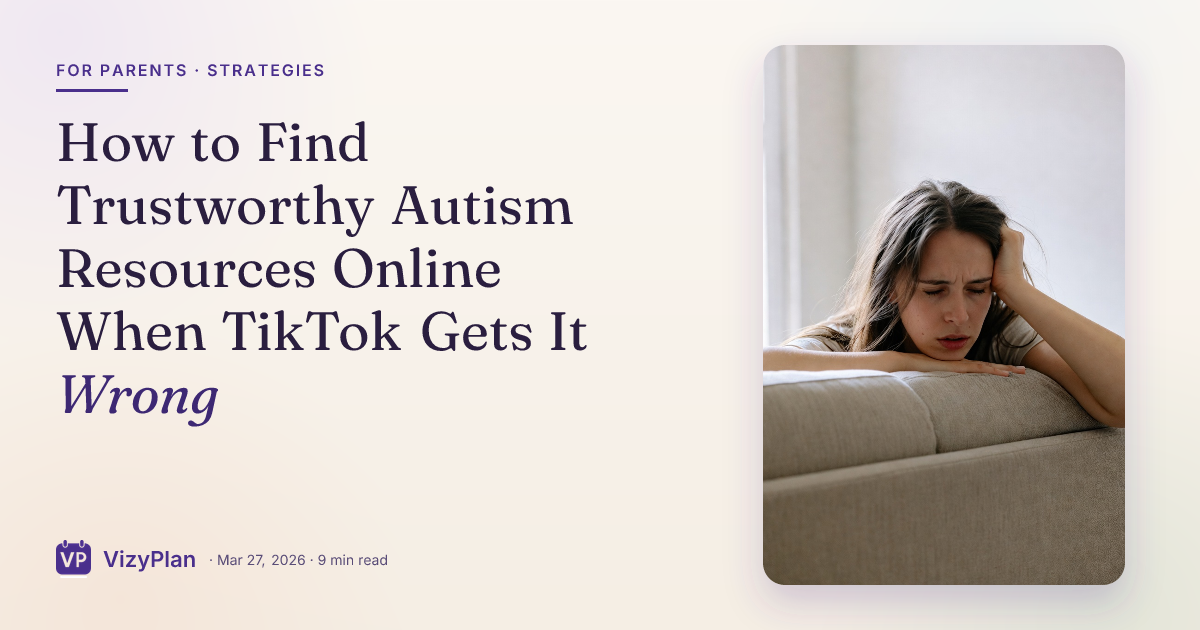
You are scrolling at midnight again. Your child was just diagnosed, or maybe you have been living this life for years but something new came up that you do not know how to handle. So you open TikTok. Or Instagram. Or you fall into a Facebook group where someone swears that a supplement changed everything for their kid.
Within ten minutes you have watched a video claiming a specific diet cures autism, another one listing "signs your therapist is gaslighting you," and a third promoting a detox spray that supposedly removes toxins causing your child's behaviors. The videos are confident. The comments are full of parents saying "this changed our lives." And you are left wondering whether you have been doing everything wrong.
You are not the only parent in this position. And the confusion you feel is not a personal failing. It is the predictable result of platforms that reward confidence over accuracy and engagement over evidence.
The Scale of Autism Misinformation Online
The numbers are worse than most parents realize.
A 2023 study from Drexel University's A.J. Drexel Autism Institute examined the top 133 informational TikTok videos about autism. These videos had a combined reach of 198.7 million views and 25.2 million likes. Of those videos, only 27 percent were classified as accurate. Forty-one percent were inaccurate. The remaining 32 percent were overgeneralized, meaning they took a kernel of truth and stretched it beyond what the evidence supports.
The most alarming finding was this: there was no significant difference in engagement between accurate and inaccurate videos. A video spreading false information about autism gets just as many likes, shares, and comments as one sharing real, evidence-based guidance. The algorithm does not care about accuracy. It cares about watch time.
A 2026 cross-platform analysis found that TikTok had the highest misinformation rate for autism content at 41 percent, compared to 22 percent on YouTube and just under 15 percent on Facebook. Neurodivergence content, including autism and ADHD, contained higher levels of misinformation than any other mental health topic studied.
And when CBC Marketplace analyzed 100 TikTok videos specifically about autism treatments, they found that approximately 80 percent featured treatments or cures that are not supported by science. Those videos had accumulated over 75 million views. The creators were often not medical professionals. They were parents sharing personal experiences, influencers promoting products, or self-proclaimed experts with no clinical credentials.
Why Social Media Misinformation Is So Convincing
Understanding why this content feels trustworthy helps you build defenses against it.
Personal stories are powerful. When a parent looks into the camera and says "this supplement changed my child's life," it hits differently than reading a clinical study. Our brains are wired to trust narratives, especially emotional ones from people who look like us and share our struggles. But a single family's experience, however genuine, is not evidence that something works. It is an anecdote. And anecdotes are where most misinformation takes root.
The algorithm creates echo chambers. TikTok's recommendation system learns what keeps you watching. If you engage with one video about an alternative autism treatment, the algorithm serves you ten more. Within days, your entire feed can become a curated reality where a fringe idea looks like mainstream consensus. You are not seeing the full picture. You are seeing what the algorithm calculated would keep you scrolling.
Credentials are easy to fake or misrepresent. Someone calling themselves a "holistic autism specialist" or "neurodivergent coach" may have no clinical training whatsoever. There is no credentialing body for most of these titles. A real Board Certified Behavior Analyst (BCBA), licensed psychologist, speech-language pathologist, or occupational therapist has years of supervised clinical education. The person on TikTok with 500,000 followers may have a ring light and strong opinions.
Desperation is a vulnerability. Parents of neurodivergent children are often exhausted, overwhelmed, and searching for anything that might help. That emotional state makes people more susceptible to promises of quick fixes or simple solutions. Misinformation marketers know this. They use emotional appeals, urgency, and the language of hope to sell products and ideas that have no scientific backing.
The Real Dangers of Bad Autism Advice
This is not just about being wrong on the internet. Bad information leads to real harm.
Dangerous treatments get promoted as cures. Chelation therapy, which claims to remove heavy metals from the blood and "cure" autism, has been promoted widely on social media despite having no evidence of effectiveness for autism. In 2005, a five-year-old boy died after receiving chelation therapy. More recently, "autism detox" products containing zeolite, a mineral compound sold as sprays, tinctures, and powders, have gone viral on TikTok with claims of curing autism. The Association for Science in Autism Treatment (ASAT) has warned that these products have no published data supporting their use and carry real health risks.
Families delay evidence-based interventions. When parents spend months pursuing an unproven treatment they discovered on social media, their child is not receiving the therapies that research has actually validated. Early intervention matters. Every month counts during critical developmental windows. Time spent chasing a TikTok miracle is time not spent on approaches that decades of research support.
It fuels stigma and misunderstanding. A 2025 study published in the Journal of Autism and Developmental Disorders found that 88.5 percent of autism-related TikTok content contained stigmatizing messages. When the most-watched autism content frames it as something to be cured, fixed, or feared, it shapes how the broader public views your child. That affects everything from school inclusion to neighborhood acceptance to how extended family members respond.
It undermines trust in real professionals. After watching enough social media content claiming that therapists are "masking your child" or that ABA is always harmful, parents may approach their child's actual care team with suspicion rather than partnership. The nuanced reality, that some therapy approaches work better for some children than others and that good practitioners continuously adapt, gets lost in the black-and-white framing that social media rewards.
Red Flags That Should Make You Pause
Not every piece of autism content online is bad. But these warning signs should trigger your skepticism immediately.
Anyone claiming to cure autism. There is no cure for autism. Autism is a neurological difference, not a disease. Any product, protocol, or program that promises to cure, reverse, or eliminate autism is not telling the truth. Full stop.
Results that sound too good to be true. "My nonverbal child started speaking sentences after three days on this supplement." "This one technique eliminated all meltdowns." Real progress with neurodivergent children is gradual, inconsistent, and deeply individual. Dramatic overnight transformations should be met with extreme skepticism.
No peer-reviewed research cited. Credible information about autism treatment comes from studies published in peer-reviewed journals, meaning other researchers evaluated the methodology and findings before publication. If someone is making treatment claims without citing published research, you are hearing their opinion, not established science.
The source cannot be corroborated. If a claim appears on a single blog, social media account, or website and you cannot find it discussed anywhere else, including by established research or medical organizations, that is a significant red flag. Legitimate findings are replicated, discussed, and built upon by multiple independent sources.
Aggressive emotional marketing. Watch for language designed to trigger fear or guilt: "doctors do not want you to know this," "the one thing you are doing that makes autism worse," "I wish someone had told me sooner." These phrases are marketing techniques, not health information.
The creator is selling something. Does the video end with a link to purchase a supplement, course, or program? Financial incentive does not automatically make information wrong, but it should make you more cautious. Ask yourself whether the information would be different if there was no product attached to it.
Where to Find Information You Can Trust
Building a personal library of reliable sources is one of the most protective things you can do as a parent.
Federal and Research Organizations
The National Institute of Child Health and Human Development (NICHD) researches autism causes, early signs, and intervention approaches. Their website provides parent-friendly summaries of current research without the spin.
The Interagency Autism Coordinating Committee (IACC) coordinates autism research and services across federal agencies and maintains a comprehensive directory of vetted organizations and resources.
The Centers for Disease Control and Prevention (CDC) offers developmental milestone tracking, screening information, and intervention guidance based on the latest research.
Enjoying this article?
Get practical tips and insights delivered to your inbox — no spam, ever.
Science-Based Nonprofits
The Association for Science in Autism Treatment (ASAT) is one of the most valuable resources most parents have never heard of. They have evaluated over 400 purported autism treatments and provide evidence-based ratings for each one. Before you try anything you found online, search the ASAT website first. Their resources are free, backed by organizations like Johns Hopkins School of Education and the Behavior Analyst Certification Board, and written for families.
The Organization for Autism Research (OAR) is parent-led and science-based. Founded and run by parents and grandparents of autistic individuals, they fund research and translate findings into practical resources families can actually use.
The Autism Science Foundation focuses exclusively on funding and communicating autism research, providing a reliable filter between complex studies and family-friendly information.
Professional Associations
The American Speech-Language-Hearing Association (ASHA) provides resources on communication development and therapy approaches backed by clinical evidence.
The American Occupational Therapy Association (AOTA) offers guidance on sensory processing, daily living skills, and practical strategies supported by occupational therapy research.
The American Academy of Pediatrics (AAP) publishes clinical guidelines on autism screening, diagnosis, and treatment that reflect the current medical consensus.
Evaluating Your Child's Own Providers
The most trustworthy source of guidance for your specific child is a qualified professional who knows them. Licensed psychologists, BCBAs, speech-language pathologists, and occupational therapists have completed years of supervised education and clinical training. When you have questions about something you saw online, bring it to your child's providers. A good clinician will not dismiss your question. They will help you evaluate the claim using the evidence that actually exists.
If you are still searching for the right therapist for your child, prioritize providers who explain their reasoning, cite evidence, and welcome your questions rather than those who promise guaranteed outcomes.
How to Evaluate Autism Content in Real Time
You do not need a research degree to vet information. Use this quick checklist when you encounter autism advice online.
Check the creator's credentials. Are they a licensed professional in a relevant field? Can you verify their license? A real BCBA, SLP, OT, or psychologist will typically list their credentials and license number. If there are no verifiable credentials, weight the information accordingly.
Look for the research. Does the post or video cite specific studies? Can you find those studies on PubMed, Google Scholar, or the ASAT treatment database? If there is no research cited, or if the cited research does not actually say what the creator claims, that is your answer.
Check if healthcare professionals made it. The Drexel study found that TikTok videos created by healthcare professionals were significantly more likely to contain accurate information. Content from clinicians is not automatically perfect, but it is a better starting point than content from someone with no clinical background.
Search for the claim on trusted sites. Take the specific claim, such as "zeolite treats autism" or "casein-free diet reverses autism symptoms," and search for it on ASAT, NICHD, or the AAP website. If trusted organizations have not validated the claim, or actively warn against it, that tells you what you need to know.
Wait before acting. The most protective habit you can build is pausing before implementing anything you learned from social media. Give yourself 48 hours. Use that time to research the claim through the sources listed above. Talk to your child's care team. The urgency you feel after watching a compelling video is manufactured by the platform. Real evidence-based approaches will still be valid in two days.
Social Media Is Not All Bad
It is important to acknowledge that social media also provides genuine value for many autism families.
The #ActuallyAutistic community on TikTok and Instagram has given autistic adults a platform to share their lived experiences in ways that help parents understand their children's inner worlds. Hearing an autistic adult explain what sensory overload actually feels like, or why transitions are so hard, or what it means when your child stims, can be profoundly helpful. Lived experience is not the same as clinical evidence, but it is valuable context that clinical research alone cannot provide.
Online parent communities offer emotional support that is genuinely hard to find elsewhere. When you are up at 2 AM after a brutal day and you need someone who understands without explanation, a Facebook group of parents living the same reality can be a lifeline. The isolation of raising a neurodivergent child is real, and online community helps.
The key is learning to separate community support and lived experience from medical and treatment advice. A parent sharing that weighted blankets helped their child sleep is a helpful data point worth discussing with your OT. That same parent claiming weighted blankets cure autism is misinformation. The line matters.
Building Your Information Filter
Over time, you can train yourself to navigate online autism content with confidence. Here is how.
Curate your feed intentionally. Follow accounts run by licensed professionals who cite their sources. Follow autistic self-advocates whose perspectives broaden your understanding. Unfollow or mute accounts that consistently promote unproven treatments or use fear-based marketing. Your algorithm reflects your behavior, so teach it what you actually want to see.
Create a trusted source list. Bookmark the organizations listed in this post. When you encounter a new claim, make it a habit to check those sources before you change anything about your child's care. Over time, this becomes second nature.
Talk to other parents with a critical lens. Parent communities are invaluable for emotional support, practical tips, and the kind of "been there" wisdom that professionals sometimes lack. But when another parent recommends a treatment or approach, apply the same evaluation framework you would use for a TikTok video. Ask what evidence supports it. Check the trusted sources. And remember that what worked for one child may not work for yours because every neurodivergent child is genuinely different.
Keep your child's providers in the loop. When you find something interesting online, bring it to your next therapy session or IEP meeting. Your child's BCBA, therapist, or pediatrician can help you evaluate whether it has merit for your specific child. This turns social media from a source of anxiety into a conversation starter.
Document what actually works. The best defense against misinformation is having your own data. When you track your child's routines, emotions, and progress over time, you build an evidence base that is specific to your child. You stop needing a stranger's anecdote to feel confident because you have your own information telling you what is actually making a difference.
You Are Already Doing the Hard Part
The fact that you are reading this post, that you are trying to find trustworthy information, that you are questioning what you see online rather than blindly following it, means you are already doing the most important thing. You are thinking critically about what your child needs.
Your child does not need a parent who has read every study ever published. They need a parent who knows where to look when questions come up, who can tell the difference between a sales pitch and real guidance, and who trusts their own observations enough to bring them to the professionals who know their child best.
The information is out there. The good kind. You just have to know where to find it.
VizyPlan helps you build evidence-based visual routines, track your child's progress with real data, and stay grounded in what actually works for your family. Start your free trial and replace the noise with tools designed by a parent who gets it.