

You have the diagnosis. Maybe it is autism, ADHD, or both. Your pediatrician hands you a list of recommended therapists and says something like, "You will want to get on some waitlists." And just like that, you are standing at the beginning of a process that feels overwhelming before it even starts.
Which type of therapy does your child actually need? How do you tell a great therapist from a mediocre one? What questions should you ask? And how do you navigate waitlists that stretch months or even years?
These are not small questions. The therapist your child works with will shape their development, their self-image, and your family's daily life. Getting this right matters. The good news is that you do not need a clinical degree to make an informed choice. You need the right framework.

Understanding What Each Therapist Does
Before evaluating individual providers, it helps to understand what each type of therapy addresses and when your child might need it.
Occupational Therapists (OTs) help children develop skills for daily living. This includes fine motor skills like handwriting and using utensils, sensory processing challenges, self-regulation, dressing, feeding, and play skills. If your child struggles with textures, has difficulty getting dressed independently, melts down in noisy environments, or avoids certain types of touch, an OT is often the first referral. The American Occupational Therapy Association (AOTA) oversees professional standards and continuing education. For more on sensory processing and daily routines, read our guide on supporting sensory processing needs through daily routines.
Speech-Language Pathologists (SLPs) work on verbal and non-verbal communication. This goes far beyond "learning to talk." SLPs help children express needs, engage in conversation, understand language, develop social communication skills, and learn to use augmentative and alternative communication (AAC) devices when appropriate. If your child has delayed speech, difficulty following multi-step directions, struggles with social conversation, or is non-speaking, an SLP is essential. The gold-standard credential is ASHA's Certificate of Clinical Competence (CCC-SLP), which requires a master's degree, 1,260 hours of supervised clinical fellowship, and passing the Praxis exam.
Board Certified Behavior Analysts (BCBAs) specialize in Applied Behavior Analysis (ABA), focusing on teaching new skills and reducing challenging behaviors through systematic interventions. BCBA certification requires a master's degree plus approximately 1,500 hours of supervised fieldwork and a board exam. However, your child's day-to-day therapy is often delivered by Registered Behavior Technicians (RBTs) who have far less training. Always ask about supervision ratios and how often a BCBA directly observes sessions.
Physical Therapists (PTs) address gross motor coordination, balance, muscle tone, and movement planning. Research shows that motor skill difficulty affects up to 83% of children with autism. If your child seems clumsy, avoids playground equipment, has difficulty with stairs, or struggles with ball skills, a PT evaluation is worth pursuing. Studies show individualized physiotherapy programs significantly improve coordination and movement skills, with benefits extending to social participation and educational engagement.
Developmental-Behavioral Pediatricians are MDs who complete three additional years of specialty training beyond general pediatrics. They diagnose complex developmental conditions, coordinate care across multiple providers, and can prescribe medication. Waitlists for developmental pediatricians average 9 months to 2 years across the United States.
Psychologists and Neuropsychologists conduct comprehensive evaluations, provide cognitive behavioral therapy (CBT), and address co-occurring mental health conditions like anxiety and depression. They perform standardized assessments that help tease apart overlapping conditions, which is particularly valuable when your child's presentation does not fit neatly into one diagnostic category.
The Waitlist Reality
Before diving into how to evaluate therapists, it is important to understand the access landscape so you can plan strategically.
The numbers are sobering. According to a survey of U.S. autism specialty centers, 61% had diagnostic evaluation wait times longer than 4 months. Twenty-five percent had waitlists exceeding 6 months. Twenty-one percent had waitlists over one year or were closed entirely to new referrals.
For specific therapies, ABA waitlists average 5.7 months. Parents report OT waitlists stretching up to 2 years and speech therapy waitlists of approximately 6 months in many regions.
What this means practically:
- Get on multiple waitlists simultaneously. You can always decline when a spot opens if you have already found a good fit.
- Ask to be placed on cancellation lists for earlier openings.
- Consider telehealth options while you wait. A systematic review found that telehealth therapy services were at least equivalent to in-person services for autistic children and their families, particularly for ABA, speech therapy, and parent coaching.
- Look into your state's early intervention program (Part C of IDEA) for children under 3, as these programs often have shorter wait times than private providers.
- Do not wait for a formal diagnosis to request evaluations. Many therapists will evaluate and begin services based on developmental concerns alone.
What to Look For: Green Flags
Not all therapists are created equal, even among those with the right credentials. Research and clinical best practices point to specific qualities that distinguish effective providers.
They ask about your child's strengths, not just their deficits. A therapist who opens the conversation with "What does your child enjoy? What are they good at?" is operating from a strengths-based framework. Research consistently shows that building on existing strengths produces better outcomes than focusing exclusively on remediation.
They presume competence. This means assuming your child can learn, think, and understand, even when they cannot yet demonstrate it through typical behaviors. A therapist who talks to your child (not about them as if they are invisible) and adjusts their communication style rather than lowering their expectations is showing this principle in action.
They involve your child in goal-setting. Even young children can contribute to identifying what they want to work on. A therapist who asks a 6-year-old, "What is hard for you that you wish was easier?" is building self-awareness and self-advocacy alongside clinical skills. For more on fostering these abilities, read our guide on teaching self-advocacy skills to your neurodivergent child.
They use data to track progress. Good therapists collect systematic data on your child's performance, share it with you regularly, and adjust their approach based on what the data shows. If a therapist cannot tell you, in concrete terms, how your child is progressing toward specific goals, that is a problem.
They coordinate with your child's other providers and school. Your child's therapists should communicate with each other and with the school team. A siloed approach, where the OT does not know what the SLP is working on and neither talks to the teacher, wastes everyone's time and limits progress. For a deeper look at provider coordination, see our guide on collaborating with providers for IEP meetings and therapy.
They teach you strategies to use at home. The most effective therapy extends beyond the session. A therapist who coaches you on how to reinforce skills during daily routines multiplies the impact of every session. Research on parent-mediated interventions shows significant improvements in language development and reduced parenting stress compared to standard community interventions.
They are transparent about what they do and why. You should never feel confused about what is happening in your child's sessions. A good therapist explains their methods, welcomes your questions, and adjusts when something is not working.
What to Watch For: Red Flags
Equally important is knowing when to trust your instincts that something is wrong.
They insist on eye contact as a therapy goal. Forcing eye contact is uncomfortable or painful for many autistic individuals. Research from the neurodiversity-affirming therapy community identifies this as a practice rooted in making autistic children appear neurotypical rather than supporting genuine communication.
They pathologize stimming. Stimming (self-stimulatory behavior like hand-flapping, rocking, or spinning) serves important regulatory functions. A therapist who treats all stimming as a behavior to eliminate rather than understanding its purpose is operating from an outdated framework. The exception is stimming that causes physical harm, which may need redirection.
They use a one-size-fits-all approach. If the therapy plan looks the same for every child on the caseload, it is not individualized. Your child's therapy should reflect their specific profile, interests, sensory needs, and goals.
They do not honor your child's "no." Ethical therapists respect autonomy. A child who consistently refuses an activity is communicating something important. The right response is to explore why, not to override their resistance.
They collect no data or refuse to share progress information. If you ask how your child is doing and get vague answers like "They are making good progress" without specifics, you have no way to evaluate whether the therapy is actually working.
They will not coordinate with other providers. Therapy does not happen in isolation. A provider who refuses to communicate with your child's school, other therapists, or pediatrician is limiting your child's care.
They make you feel unwelcome in sessions. You should be able to observe therapy sessions. A therapist who consistently discourages your presence or becomes defensive when you ask questions is not treating you as the equal partner you are in your child's care.
An Honest Look at the ABA Debate
If your child has been diagnosed with autism, ABA therapy is likely one of the first recommendations you receive. It is also one of the most debated topics in the neurodivergent community, and you deserve a balanced understanding before making decisions.
What the research shows: A 2025 meta-analysis in the Review Journal of Autism and Developmental Disorders found that ABA-based interventions showed a large effect size for receptive language skills and moderate effect sizes for adaptive and cognitive skills. A 2022 meta-analysis in BMC Psychiatry found medium effects for intellectual functioning and adaptive behavior. Greater treatment duration and intensity were associated with greater improvements.
What the criticism says: The Autistic Self Advocacy Network and many autistic adults argue that traditional ABA focuses too heavily on making autistic children appear "indistinguishable from their peers," which can force harmful masking behaviors. A widely cited 2018 study by Kupferstein in Advances in Autism found that 46% of ABA-exposed respondents met the diagnostic threshold for PTSD, though this study has been criticized for methodological limitations. The U.S. Department of Defense's 2019 report on ABA outcomes for military families found that after one year, 76% of 16,000 participating children showed no measurable change. A 2021 follow-up improved to 57% showing statistically significant improvements.
Where this leaves you: Modern, neurodiversity-affirming ABA looks different from the ABA of decades past. The best practitioners use preference assessments, honor the child's choices, incorporate the child's interests, and set goals focused on functional independence and quality of life rather than neurotypical appearance. A 2025 publication in Societies examines how the field is integrating autistic voices into ABA practice.
If you pursue ABA, prioritize providers who:
- Set goals focused on communication, independence, and safety rather than compliance and appearance
- Never use punishment-based techniques
- Respect your child's right to say no and to stim
- Include your child's interests and preferences in every session
- Have a BCBA directly supervising sessions regularly, not just signing off on paperwork
Questions to Ask When Interviewing Therapists
Treat your first meeting as a mutual interview. You are evaluating them as much as they are assessing your child.
About their approach:
- "How do you tailor therapy to each child's individual needs?"
- "What is your experience specifically with children who have autism/ADHD/my child's diagnosis?"
- "How do you incorporate my child's interests into sessions?"
- "How do you handle it when a child refuses an activity?"
- "Are you familiar with the neurodiversity paradigm, and how does it inform your practice?"
About goals and progress:
- "How will we set goals together, and will my child be included in that process?"
- "What data do you collect, and how often will you share progress reports with me?"
- "What does a successful outcome look like to you?"
- "How do you decide when to adjust the treatment plan?"
About qualifications and logistics:
- "What are your credentials and specialized training?"
- "For ABA: How often does a BCBA directly observe my child's sessions?"
- "Do you coordinate with school teams and other providers?"
- "What insurance do you accept, and what will my out-of-pocket costs be?"
- "Do you have a waitlist, and can I be placed on a cancellation list?"
- "Do you offer telehealth sessions?"
A therapist who welcomes these questions and answers them thoroughly is a good sign. One who becomes defensive or dismissive is telling you something important.
Navigating Insurance and Costs
Therapy is expensive, and understanding your financial options matters.
All 50 U.S. states plus D.C. have passed legislation requiring insurance companies to cover ABA therapy for autism. However, the details vary significantly by state, including age limits, dollar caps, and which therapy types are covered. Check your state's specific mandate through the National Conference of State Legislatures.
Typical costs without insurance:
- Intensive ABA therapy: $40,000 to $60,000 per year
- Speech therapy: $100 to $250 per session
- Occupational therapy: $100 to $200 per session
- Families with an autistic child face an average of $4,110 to $6,200 in additional annual medical expenses according to CDC estimates
Strategies to reduce costs:
- Verify your insurance covers the specific therapy type and provider before starting
- Ask about sliding scale fees, especially at university-affiliated clinics
- Look into your state's early intervention program (Part C of IDEA) for children under 3, which provides services at no cost or reduced cost
- Check if your school district offers related services through an IEP, as those are provided at no cost to families. For help navigating IEPs, read our guide on 504 Plans vs IEPs
- Explore nonprofit organizations that offer therapy scholarships or grants
- Consider parent-mediated therapy models. A 2024 study in JMIR Pediatrics found that parent-led ABA can lead to goal achievement and improved clinical outcomes while dramatically reducing costs
The Case for Starting Early
Research consistently supports earlier intervention, though "early" does not have to mean "intensive."
A 2023 study published in Autism found that toddlers randomized to early social interaction therapy at 18 months showed greater gains in receptive and expressive language than those starting at 27 months. The landmark Early Start Denver Model (ESDM) trial by Dawson et al. showed that children receiving intervention from ages 18 to 30 months gained an average of 17.6 IQ points compared to 7.0 points in the comparison group.
However, only 50% of children with ASD currently receive early intervention services before age 3. Children from higher-income families and non-Hispanic White families are significantly more likely to access early intervention, highlighting a persistent equity gap.
What this means for you: If your child is young and you suspect developmental differences, do not wait for a formal diagnosis to seek services. Many early intervention programs and therapists will begin working with your child based on documented developmental concerns. Every month of waiting is a month of missed opportunity during the period when the brain is most responsive to intervention.
If your child is older, do not despair. The brain remains plastic throughout childhood and beyond. Starting therapy at 5, 8, or 12 still produces meaningful improvements. "Earlier is better" does not mean "later is useless."
How to Know When It Is Working
Progress for neurodivergent children rarely looks like a straight line. Expect cycles of breakthroughs, apparent plateaus, and what may look like setbacks but is often the brain consolidating recent learning.
Signs therapy is working:
- Your child is making measurable progress toward specific goals, even if slowly
- Your child shows increased confidence, independence, or willingness to try new things
- Skills practiced in therapy are starting to appear at home and school
- Your child generally enjoys or tolerates sessions (some resistance is normal, consistent dread is not)
- The therapist can show you data demonstrating progress over time
Signs it might be time to change:
- No measurable progress toward goals after 3 to 6 months, despite the therapist adjusting their approach
- Your child consistently expresses dread, anxiety, or distress about sessions
- The therapist is not willing to modify strategies based on outcome data
- Communication with you has broken down
- Goals focus on making your child appear neurotypical rather than building functional skills
- You feel dismissed when you raise concerns
Tracking your child's daily patterns outside of therapy sessions helps you evaluate whether gains are generalizing. Tools like VizyPlan let you monitor your child's emotional responses, routine completion, and behavioral patterns over time, giving you concrete evidence to share with therapists and to inform decisions about whether therapy is producing real-world changes.
Bridging Therapy and Home Life
The most effective therapy happens when strategies are reinforced consistently between sessions. This does not mean turning your home into a clinic. It means building therapeutic goals into the rhythms of daily life.
If your child's OT is working on sensory regulation, you can create a visual routine at home that includes sensory breaks at predictable times. If your SLP is building expressive language, you can practice the same strategies during mealtime conversations or bedtime routines.
VizyPlan helps bridge this gap by letting you build personalized visual routines with AI-generated images of your child. When the same structure and visual language appears at home and in therapy, children internalize skills faster and transfer them between settings. You can share routine data with your child's therapy team so everyone is working from the same playbook.
Where to Start Today
If you are at the beginning of this process:
- Make a list of your child's biggest daily challenges. Where do they struggle most? Communication, sensory regulation, motor skills, behavior, daily living skills? This helps you prioritize which therapist to pursue first.
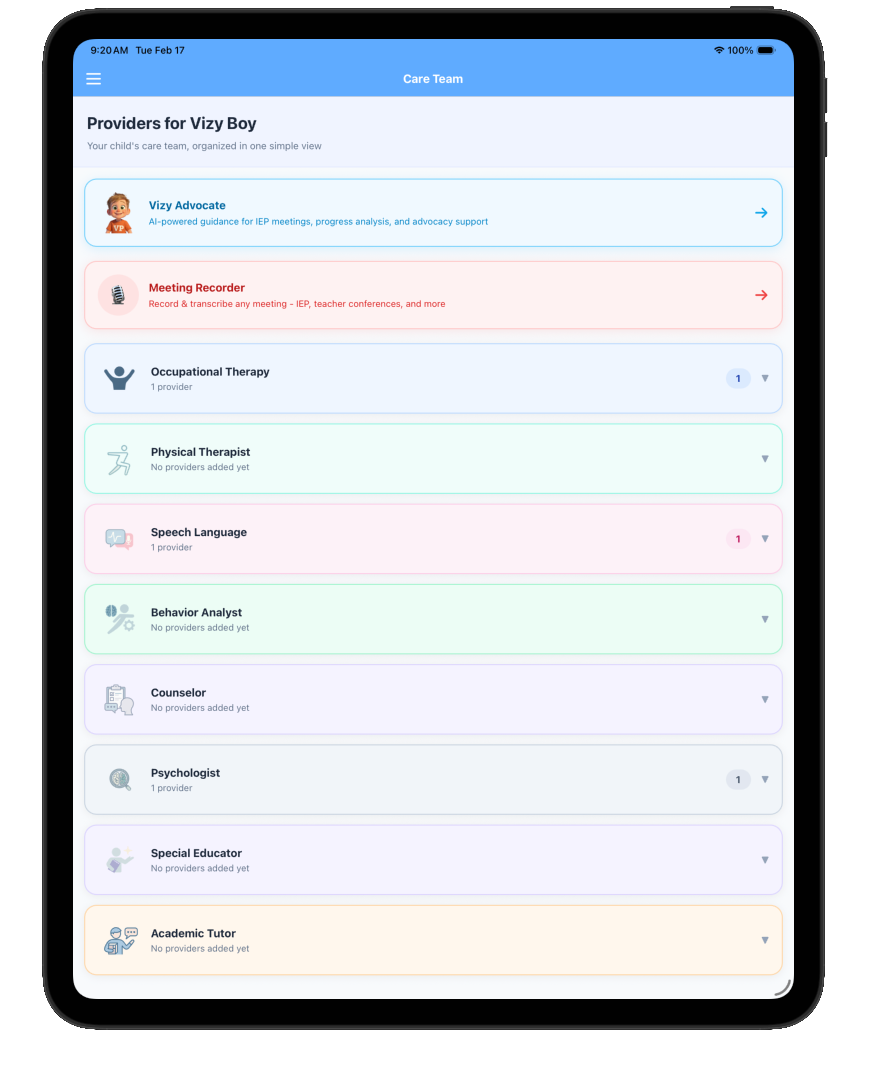
- Start documenting now. Track daily patterns, emotional responses, and what strategies help or do not help at home. VizyPlan makes this simple with built-in routine tracking and emotion monitoring. This documentation will be invaluable when you meet with potential therapists and when you attend IEP meetings.
- Get on waitlists today. Do not wait until you have "figured everything out." Call multiple providers, get on cancellation lists, and explore telehealth options to start sooner.
- Trust your instincts. You know your child better than any professional. A therapist's credentials matter, but so does the feeling you get when you watch them interact with your child. If something feels wrong, it probably is.
Finding the right therapist is not about finding a perfect person. It is about finding someone who sees your child as a whole person, who partners with you as an equal, and who measures success by your child's quality of life, not by how closely they approximate neurotypical behavior.
Download VizyPlan and start your 7-day free trial today. Track daily routines, monitor emotional patterns, and build the documentation that helps you collaborate effectively with your child's therapy team. If it helps, keep going for $6.99/month or $59.99/year.