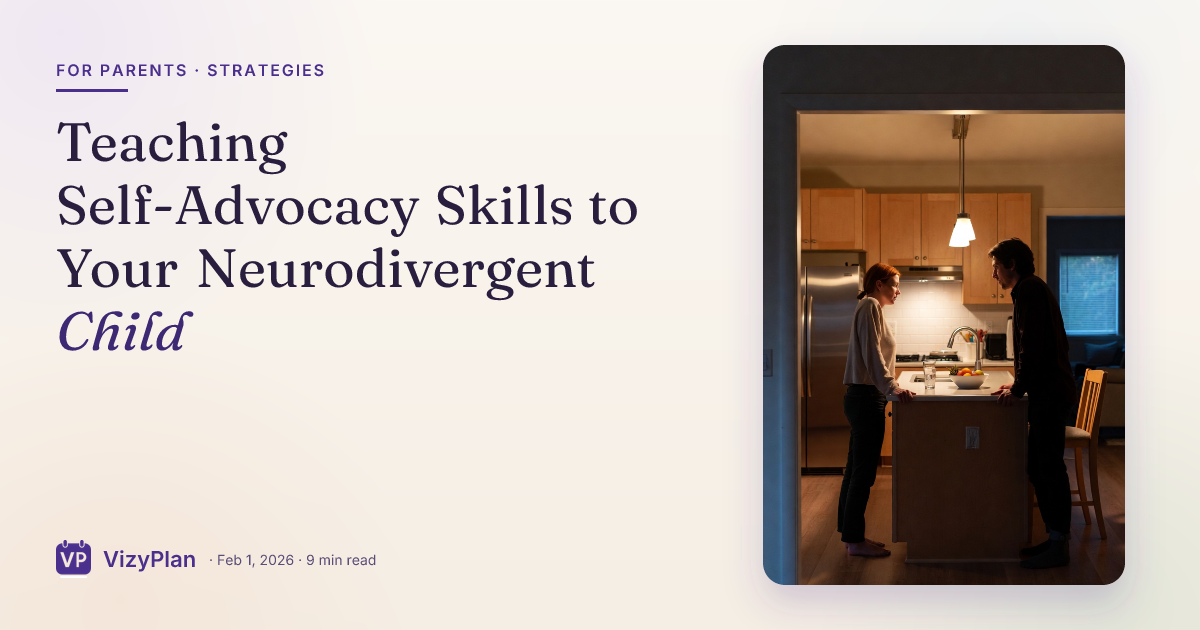
Your child sat through an entire class with a headache and never told the teacher. They ate a food at a friend's house that made them gag rather than say "no thank you." They endured a scratchy shirt all day because they did not know how to ask for a different one. They are suffering in silence, not because they do not have needs, but because they do not yet have the skills to voice them.
Self-advocacy, the ability to understand who you are and communicate what you need, does not come naturally for most neurodivergent children. It has to be taught, practiced, and reinforced. And the stakes could not be higher: children who learn to speak up for themselves become adults who can navigate workplaces, relationships, and healthcare systems on their own terms.
Why Self-Advocacy Matters for Neurodivergent Children
Research consistently shows that self-advocacy is one of the strongest predictors of positive outcomes for neurodivergent adults. People who can identify their needs and communicate them effectively are more likely to succeed in education, employment, and relationships.
But the benefits start long before adulthood.
Building confidence from the inside out. When a child successfully asks for what they need and gets a positive response, it reinforces a powerful message: "My voice matters." Over time, these small moments of agency build genuine self-confidence that no amount of external praise can replicate.
Reducing frustration and meltdowns. Many challenging behaviors stem from unmet needs that a child cannot articulate. A child who melts down at the grocery store may be overwhelmed by fluorescent lighting but lack the words or tools to say, "This is too bright for me." Teaching self-advocacy gives children a constructive path to express what they are experiencing before they reach a breaking point.
Creating long-term independence. The child who learns to say "I need a break" at age five becomes the teenager who can explain their accommodations to a teacher, and eventually the adult who can advocate for themselves in the workplace. Each stage builds on the last.
The disability rights movement gave us the phrase "Nothing about us without us." Teaching self-advocacy to our children honors that principle from the very beginning. We are not just helping them fit into the world. We are helping them shape it.
What Self-Advocacy Looks Like at Different Ages
Self-advocacy is not a single skill. It is a developmental progression that looks different at every stage.
Toddlers and preschoolers (ages 2 to 4): At this stage, self-advocacy might look like a child pointing to a picture card to indicate they want a break, pushing away a food they do not like, or choosing between two activities. The goal is not eloquent communication. It is building the understanding that they have preferences and those preferences are valid.
Early elementary (ages 5 to 7): Children can begin using simple scripts like "I need help" or "Can I have a turn?" They can start identifying basic emotions ("I feel frustrated") and connecting those feelings to situations. They may begin to understand that their brain works differently from some of their peers, and that this is okay.
Upper elementary (ages 8 to 10): This is when self-advocacy becomes more nuanced. Children can learn to explain their needs to teachers ("I focus better when I can stand at my desk"), participate in parts of their IEP meetings, and begin to understand their specific strengths and challenges. They can practice more complex communication scripts for peer interactions.
Tweens and beyond (ages 11+): Older children can take increasing ownership of their accommodations, learn to politely but firmly set boundaries, and begin to develop a positive neurodivergent identity. They can practice self-advocacy in community settings like extracurricular activities and eventually in job or volunteer contexts.
No matter where your child falls on this spectrum, the key is to meet them where they are and build from there.
Building Self-Understanding First
Here is something that often gets overlooked: self-advocacy requires self-understanding. A child cannot ask for what they need if they do not know what they need.
This is where intentional, everyday conversations and tools make a huge difference.
Start with sensory preferences. Help your child build awareness of their sensory world. Do they prefer dim lighting or bright rooms? Do certain textures bother them? Are they a child who seeks movement or one who prefers stillness? You can create a simple "sensory profile" together. Use pictures to identify things that feel good, things that feel bad, and things that are just okay.
Name their strengths. Neurodiversity-affirming approaches frame neurological differences as natural human variation, not deficits. Help your child understand what they are great at. Maybe they have an incredible memory for facts, a deep passion for specific topics, or an unusual ability to notice patterns. Knowing their strengths builds the confidence they need to also talk about their challenges.
Explore how their brain works. Age-appropriate conversations about neurodivergence help children develop a framework for understanding their experiences. You might say, "Your brain is wired to notice every sound in the room. That is a superpower sometimes, and sometimes it makes things feel overwhelming. Both of those things are true."
Tools like VizyPlan's emotion tracking features can be incredibly helpful here. When children regularly check in with their emotions using visual supports, they begin to notice patterns. "I always feel cranky after loud places." "I feel happy when I get to draw first thing in the morning." These insights become the raw material for self-advocacy.
Teaching Communication Scripts
Once children begin to understand their own needs, they need the language to express them. For many neurodivergent children, especially those who are non-speaking, minimally speaking, or who struggle with spontaneous language, visual scripts are a game-changer.
Visual scripts are pre-taught phrases or sequences, often paired with pictures, that children can use in specific situations. They take the pressure off having to generate language in the moment and provide a reliable framework for communication.
Essential self-advocacy scripts to teach:
- Requesting help: "I need help with this, please." (Paired with a visual of a child raising their hand or approaching an adult.)
- Asking for a break: "I need a break." or "My body needs to move." (Paired with a visual of a calm-down corner or movement activity.)
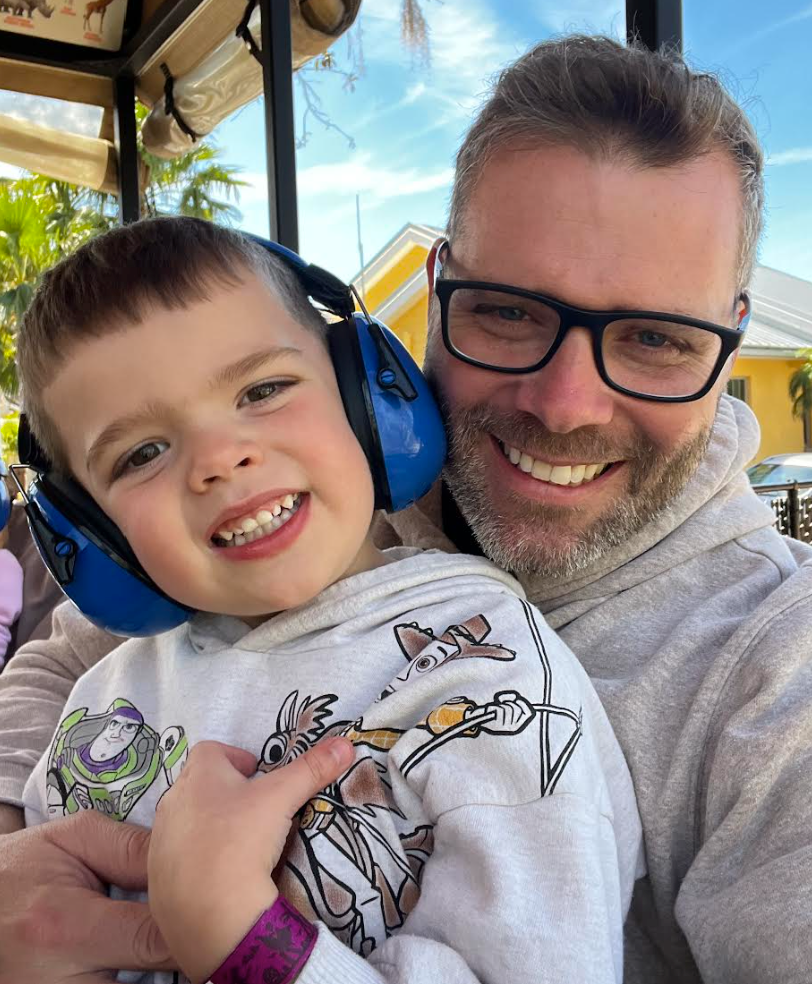
- Expressing sensory needs: "It is too loud for me." or "I need my headphones." (Paired with visuals of the sensory trigger and the solution.)
- Setting boundaries: "I do not want a hug right now." or "Please stop, I do not like that." (Paired with visuals showing personal space.)
- Asking for accommodations: "Can I sit in the quiet area?" or "I work better when I can use my fidget." (Paired with visuals of the accommodation.)
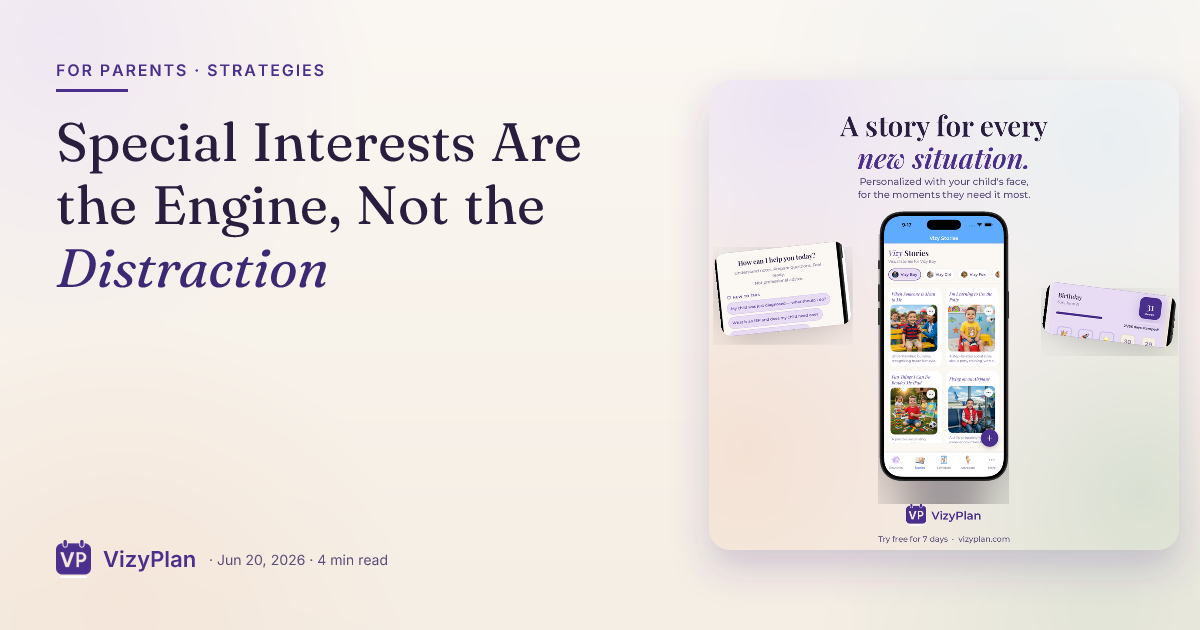
You can create these scripts using social stories that walk through the situation step by step. VizyPlan's social story feature, combined with AI-generated personalized images, lets you build scripts that feature your child in familiar settings. When a child sees themselves in the story, it becomes more meaningful and easier to internalize.
Practice these scripts the way you would practice any skill: frequently, in low-pressure moments, with lots of encouragement.
Practicing in Safe Environments
Knowing a script is one thing. Using it in real life is another. The bridge between the two is practice in safe, supportive environments.
Role-play at home. Set up common scenarios and practice together. You might pretend to be a teacher and have your child practice saying, "I need a break, please." Switch roles so they can see what it looks like from both sides. Keep it playful and low-stakes. Stuffed animals and action figures make excellent stand-ins for tricky social situations.
Use social stories before challenging situations. If your child has a field trip coming up, create a social story that walks through the day and includes moments where they might need to advocate for themselves. "If the museum is too loud, I can tell my teacher, 'I need to step into the quiet room.'" Reviewing the story beforehand gives your child a mental rehearsal that makes the real moment feel more familiar.
Create a visual schedule that includes advocacy checkpoints. Build moments into your child's daily routine where they practice making choices and expressing preferences. VizyPlan's visual schedule feature makes this easy to do. You might include a "check-in" step where your child identifies how they are feeling, or a "choice time" where they pick between two activities. These small, embedded moments of self-advocacy add up over time.
Celebrate the attempts, not just the outcomes. Research shows that children who practice advocacy in safe environments are more likely to generalize those skills to new settings. Every practice session, even an imperfect one, is building neural pathways and muscle memory for the real thing.
.png)
Emotion Literacy as a Foundation
Self-advocacy and emotion literacy are deeply intertwined. A child who can name what they are feeling is far better equipped to communicate what they need.
Start with the basics. Help your child identify and name the core emotions: happy, sad, angry, scared, surprised, and disgusted. Use picture cards, emotion charts, or apps with visual supports. VizyPlan's emotion tracking tools give children a visual way to check in with their feelings throughout the day, building familiarity and fluency over time.
Connect feelings to body sensations. Many neurodivergent children experience emotions intensely but struggle to identify them. Teaching body awareness helps bridge this gap. "When your stomach feels tight and your fists are clenched, that might be anger." "When your chest feels fluttery and you want to run, that might be anxiety." Body maps where children color in where they feel different emotions can be a powerful tool.
Link feelings to needs. This is the crucial step that turns emotion literacy into self-advocacy. Help your child see that feelings carry information. "You are feeling frustrated. What do you think would help right now?" Over time, children learn to make these connections independently. "I am feeling overwhelmed. I think I need some quiet time."
Expand the vocabulary. As children grow, help them move beyond basic emotion words to more nuanced ones. "Frustrated" is more useful than "mad." "Overstimulated" is more specific than "bad." The richer their emotional vocabulary, the more precisely they can communicate their needs.
Supporting Self-Advocacy at School
School is where self-advocacy skills get their biggest test. It is also where they matter most.
Start with the IEP or 504 team. If your child has an Individualized Education Program or a 504 plan, these meetings are natural opportunities to practice self-advocacy. Even very young children can participate in some way. A preschooler might choose a picture that represents their favorite part of school. An elementary student might share one thing that helps them learn. An older student can present their own strengths and accommodation needs.
Prepare your child before meetings. Use a visual schedule or social story to walk through what the meeting will look like, who will be there, and what your child might say. Practice key phrases like "I learn best when..." or "Something that is hard for me is..." The more prepared they feel, the more likely they are to participate.
Partner with teachers. Share your child's communication scripts with their teachers and support staff. Let them know what self-advocacy looks like for your child and how to respond when your child uses their scripts. A teacher who responds positively when a child says "I need a break" reinforces the skill far more effectively than one who says "Not right now."
Create a self-advocacy toolkit for school. This might include a small card with key phrases, a visual feelings chart in their binder, or a signal they can use with their teacher when they need something. The goal is to make advocacy accessible even in the structured, sometimes overwhelming environment of a classroom.
Celebrating Self-Advocacy Moments
When your child speaks up for themselves, that deserves recognition. Positive reinforcement strengthens the connection between advocacy and positive outcomes, making it more likely your child will advocate again in the future.
Be specific with your praise. Instead of "Good job," try "I noticed you told your brother you needed space. That was really brave and it helped you stay calm." Specific praise helps children understand exactly what they did well.
Use a reward system thoughtfully. For some children, a visual reward system can provide extra motivation during the learning phase. VizyPlan's reward system feature lets you set up personalized goals and track progress with visual tokens. You might create a goal around using advocacy scripts, with a small celebration when your child reaches a milestone.
Share advocacy wins with the family. At dinner or during a family meeting, highlight moments of self-advocacy you observed during the day. "Today your sister told her teacher she needed to sit in the quiet corner during reading time. That took a lot of courage." This normalizes advocacy and makes it a family value, not just a skill to practice.
Let your child see you self-advocate. Children learn by watching. Narrate your own self-advocacy moments: "I am going to ask the server if they can turn down the music. It is a little loud for me." Modeling shows children that advocacy is a normal, lifelong practice, not something only they have to do.
Building Self-Advocacy Skills with VizyPlan
Teaching self-advocacy is not a single conversation or a one-time lesson. It is a daily practice woven into the fabric of your child's routine. And that is exactly where VizyPlan can help.
With visual schedules, you can embed self-advocacy checkpoints into your child's day, giving them regular opportunities to check in with their feelings, make choices, and practice expressing their needs. The emotion tracking feature builds the emotional vocabulary that fuels self-advocacy, helping your child notice patterns and connect feelings to actions. Social stories with AI-generated personalized images let you create custom scripts for any situation your child might face, from asking for help at school to setting boundaries with a friend. And the reward system provides positive reinforcement that keeps your child motivated as they build these crucial skills.
Self-advocacy is one of the greatest gifts you can give your neurodivergent child. It says, "Your needs matter, your voice matters, and you are capable of speaking up for yourself." With patience, practice, and the right visual supports, every child can learn to be their own best advocate.
Ready to start building self-advocacy skills into your child's daily routine? Download VizyPlan today and try it free for 7 days. If it helps, keep going for $6.99/month or $59.99/year. Because every child deserves the tools to speak up for themselves.