If your child freezes at the door of a birthday party, melts down after 20 minutes at a friend's house, or begs not to go to the neighborhood barbecue, you are not alone. Social gatherings that seem effortless for other families can feel like navigating a minefield when you are raising a neurodivergent child.
But here is the thing: your child is not "bad at socializing." Their brain simply processes social environments differently. And with the right preparation, accommodations, and support, playdates and social gatherings can become genuinely enjoyable experiences for the whole family.
This guide will walk you through evidence-based, neurodiversity-affirming strategies for before, during, and after social events. Whether your child is autistic, has ADHD, sensory processing differences, or any combination, these approaches can help build social confidence one small success at a time.
Why Social Situations Are Uniquely Challenging
Before we dive into strategies, it helps to understand *why* social gatherings are so demanding for neurodivergent children. It is rarely about a lack of desire to connect. Most neurodivergent kids want friendships deeply. The challenge lies in the environment itself.
Sensory overload. Birthday parties, playdates at unfamiliar homes, and family gatherings bombard the senses. Loud music, competing conversations, unfamiliar smells, fluorescent lighting, and crowded rooms create a sensory storm that can overwhelm a child before any socializing even begins.
Unstructured time. Many neurodivergent children thrive with clear expectations and routines. "Go play!" is one of the most anxiety-inducing instructions for a child who does not intuitively know how to enter a group, initiate play, or figure out the "rules" of an unstructured social setting.
Unwritten social rules. Neurotypical social interaction is full of implicit expectations: when to make eye contact, how close to stand, when it is your turn to talk, how to read facial expressions. For many neurodivergent children, these "obvious" rules are anything but.
Unpredictable environments. New homes, unfamiliar adults, unexpected changes to the plan, surprise activities. Unpredictability is the enemy of regulation for many neurodivergent kids. When a child cannot predict what will happen next, their nervous system stays on high alert.
Understanding these challenges is not about lowering expectations. It is about building the right scaffolding so your child can succeed.
Preparing Before the Playdate
The most important work happens before you ever leave the house. Preparation is your superpower as a parent of a neurodivergent child.
Create a visual schedule of what to expect. Children who struggle with uncertainty benefit enormously from knowing what is coming. A simple visual schedule that outlines the playdate step by step can transform anxiety into anticipation.
Your visual schedule might look something like this:
- Get dressed and pack our bag
- Drive to Marcus's house (10 minutes)
- Say hello to Marcus and his mom
- Play with Legos together
- Have a snack
- Play outside for a little while
- Say goodbye and drive home
The key is to be specific and honest. If you are not sure what activities will be available, it is perfectly fine to include "surprise activity" as a step so your child knows to expect something unplanned. Tools like VizyPlan make this incredibly easy. You can build a personalized visual schedule with AI-generated images that match the specific details of your child's upcoming playdate. Instead of generic clip art, your child sees images that look like their actual experience, which makes the preparation feel real and relevant.
Use social stories. Social stories are short, simple narratives that walk a child through a social situation, including what will happen, how people might feel, and what they can do. Research consistently supports their effectiveness for helping neurodivergent children understand social expectations.
Before a playdate, you might create a social story about:
- Sharing and turn-taking: "When Marcus is playing with a toy I want, I can say 'Can I have a turn when you are done?' Then I can play with something else while I wait."
- Joining play: "When I get to the party, I can watch what the other kids are doing first. Then I can ask, 'Can I play too?'"
- Handling disappointment: "If we do not play the game I wanted, that is okay. I can take a deep breath and try the other game. I might even like it."
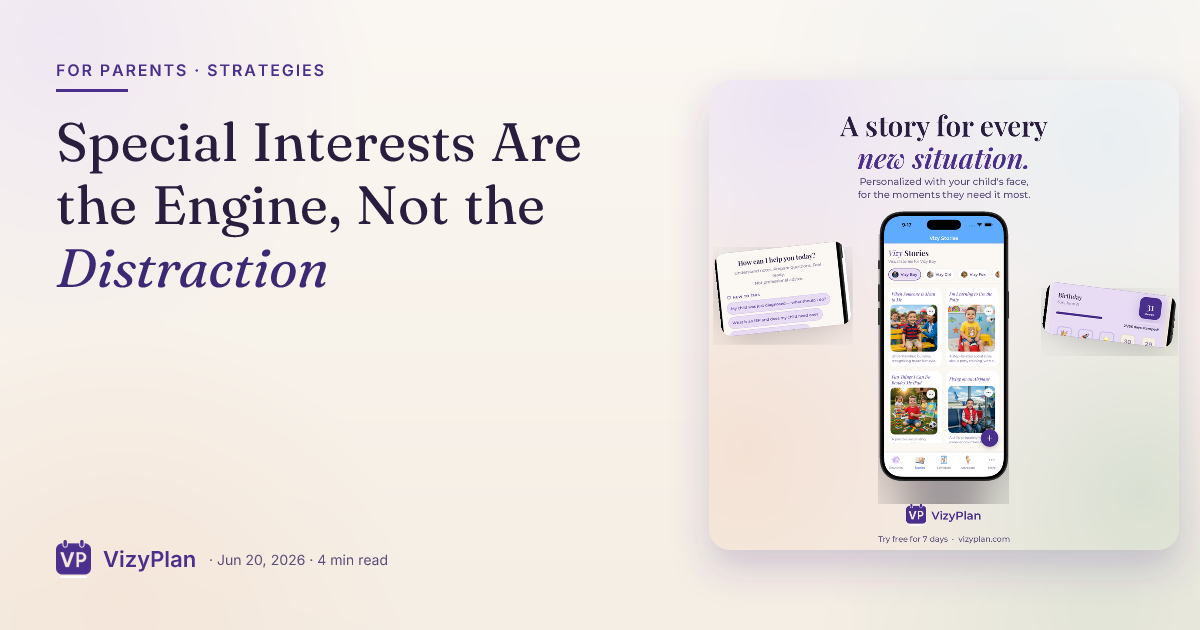
VizyPlan's social story feature lets you create these narratives with personalized visuals, so your child sees themselves in the story. This personal connection makes social stories significantly more effective than generic versions.
Choose the right environment. Not all social settings are created equal. When possible, choose environments that set your child up for success:
- Familiar locations over new ones
- Smaller groups (one-on-one playdates are a great starting point) over large gatherings
- Shorter durations over marathon events
- Activity-based gatherings over unstructured free play
- Quieter settings over loud, chaotic ones
You know your child best. If the neighborhood block party with 40 people and a bouncy castle is going to be too much, there is no shame in suggesting a quieter one-on-one playdate with one friend from the party instead.
The Power of Interest-Based Socializing
Here is one of the most important things to understand about neurodivergent social connection: it often works differently than neurotypical socializing, and that is perfectly okay.
Many neurodivergent children (and adults) connect most naturally through shared interests. This is sometimes called "interest-based socializing," and it is a genuine strength, not a deficit.
Instead of expecting your child to engage in free-form social chitchat, lean into their passions:
- If your child loves dinosaurs, invite a friend to visit a natural history museum together
- If they are into Minecraft, set up a side-by-side gaming session
- If they love building, plan a Lego or craft-based playdate
- If they are drawn to animals, visit a farm or pet store together
Structured activities provide a shared focus, which takes the pressure off constant social negotiation. Two kids building a Lego set together are naturally practicing turn-taking, communication, and collaboration without the overwhelming demand of unstructured "just play."
Research in play therapy supports this approach. Following the child's lead and building social opportunities around their genuine interests creates more authentic connection than forcing participation in activities that feel meaningless or distressing.
During the Playdate: Strategies That Work
Even with great preparation, your child will likely need support during the event itself. Here are practical strategies to keep things on track.
Use visual timers. Many neurodivergent children struggle with the abstract concept of time. "We are leaving in 30 minutes" means very little to a child who cannot feel time passing. Visual timers make the invisible visible. Use a visual timer to show how long until transition points, turn-taking intervals, or how long until it is time to go home. When your child can see time moving, transitions become less jarring and conflicts over sharing become easier to navigate.
Build in sensory breaks. Do not wait for a meltdown to take a break. Proactively schedule sensory breaks into your playdate plan. This might look like a five-minute quiet time in a separate room, a walk around the block together, time with noise-canceling headphones, or a few minutes of deep pressure input. Normalize these breaks by building them into the visual schedule from the start. When a sensory break is just "step 4 on the schedule," it does not feel like punishment or failure. It feels like part of the plan.
Adult facilitation (without hovering). Your role during a playdate is to be a bridge, not a helicopter. This means narrating social cues your child might miss, offering language for tricky moments, stepping back when things are going well, and redirecting gently when things start to go sideways. The goal is to gradually reduce your involvement over time as your child builds their own social toolkit.
Hosting vs. Attending: A Strategic Decision
Where the playdate happens matters more than you might think.
The advantages of hosting: When you host, your child has home-field advantage. They have a familiar sensory environment, access to comfort items, control over the space, and predictability. A helpful tip: before the friend arrives, let your child choose which toys they are willing to share and put away any special items that would cause distress. This prevents conflict and teaches self-advocacy.
When you are attending: If you are going to someone else's home or a public venue, visit the location beforehand if possible, bring a comfort kit (noise-canceling headphones, a favorite small toy, a chewy snack, sunglasses), identify a quiet space where your child can retreat, and have an exit plan discussed in advance. Knowing they have an escape route actually helps many neurodivergent children stay longer, because the option to leave reduces the feeling of being trapped.
After the Playdate: Reflection and Celebration
What happens after the playdate is just as important as the preparation. This is where you reinforce learning and build confidence for next time.
Emotion check-ins. Give your child space to process how they felt. For children who struggle to name emotions verbally, emotion tracking tools can be incredibly helpful. VizyPlan's emotion check-in feature lets children identify how they are feeling using visual supports, which builds emotional vocabulary over time and helps you spot patterns. Maybe your child consistently feels drained after gatherings longer than an hour, or maybe they feel happiest after playdates that involve building activities. These insights help you plan better next time.
Celebrate successes with reward systems. Every successful social interaction, no matter how small, deserves recognition. Did your child say hello to the host? Share a toy without a meltdown? Ask for a break instead of hitting? Stay for the whole playdate? Reward systems that acknowledge effort help neurodivergent children associate social situations with positive feelings. VizyPlan's reward system lets you set up personalized goals and celebrations, so your child sees their social bravery reflected back to them in a concrete, motivating way.
Be specific with your praise: "I noticed you waited your turn with the train set even though it was really hard. That took a lot of patience, and I am so proud of you."
Building Social Skills Gradually Over Time
Social skill development is not a straight line. There will be wonderful playdates and terrible ones. The research is clear: short, successful interactions build more social confidence than long, overwhelming ones. It is better for your child to leave a playdate after 20 happy minutes than to push through 90 miserable ones. Success breeds success. Each positive experience lays the foundation for the next one.
A neurodiversity-affirming approach means we are not trying to make our children "look neurotypical" in social settings. We are trying to help them build genuine connections in ways that honor how their brains work. That might mean side-by-side play instead of face-to-face conversation. It might mean bonding over shared facts about marine biology instead of small talk. It might mean two kids happily stimming together while watching a favorite show. All of these are valid, meaningful social connections.
How VizyPlan Supports Your Child's Social Journey
Everything we have discussed in this guide, from visual schedules and social stories to emotion check-ins and reward systems, comes together in VizyPlan.
VizyPlan is an AI-powered visual routines app designed specifically for neurodivergent children. It helps you:
- Build personalized visual schedules for playdates and social events with AI-generated images that match your child's real life
- Create social stories that prepare your child for specific social situations
- Track emotions before and after social gatherings to spot patterns and celebrate growth
- Set up reward systems that motivate and recognize social bravery
- Use visual timers that make transitions smoother and more predictable
Social situations do not have to be a source of dread for your family. With the right preparation, the right tools, and a neurodiversity-affirming mindset, your child can build meaningful friendships at their own pace, in their own way.
Start your free 7-day trial of VizyPlan today. Plans start at just $6.99/month. Download VizyPlan on the App Store and start building visual supports for your child's next playdate.
You know your child better than anyone. Trust that knowledge, lean into their strengths, and remember: every small step forward is a victory worth celebrating.