
Your child just received a diagnosis. Maybe it is autism, ADHD, or both. The school mentions something about a "504" or an "IEP," and suddenly you are navigating a system filled with acronyms, legal language, and meetings that feel high-stakes because they are.
You are not alone. In the 2022-23 school year, 7.5 million students received special education services under IDEA, representing 15% of all public school students, an all-time high according to the National Center for Education Statistics. Meanwhile, the number of students with 504 Plans has nearly quadrupled over the past 15 years. These plans shape your child's daily school experience, and getting the right one matters.
This guide breaks down the real differences between 504 Plans and IEPs, explains when each applies to neurodivergent children, and gives you the tools to advocate confidently at your next school meeting.
What Is a 504 Plan?
A 504 Plan comes from Section 504 of the Rehabilitation Act of 1973, a civil rights law that prohibits discrimination against individuals with disabilities in any program receiving federal funding, including public schools.
The core purpose is equal access. If your child has a physical or mental impairment that substantially limits a major life activity (including learning, reading, concentrating, thinking, or communicating), they qualify for accommodations that level the playing field.
A 504 Plan typically includes accommodations like:
- Extended time on tests and assignments
- Preferential seating away from distractions
- Frequent breaks during long tasks
- Modified homework expectations
- Permission to use fidget tools or noise-canceling headphones
- Access to a quiet testing environment
- Copies of class notes or audio recordings of lectures
The key word is accommodations. A 504 Plan changes how your child accesses the same curriculum, not what they are taught. The classroom expectations remain the same, but barriers are reduced so your child can meet them.
What Is an IEP?
An Individualized Education Program comes from the Individuals with Disabilities Education Act (IDEA), a federal funding statute that requires schools to provide a Free Appropriate Public Education (FAPE) to children with disabilities.
An IEP goes significantly further than a 504 Plan. It provides:
- Specialized instruction tailored to your child's unique needs
- Related services such as speech therapy, occupational therapy, counseling, or behavioral support
- Modifications to the curriculum itself (not just how your child accesses it)
- Measurable annual goals with regular progress monitoring
- Transition planning starting at age 16 for life after high school
- Extended school year services if your child regresses during breaks
- Assistive technology evaluations and devices
An IEP is a legally binding document. The school must provide everything written in it. If they do not, you have robust due process rights to hold them accountable.
The Differences That Actually Matter
Understanding the legal nuances helps, but what parents really need to know is how these plans differ in daily practice.
Eligibility is the first dividing line. IDEA requires your child to have one of 13 specific disability categories AND need specialized instruction. Section 504 uses a broader definition: any physical or mental impairment that substantially limits a major life activity. A child who does not qualify for an IEP may still qualify for a 504 Plan.
The level of support is fundamentally different. A 504 Plan provides accommodations within the general education setting. An IEP can provide specialized instruction, pull-out services, a modified curriculum, and dedicated support staff. If your child needs someone to teach them differently, not just adjust the environment, an IEP is the right tool.
Legal protections are stronger under an IEP. IDEA requires written notice before any changes to your child's identification, evaluation, or placement. It gives you the right to request an Independent Educational Evaluation at the school's expense if you disagree with their assessment. It includes a "stay-put" provision that keeps your child in their current placement during disputes. Section 504 offers more limited procedural safeguards.
Progress monitoring differs dramatically. An IEP requires measurable annual goals and regular progress reports sent to parents. A 504 Plan has no federal requirement for goals or progress reporting. Without built-in accountability, 504 accommodations can quietly stop being implemented, and you may not know until the next report card.
The team composition is mandated for IEPs. An IEP meeting must include at least one general education teacher, one special education teacher, a school psychologist or evaluation specialist, a district representative, and you. A 504 meeting has no mandated attendee list, which sometimes means fewer qualified voices in the room.
How Autism and ADHD Factor In
The diagnosis your child carries often influences which plan schools recommend, but the decision should be based on need, not diagnosis alone.
Autism and IEPs. Autism is one of IDEA's 13 disability categories, which makes IEP eligibility more straightforward. In 2022-23, autism represented 13% of all students in special education, up from 7.8% a decade earlier. Most children with autism who receive formal school support have an IEP because autism typically affects educational performance broadly, across communication, social skills, behavioral regulation, and academics.
However, a medical diagnosis of autism does not automatically qualify your child for an IEP. Research published in PMC found that more than 36% of children with ASD did not receive an autism eligibility classification in special education, often being served under other categories or not at all. The school must determine that autism adversely affects educational performance and that specialized instruction is needed.
ADHD and the gray area. ADHD is not a standalone IDEA category. Children with ADHD typically qualify under "Other Health Impairment," though some qualify under Specific Learning Disabilities or Emotional Disturbance. This creates a gray area where schools may push toward a 504 Plan even when an IEP is warranted.
The data is revealing: among students with ADHD who have formal education plans, 42.9% have an IEP while only 13.6% have a 504 Plan, more than a 3-to-1 ratio favoring IEPs (CHADD). Yet research from CHADD also shows that about one in three students with ADHD who would qualify for accommodations receive no formal plan at all.
If your child with ADHD struggles not just with attention but with executive function, emotional regulation, social skills, or academic performance despite accommodations, they likely need the specialized instruction an IEP provides, not just the accommodations of a 504.
When a 504 Plan Is the Right Choice
A 504 Plan is appropriate when your child:
- Has a disability that substantially limits a major life activity but can succeed in general education with accommodations
- Needs environmental adjustments like extended time, seating changes, or break schedules
- Performs at or near grade level academically but struggles with specific barriers
- Has a condition like anxiety, a medical condition, or mild ADHD that needs accommodations but not specialized instruction
- Was evaluated for an IEP but found ineligible because they do not need specialized instruction
A well-written 504 Plan can be genuinely effective. The problem is not the plan itself but how it is sometimes used: as an easier, less resource-intensive alternative when an IEP is what the child actually needs.
When an IEP Is the Right Choice
Push for an IEP when your child:
- Needs specialized instruction, not just accommodations, to make progress
- Requires related services such as speech therapy, occupational therapy, counseling, or behavioral intervention
- Needs modifications to the curriculum (reduced assignments, alternate assessments, simplified content)
- Has significant needs that require measurable goals and regular progress monitoring
- Has autism, intellectual disability, or significant learning disabilities that affect educational performance
- Is not making adequate progress with a 504 Plan already in place
The U.S. Supreme Court made an important distinction in Endrew F. v. Douglas County (2017): an IEP must be "reasonably calculated to enable a child to make progress appropriate in light of the child's circumstances" and must be "appropriately ambitious." If your child is stagnating, the law is on your side.
Enjoying this article?
Get practical tips and insights delivered to your inbox — no spam, ever.
The Evaluation Process
For an IEP: Request an evaluation in writing to the school principal or special education coordinator. The school has 60 days (or your state's timeline) to complete a comprehensive evaluation after receiving your consent. They must assess all areas of suspected disability using multiple assessment tools. If eligible, an IEP must be developed within 30 days.
For a 504 Plan: The process is less standardized. The school evaluates using information from a variety of sources including grades, teacher reports, medical records, and standardized tests. There is no federally mandated timeline, which means it can move quickly or slowly depending on the school.
Critical tip: Always make your request in writing. A verbal request at pickup does not create a paper trail. An email or letter does.
Common Mistakes Parents Make
Research and advocacy organizations consistently identify several pitfalls.
Accepting a 504 when an IEP is warranted. Schools sometimes steer parents toward a 504 Plan because it requires fewer resources and less oversight. If your child needs specialized instruction, accommodations alone will not close the gap. Do not let convenience drive the decision.
Signing documents at the meeting. You are not required to agree on the spot. Request time to review proposed plans with your pediatrician, therapist, or an educational advocate. Bring the documents home, read them carefully, and ask questions before signing.
Not addressing executive function needs. A peer-reviewed study published in PMC found that while 85% of IEP Present Level statements for students with ADHD described behavioral concerns, less than half had measurable goals targeting those areas. If your child struggles with planning, organization, emotional regulation, or task initiation, those needs belong in the plan.
Assuming the plan will be automatically implemented. Plans are only as good as their execution. Check in regularly with teachers. Ask your child how supports are working. Request a mid-year review if something feels off.
Not updating plans annually. Your child grows and changes. A strategy that worked in second grade may be irrelevant by fourth grade. Push for plans that evolve with your child's current needs, not carry over the same language year after year.
Missing assessment bias. Research shows that girls, children of color, and children from non-English-speaking households are systematically under-identified or misidentified for services. If your child does not fit the stereotypical presentation, you may need to advocate harder for an accurate evaluation.
How to Advocate Effectively
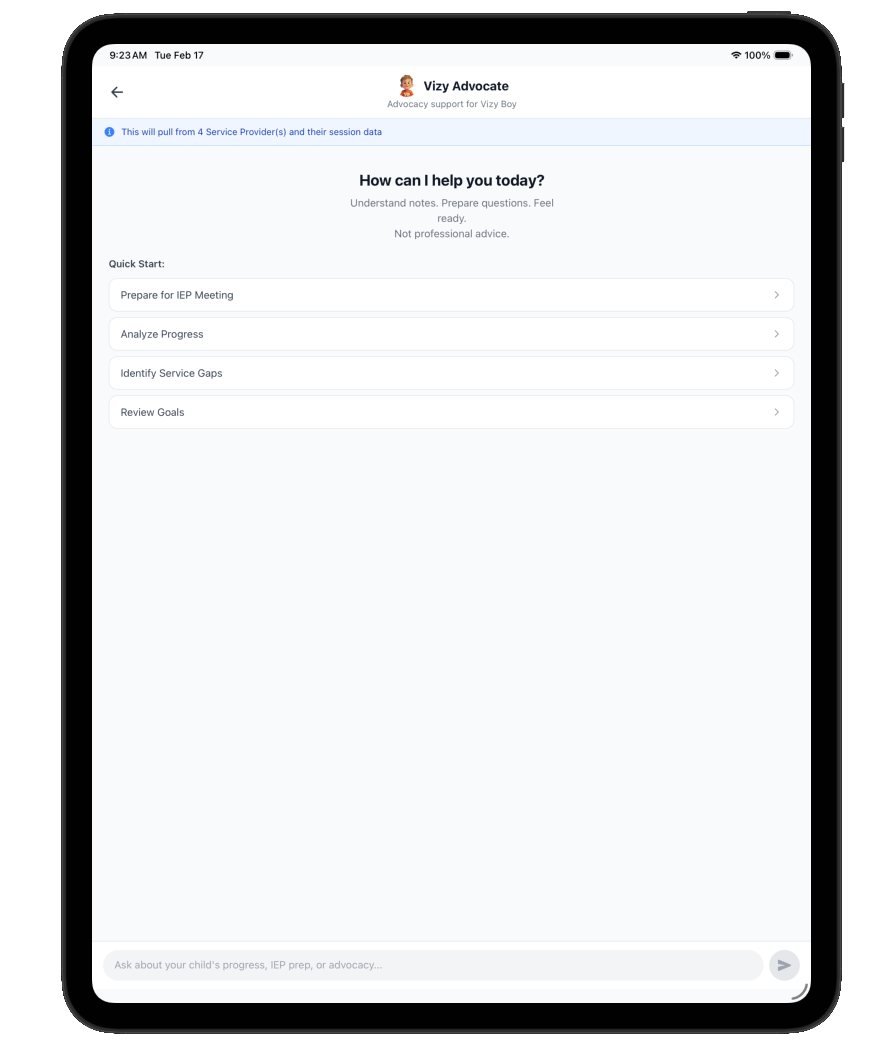
Document everything at home. The strongest IEP meetings start long before the meeting itself. Keep records of your child's daily challenges, the strategies you use at home, and what works or does not work. Tools like VizyPlan can help you track your child's daily routines, emotional patterns, and progress over time, giving you concrete data to bring to school meetings rather than relying on memory alone.
.png)
Know your rights before walking in. IDEA mandates that parents are equal members of the IEP team. You are not a guest at this meeting. You are a decision-maker. Resources like Wrightslaw, your state's Parent Training and Information Center (PTI), and organizations like CHADD provide free training on your legal rights.
Bring outside evaluations. If your child sees a private therapist, psychologist, or developmental pediatrician, request a written summary of their recommendations. Outside evaluations carry weight in meetings and can highlight needs the school's assessment may have missed.
Request an Independent Educational Evaluation (IEE) if needed. Under IDEA, if you disagree with the school's evaluation, you can request an IEE at the school's expense. The school must either fund the evaluation or file for due process to prove their own evaluation was adequate. This is a powerful tool parents often do not know they have.
Focus on measurable goals. Vague goals like "improve reading" are hard to enforce. Push for specifics: "By May, the student will read 80 words per minute on grade-level passages with 95% accuracy, as measured by weekly fluency probes." Measurable goals create accountability.
Use dispute resolution strategically. If the school is not meeting your child's needs, start with an informal conversation with the special education coordinator. If that fails, request mediation. CADRE data shows that mediation has consistently high agreement rates between families and schools. Save due process hearings as a last resort.
Involve your child when appropriate. Research from ERIC found a positive association between student participation in IEP planning and academic outcomes. Even young children can contribute to goal-setting and self-advocacy discussions at a developmentally appropriate level. For more on building these skills, read our guide on teaching self-advocacy skills to your neurodivergent child.
Building a Bridge Between Home and School
The most effective education plans do not exist in isolation. They work best when home routines and school supports reinforce each other.
If your child's IEP includes goals around following multi-step directions, you can practice that skill at home using visual routines in VizyPlan that break daily activities into clear, sequential steps with personalized images of your child. When the same structure appears at home and school, children internalize it faster and transfer skills between settings.
If your child's 504 Plan includes break schedules or emotional regulation accommodations, tracking which strategies work at home helps inform what works at school. When you can tell the team, "We have been tracking his emotional responses for the past month, and here is what we have found," you shift the conversation from opinions to evidence.
For a deeper look at using visual tools in provider meetings, read our guide on collaborating with providers for IEP meetings and therapy.
The Numbers That Should Motivate You
The stakes are real. Students with IEPs are 85% more likely to repeat a grade than peers without disabilities. Students with 504 Plans are 110% more likely (NCLD). Written state complaints about special education services surged to 9,927 in 2023-24, a 79% rise over the 10-year average, according to CADRE.
These numbers reflect a system under strain, but also a system where parents who advocate get results. The families who understand the difference between a 504 and an IEP, who show up prepared with documentation, and who know their legal rights are the ones who secure the supports their children need.
You do not need to be a special education lawyer to be an effective advocate. You need to understand your options, prepare your evidence, and be willing to push when your child's needs are not being met.
Where to Start Today
If your child does not yet have a formal plan:
- Request an evaluation in writing to the school's special education coordinator. Be specific about the areas of concern: academics, behavior, social skills, communication, executive function.
- Start documenting at home. Track your child's daily challenges, emotional patterns, and what strategies help. VizyPlan makes this simple with built-in routine tracking and emotion monitoring that gives you shareable data for school meetings.
- Connect with your state's PTI. Every state has a federally funded Parent Training and Information Center that provides free guidance on special education rights and advocacy strategies.
If your child already has a plan that is not working:
- Request an IEP or 504 review meeting. You can request a meeting at any time, not just at the annual review.
- Bring data. Report cards, work samples, behavioral logs, and daily routine tracking from tools like VizyPlan help you show the team exactly where supports are falling short.
- Consider whether the plan type is right. If your child has a 504 but is not making progress, it may be time to request an IEP evaluation.
Your child deserves a school experience built around their actual needs, not the plan that is easiest for the school to administer. Understanding the difference between a 504 Plan and an IEP is the first step toward making that happen.
Download VizyPlan and start your 7-day free trial today. Track daily routines, monitor emotional patterns, and build the documentation you need to advocate effectively at your child's next school meeting. If it helps, keep going for $6.99/month or $59.99/year.