
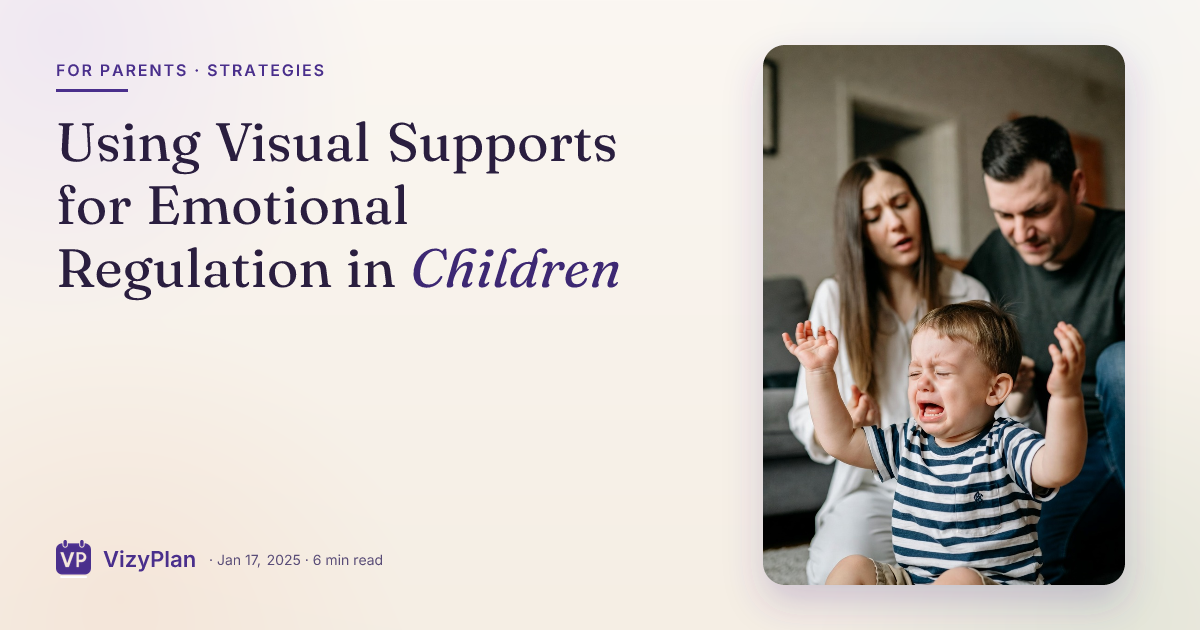
"Use your words." You have said it a hundred times. But your child cannot use their words because they do not have words for what they are feeling. They are drowning in a feeling so big it has taken over their entire body, and telling them to "calm down" is like telling someone underwater to just breathe.
This is the core challenge of emotional regulation for neurodivergent children: the feelings are intense, the ability to name them is limited, and the path from overwhelmed to okay is invisible. Visual supports change that equation by making the invisible visible, giving children a concrete map from "I am falling apart" to "I know what to do."
Why Emotional Regulation Is Challenging
Children with autism frequently experience alexithymia, difficulty identifying and describing their own emotions. A child may feel intensely without being able to name or understand what they are feeling.
Children with ADHD often experience emotions with greater intensity and have difficulty modulating their responses. The gap between feeling an emotion and acting on it may be much shorter than for neurotypical peers.
Both conditions can involve sensory processing differences that amplify emotional experiences or make it harder to distinguish between physical sensations and emotions.
Visual Emotion Identification Tools
Before children can regulate emotions, they need to recognize them. Visual tools make this abstract skill concrete.
Emotion charts with pictures help children match their internal experience to a named emotion. Charts showing faces with different expressions give children a reference point for identifying what they feel.
Feeling thermometers or scales help children identify the intensity of emotions, not just the type. Learning to distinguish between "a little frustrated" and "very frustrated" supports more proportional responses.
Body maps show where different emotions are felt physically. This helps children connect physical sensations like a tight chest or warm face to specific emotions, building emotional awareness.
Creating a Visual Calm-Down Sequence
When emotions become overwhelming, having a visual guide for calming down removes the need to think clearly during a difficult moment.
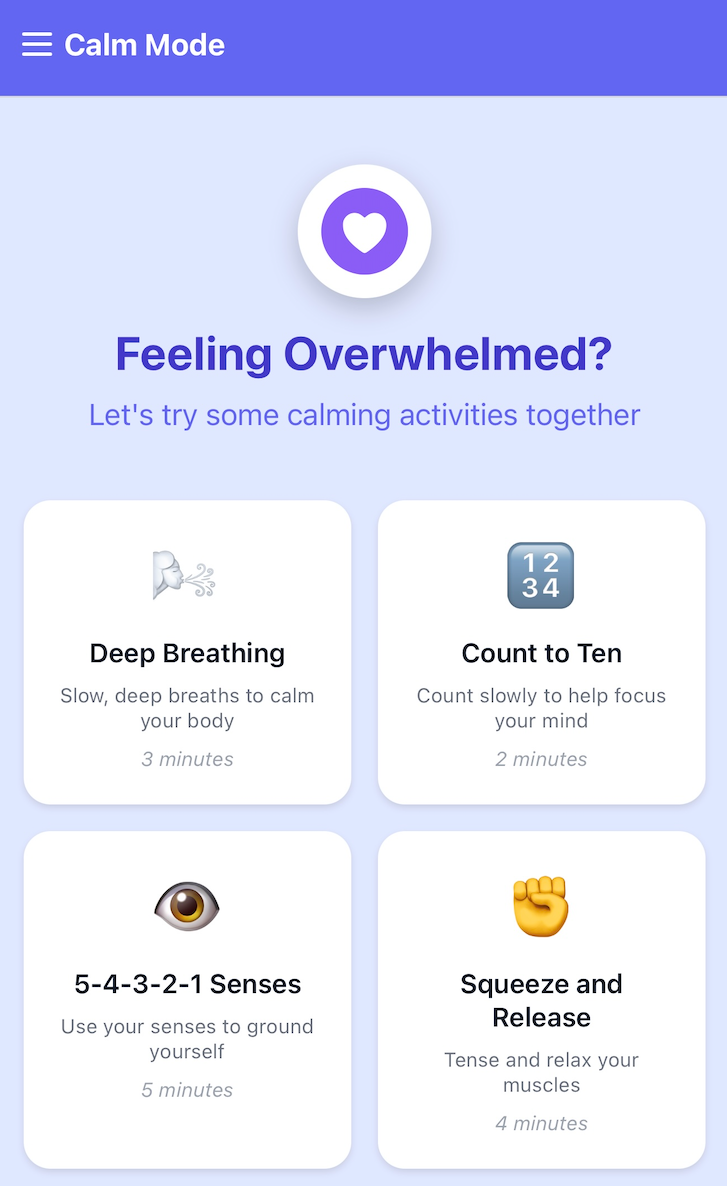
Include specific strategies the child has practiced and can use independently:
- Take three deep breaths
- Count to ten
- Squeeze a stress ball
- Find a quiet space
- Ask for help
Keep it accessible. The calm-down sequence should be posted where the child can see it during difficult moments, not tucked away in a drawer.
Practice during calm times. Children cannot learn new strategies while dysregulated. Practice the calm-down sequence when everyone is relaxed so it becomes familiar and automatic.
Zones of Regulation and Color Coding
Many families and educators find success with color-coded systems that categorize emotional states into zones.
The basic concept assigns colors to different energy and emotional states. For example, blue might represent low energy or sad feelings, green represents calm and focused, yellow represents heightened energy or worry, and red represents intense emotions.
Visual check-ins using these colors help children communicate their state quickly. A child can point to a color to show how they are feeling when words are difficult.
Matching strategies to zones helps children learn that different emotional states call for different responses. Yellow zone feelings might need movement or deep breaths, while blue zone feelings might need connection or a change of activity.
Visual Supports for Recognizing Triggers
Helping children identify what triggers difficult emotions builds self-awareness and prevention skills.
Trigger identification charts help children learn patterns in their emotional responses. Visual representations of common triggers, transitions, sensory experiences, social situations, give children vocabulary for understanding their experiences.
Routine reviews using visuals can help identify when in the day difficult emotions are most likely to occur, allowing for proactive support during those times.
Pattern tracking over time, even with simple visual logs, helps both children and caregivers understand emotional patterns and plan accordingly.
Enjoying this article?
Get practical tips and insights delivered to your inbox — no spam, ever.
Social Stories for Emotional Situations
Social stories can teach children how to handle emotionally challenging situations before they occur.
Normalize difficult emotions. Stories can convey that everyone feels angry, sad, or frustrated sometimes, and that these feelings are okay even when the behaviors that follow might not be.
Provide specific scripts. What can a child say or do when they feel overwhelmed? Social stories can suggest exact words and actions to use.
Include successful outcomes. Showing the positive results of using coping strategies motivates children to try them.
Building an Emotional Vocabulary
Many children with autism and ADHD have limited emotional vocabulary, which restricts their ability to process and communicate about feelings.
Visual word banks with emotion words paired with images expand vocabulary over time. Moving beyond basic "happy, sad, mad" to include words like "frustrated, disappointed, excited, nervous" gives children more precise language.
Daily check-ins using visual supports create regular opportunities to practice identifying and naming emotions in low-pressure situations.
Modeling emotional language while using visual supports teaches children how to express emotions. When caregivers point to emotion visuals and name their own feelings, children learn by example.
Visual Coping Strategy Cards
Individual coping strategy cards give children a menu of options when they need to regulate.
Create cards for strategies that work for your specific child. What helps one child may not help another. Build a personalized collection based on what you observe actually helps.
Make them portable. A small set of cards on a ring can travel in a backpack, giving children access to their strategies anywhere.
Include sensory strategies alongside cognitive ones. Deep pressure, movement, fidgets, and other sensory inputs are often as important as breathing or counting for neurodivergent children.
Teaching Emotional Regulation Takes Time
Building self-regulation skills is a long-term process. Visual supports help, but patience and consistency are equally important.
Expect gradual progress. A child who melts down daily now may melt down weekly in six months and monthly in a year. This is significant progress even if it feels slow.
Adjust supports as needed. As children grow and change, their emotional needs and effective strategies will evolve. Revisit and update visual supports regularly.
Celebrate effort, not just success. A child who tried to use a coping strategy, even if it did not fully work, is building skills and deserves recognition.
VizyPlan helps you create visual emotional regulation tools for your child. Start your free trial and support your child's emotional growth.