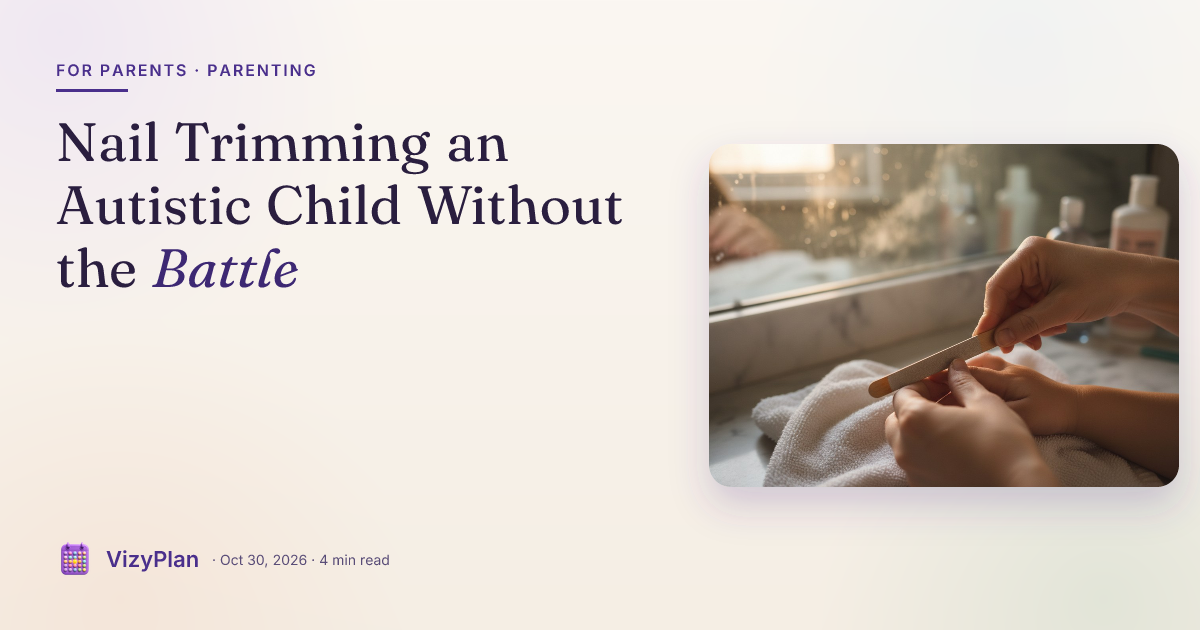
Some families can cut ten fingernails during a cartoon. Others need two adults, a towel and a week to recover. Nail trimming an autistic child is one of those small jobs that can become the hardest five minutes of the week, and it is rarely about stubbornness. It is usually about what the clippers feel like, sound like, and how little warning comes before each one.
Why nail trimming an autistic child is so hard
Touch is a common place for sensory differences to show up. A 2022 study in the Journal of Autism and Developmental Disorders directly assessed children with neurodevelopmental concerns and found that 54% showed over-responsivity to sound, touch or both, and that the pattern appeared whether or not a child had an autism diagnosis. An earlier report from the same research group found tactile over-responsivity in 27% of that cohort. For a child in that group, a light, unexpected touch on the fingertips can register as alarming rather than neutral.
Nail clipping stacks three hard inputs together:
- The sound. The sharp click of clippers lands right next to the hand, often with no rhythm the child can predict.
- The pressure. Clippers squeeze the nail bed, and fingertips are among the most sensitive skin on the body.
- The unpredictability. Your child does not know which finger is next, how many are left, or when it ends.
Occupational therapy guidance for families describes everyday self-care like nail care as genuinely difficult for many autistic children because of how they process sensory input. Nail trimming an autistic child goes better when you change those three inputs instead of trying to push through them.
A calmer way to trim nails, step by step
- Trim after the bath. Nails are softer after warm water, so they cut with less force and less noise. If bath time is already part of the evening routine, our bath time routines guide can help you slot nails in at the end.
- Start with deep pressure. Before any tool comes out, give a firm squeeze to each finger or a hand massage. Firm, steady touch is often easier to tolerate than light touch, and it gives your child a predictable warm-up.
- Try a file instead of clippers. A file has no click and no squeeze. It takes longer, but many children accept a slow, quiet file far more readily than a fast, loud clipper.
- Count each finger on a visual strip. Show five boxes for five fingers and check one off after each nail. A countable target tells your child exactly how much is left and when it ends.
- Do one hand per day. Ten fingers in one sitting is a lot to ask. One hand tonight and one tomorrow keeps every session short enough to finish on a good note.
- Let your child do one. Hand over the file for one finger, or let your child press the clippers with your hand guiding. A little control turns something done to them into something done with them.
- Stop before it falls apart. Ending after three fingers that went well builds more tolerance than forcing all five.
Rewards can help with nail trimming an autistic child too. A small 2018 study in the Journal of Applied Behavior Analysis worked with two autistic adolescents who resisted nail cutting and found that offering a preferred snack for cooperating increased their cooperation. With only two participants, it is a useful idea rather than a proven method, but a favorite treat after the last box is checked costs very little to try.
Enjoying this article?
Get practical tips and insights delivered to your inbox — no spam, ever.
When to ask an occupational therapist
If nail trimming an autistic child still means restraint, injury risk, or nails so long they snag and tear, an occupational therapist is the right next call. An OT can look at your child's whole sensory profile, suggest tools like vibrating files or graded touch activities, and build a sensory diet at home that makes grooming easier over time. If haircuts are a similar struggle, our guide to sensory friendly haircuts uses many of the same principles.
The goal of nail trimming an autistic child is not ten perfect nails in one night. The goal is a routine your child can predict, tolerate, and eventually help with.
VizyPlan was built by an autism dad and an autism mom who is a licensed speech-language pathologist so the bath, the squeeze, the file and the five boxes can be a routine your child sees before the first finger.
Download VizyPlan and start your 7-day free trial today. Show the steps before the clippers come out. If it helps, keep going for $6.99/month or $59.99/year.
VizyPlan was built by an autism dad and an autism mom who is a licensed speech-language pathologist who needed something that did not exist. Start your free trial.