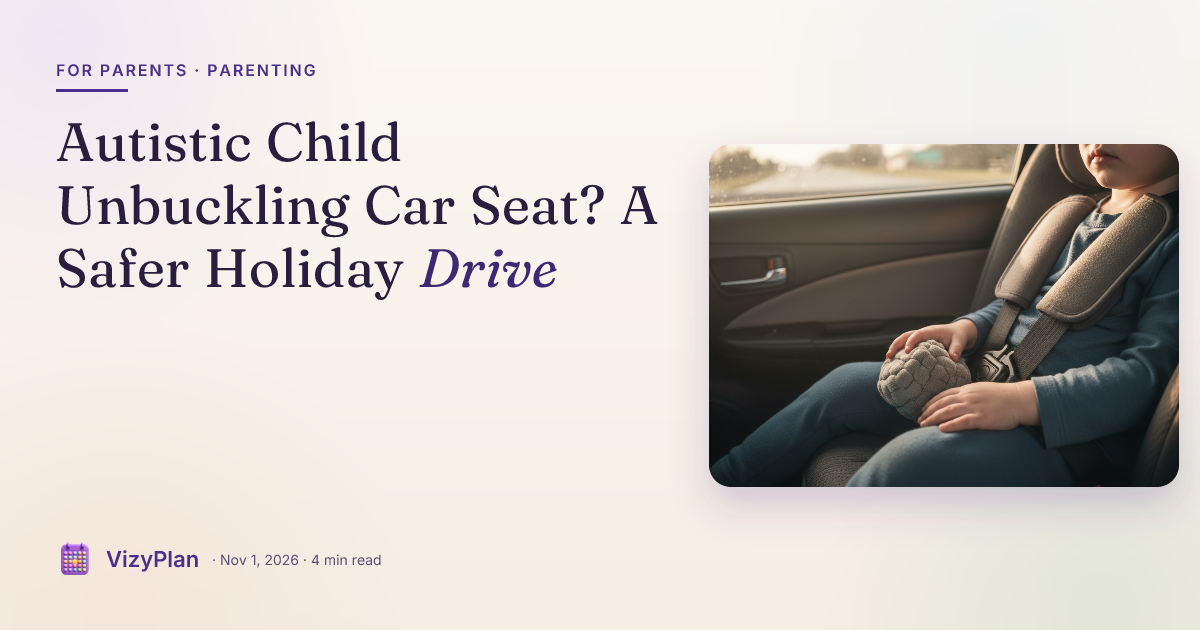
Every parent of an escape artist knows the sound: a small click from the back seat while you are doing 65 on the highway. An autistic child unbuckling car seat straps is not a discipline failure and it is not rare. It is a safety problem with a cause, and the weeks before Thanksgiving and holiday driving are the right time to work on it.
In a 2013 review in the American Journal of Occupational Therapy of 82 autistic children referred to a special needs car seat program, escape attempts were the norm, with about 84% of kids in boosters or seat belts trying to get out compared with about 58% of kids in a five-point harness. A separate 2011 Yale pilot survey of young children in general found that 43% of kids who unbuckled themselves did it while the car was moving.
Why an autistic child unbuckling car seat straps keeps happening
Clinicians at Children's Hospital of Philadelphia say to find the reason before you pick the fix. The common ones:
- Sensory discomfort. Straps rubbing on bare neck or shoulders, a buckle pressing on the belly, a seat that feels too hot or too tight.
- Boredom or the need to move. A long drive with nothing to do and a body that wants input.
- Anxiety about the trip. Not knowing where the car is going, how long it will take, or what happens at the other end.
- The buckle is the game. For some kids, the click itself is the reward, especially when it reliably gets a big reaction from the front seat.
Talk to a certified technician before buying anything
Buckle guards, chest clip covers and special needs restraint systems all exist. Do not assume any of them is safe for your child on the strength of a product page. The American Academy of Pediatrics says many children with special health care needs can ride in standard car seats, which are preferable when they work, and that kids with behavioral challenges may need specialized resources to travel safely. CHOP clinicians warn families not to make their own modifications to a car seat.
For an autistic child unbuckling car seat buckles over and over, the right next step is a certified Child Passenger Safety Technician. The national CPS certification directory lets you search for technicians and filter for extra special needs training. Ask the technician what the seat manufacturer allows. A five-point harness that fits correctly is harder to escape than a booster, and a technician can tell you whether your child can stay in one longer.
A visual car rule card and a safe pull over plan
A rule your child can see works better than a rule shouted over your shoulder. Make a small card with three pictures and keep it on the back of the front seat.
- Buckle first. A picture of the buckle clicked closed. The car does not start until it is.
- Hands on my lap or my toy. One picture of the busy item that only lives in the car.
- Buckle stays on until we stop. A picture of the car parked, then the buckle open.
- If the buckle opens, we pull over. Say it calmly, every time, so it is predictable rather than dramatic.
If the buckle does open, signal, find a safe place fully off the road, stop, and rebuckle without a lecture. Keep your voice flat and boring so the click stops earning a reaction. Handling an autistic child unbuckling car seat straps the same way every time is what makes the behavior fade. On a long holiday drive, plan movement stops before your child needs them rather than after.
Enjoying this article?
Get practical tips and insights delivered to your inbox — no spam, ever.
Small sensory fixes that help
Sometimes the whole autistic child unbuckling car seat pattern starts with a strap on bare skin. Long sleeves or a soft collar keep straps off bare skin. Check that the harness fits the way the seat manual describes, because a strap that is twisted or too loose is both uncomfortable and unsafe. Skip thick winter coats under the harness and lay a blanket over the buckled straps instead. Do not add padding, covers or inserts that did not come with the seat unless a technician approves them.
If your child also bolts in parking lots or at rest stops, our elopement and wandering safety guide covers the plan for the moment the car door opens. For the rest of the trip, see our travel tips for autistic and ADHD kids.
VizyPlan was built by an autism dad and an autism mom who is a licensed speech-language pathologist so the buckle rule and the drive to grandma's can be a routine your child sees before you back out of the driveway.
Download VizyPlan and start your 7-day free trial today. Show the drive before the drive. If it helps, keep going for $6.99/month or $59.99/year.
VizyPlan was built by an autism dad and an autism mom who is a licensed speech-language pathologist who needed something that did not exist. Start your free trial.