The behavior specialist will write the report, but the classroom teacher holds most of the evidence. A functional behavior assessment for teachers is not a form to sign at the end of a meeting. It is the ten seconds after an incident when someone writes down what happened right before it, and that note decides whether the plan that follows actually fits the student.
An FBA asks one question: what is this behavior getting the student? A plan built on the wrong answer can make the behavior stronger, which is why the person who sees the behavior every day matters more than anyone else at the table.
What IDEA says about when an FBA is required
The federal special education rules are narrower than most staff assume. Under 34 CFR 300.324, when a student's behavior impedes their own learning or the learning of others, the IEP team must consider positive behavioral interventions and supports. The rule is a duty to consider, not an automatic FBA, and a functional behavior assessment for teachers often begins informally at this stage.
The firm requirement sits in the discipline rules at 34 CFR 300.530. When a removal triggers a manifestation determination and the team finds the behavior was a manifestation of the disability, the school must conduct an FBA and implement a behavioral intervention plan, unless one was already done, in which case the existing plan is reviewed and modified. For removals to an interim setting, the regulation says the student receives an FBA "as appropriate." Many states and districts go further than the federal floor, so check your own district policy before assuming either way.
The practical takeaway for a functional behavior assessment for teachers: waiting for the discipline trigger means waiting too long. Teams can request an FBA any time a behavior is getting in the way of learning, and the request is far easier to support with data already in hand.
The four functions a functional behavior assessment for teachers looks for
Behavior analysts generally sort behavior into four functions:
- Escape. The behavior removes a demand, a task, a noise or a person. The worksheet goes away.
- Attention. The behavior brings an adult or peer closer, even if the attention is a reprimand.
- Tangible. The behavior gets access to an item or activity, like the tablet or the swing.
- Sensory. The behavior feels good or relieves discomfort on its own, regardless of who is around.
The same action can serve different functions for different students. Two students who both throw a pencil may be escaping math and recruiting a teacher, and the right response for one makes the other worse. Setting events matter too: a missed breakfast, a bad night of sleep or a substitute teacher can make a behavior far more likely without being the trigger in the moment.
How to take quick classroom ABC data
ABC stands for antecedent, behavior, consequence, and it is the core of any functional behavior assessment for teachers. Teachers do not need a clipboard and a free period to collect useful data.
- Keep a sticky note or index card in your pocket. Three columns, A, B and C, and nothing else. Speed beats completeness.
- Write the antecedent in plain words. "Asked to start writing" or "transition from recess" is enough. Note the time and the activity.
- Describe the behavior as a camera would see it. "Pushed materials off desk" is data. "Had a meltdown" or "was defiant" is an interpretation.
- Record what happened next, honestly. If the task was dropped, write that down. The consequence is where the function usually shows itself.
- Add a setting event line when you know one. Fire drill, new seat, parent mentioned a rough morning.
- Collect five to ten entries before drawing conclusions. A pattern across a week is worth more than one dramatic incident.
- Hand the cards to the person writing the FBA. Your notes become the observation section of the report.
Our guide to recognizing triggers before meltdowns covers early warning signs that make the antecedent column easier to fill in.
Enjoying this article?
Get practical tips and insights delivered to your inbox — no spam, ever.
Where visual supports appear in a behavior intervention plan
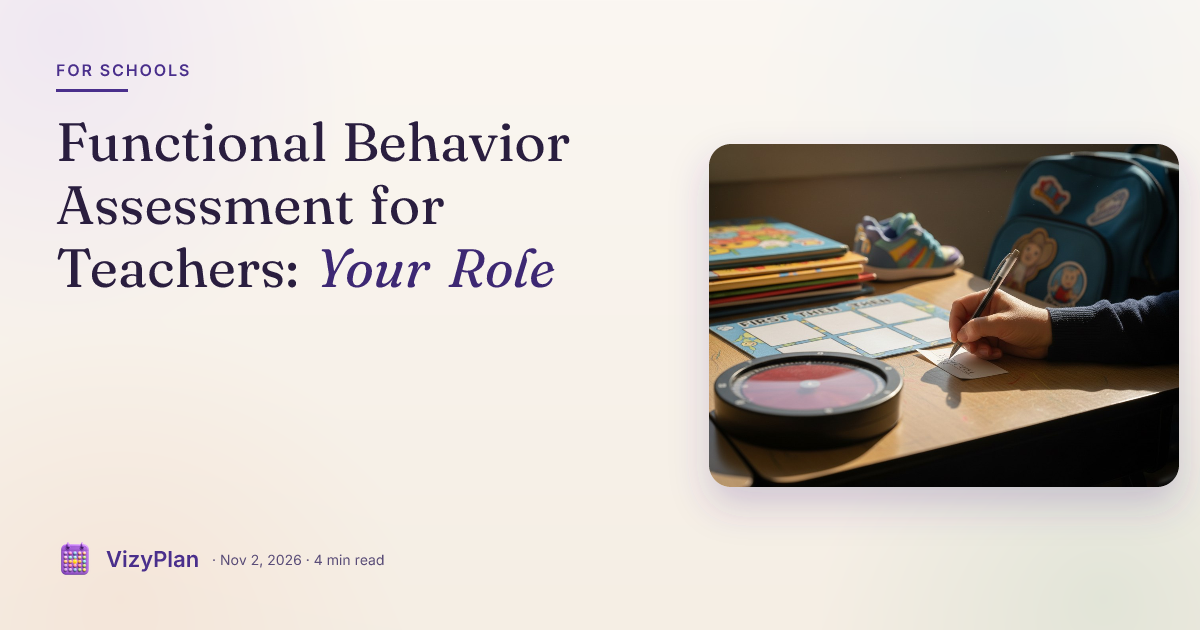
A BIP usually has three parts: prevention strategies, a replacement behavior that serves the same function, and how adults respond. Visual supports show up in the first two, and a functional behavior assessment for teachers that names the function tells the team which visuals to pick. The National Clearinghouse on Autism Evidence and Practice's 2020 review classifies visual supports as an evidence-based practice for autistic children and young adults.
For an escape function, a visual schedule showing the task, then a break, makes the end of the demand visible. A first-then board pairs a hard task with a preferred one. A break card gives the student a sanctioned way to ask for escape instead of earning it through behavior. For transitions, a visual timer removes the surprise that often starts the chain.
When the plan goes home, so should the visuals. Families who get a call from school about behavior want something concrete to do, and a matching visual routine at home is often the most useful thing a teacher can offer.
VizyPlan was built by an autism dad and an autism mom who is a licensed speech-language pathologist so the first-then board and the break card a student uses at school can look the same at home.
Share VizyPlan with your families so the visual supports in the behavior plan carry over to home. The 7-day free trial lets a family try it first. If it helps, keep going for $6.99/month or $59.99/year.
VizyPlan was built by an autism dad and an autism mom who is a licensed speech-language pathologist who needed something that did not exist. Explore VizyPlan.