"Find a partner and get started" is one of the hardest sentences a teacher says all day, and almost nobody notices. Group work for autistic students tends to break down before the first idea is shared, at the part of the task nobody wrote down: who is in the group, who does what, when it is your turn to talk, and what counts as done.
The student who sits silently at the edge of the table, or takes over the whole project, is usually not refusing to collaborate. They are trying to follow rules that were never stated.
Why group work for autistic students is harder than it looks
Count what an open group task actually asks for. Choosing partners in front of the whole class. Negotiating roles with no adult present. Reading when a peer is joking and when they are annoyed. Working through the noise of six other groups talking at once. Trusting that the grade will reflect your work when the workload is rarely shared evenly. Each of those is a social or sensory demand layered on top of the academic one, and the academic one is the only part on the rubric.
The difficulty also runs both ways. The double empathy idea holds that communication breakdowns between autistic and non-autistic people are a mismatch between two styles, not a deficit on one side. A 2020 study in Autism tested it with a story passed person to person along chains of eight: autistic chains kept the details about as well as non-autistic chains, while mixed chains lost detail faster and reported lower rapport. A later replication found the gap less clear-cut, so treat it as a lens rather than a rule. The lens is useful anyway, because it moves the fix from "teach this student to fit in" to "make the group's expectations visible to everyone." Our piece on the double empathy problem goes deeper.
What the research says about structure
Structure is where the evidence points. A 2015 systematic review in the Journal of Autism and Developmental Disorders found peer-mediated interventions, where classmates are taught specific ways to include and respond to an autistic peer, had mostly positive effects on social outcomes in inclusive settings, including whether those gains carried over and held. A 2019 study in Open Education Studies gave four fifth grade autistic students a structured protocol for cooperative group work, and both prompted and unprompted back-and-forth exchanges increased. Across cooperative learning studies, the common thread is that group work for autistic students works better when the hidden rules become written ones.
Seven ways to make group work for autistic students fair
- Choose the groups yourself. Student-picked groups put the hardest social moment of the task first, in public. Teacher-chosen groups remove it, and you can place an autistic student with patient, steady peers.
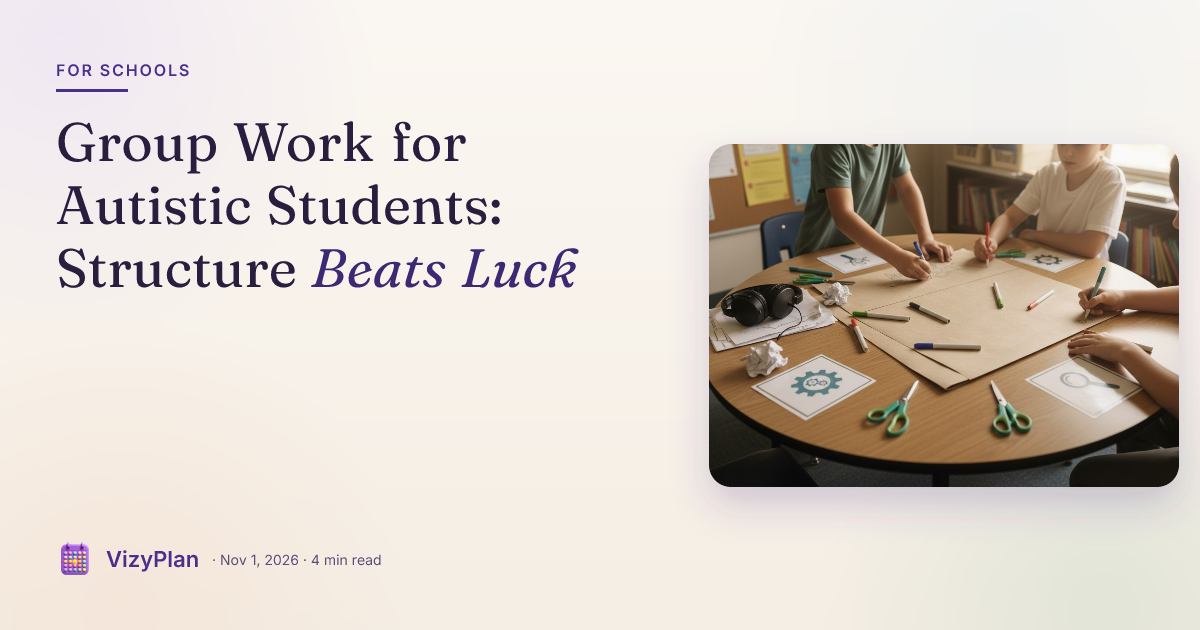
- Assign roles on visual role cards. Recorder, materials manager, timekeeper, reporter. A card with the role name, a picture and two or three sentences of what that job does turns "help out" into a defined task.
- Hand out a written plan with numbered steps. Step one, step two, step three, and what finished looks like. The plan answers "what are we supposed to be doing right now" without anyone having to ask a peer.
- Script the start. Give each group the first sentence: "Recorder, read step one out loud." A scripted opening skips the most ambiguous ninety seconds.
- Offer a quieter spot. A group that may work in the hallway, the library corner or the far table is a group that can actually hear itself. Our guide to a sensory friendly classroom setup covers the noise side.
- Build in individual accountability. Each student turns in their own piece, or answers one question on their own afterward. Separate deliverables protect the student who does all the work and the one who gets shut out.
- Grade the contribution, not the socializing. Unless the learning goal is collaboration itself, eye contact and enthusiasm do not belong on the rubric. Score the work each student produced.
Enjoying this article?
Get practical tips and insights delivered to your inbox — no spam, ever.
When group work for autistic students should be optional
Some days the right accommodation is a partner instead of a group of four, or a solo version of the same task. If a student's IEP or 504 plan names group settings as a barrier, honor it without making it a public exception. Unstructured peer time is hard for the same reasons, which our guide to recess and lunch covers.
Group work for autistic students goes well when the plan is on paper and the roles are on the table. That structure tends to help every student in the room.
VizyPlan was built by an autism dad and an autism mom who is a licensed speech-language pathologist so the steps of a task can be a picture sequence a student checks without having to ask anyone.
Share VizyPlan with your families so the visual steps a student uses in class can carry over to homework time. The 7-day free trial lets a family try it first. If it helps, keep going for $6.99/month or $59.99/year.
VizyPlan was built by an autism dad and an autism mom who is a licensed speech-language pathologist who needed something that did not exist. Explore VizyPlan.