Every gift-giving day has a moment the whole room waits for, and it is the same moment whether the day is a birthday, Christmas, Hanukkah, Eid or Diwali. Opening presents with an autistic child often goes wrong right there, at the instant the paper comes off, and it usually has very little to do with the gift.
Adults remember that moment as the fun part. For a lot of kids, it is the hardest ninety seconds of the day.
What opening presents with an autistic child actually asks
Look at the moment from the child's side. A wrapped box is a deliberate mystery. Then a circle of relatives goes quiet and watches. Then there is an expected face, a big happy reaction, followed by a prompted "say thank you" to a specific person. Then the next box arrives before the first one has been understood.
Every one of those pieces is a known pressure point. A 2020 meta-analysis in Autism found that intolerance of uncertainty and anxiety are both consistently elevated in autistic people, and earlier meta-analytic work estimated that about 40% of autistic children have at least one anxiety disorder. A surprise is uncertainty with a bow on it. Noise matters too: a large 2022 analysis of autistic children and adults found that around 60% currently had over-responsivity to sound, and tearing paper in a loud room is sound.
So the flat face, the walking away, or the meltdown on gift three while opening presents with an autistic child is rarely ingratitude. It is a nervous system responding to a lot of input at once.
Opening presents with an autistic child: change the format, not the child
- Space the gifts out. One in the morning, one after lunch, one at bedtime, or one a day across the week. Fewer at once means each gift actually gets noticed.
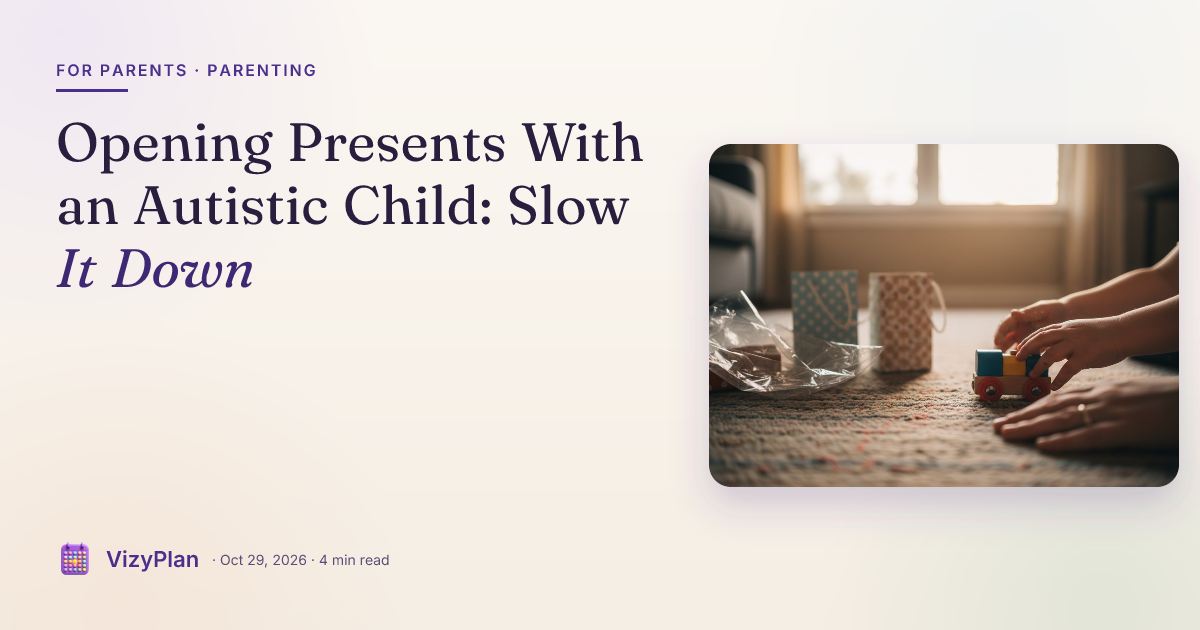
- Use clear wrap, a bag with no tissue, or no wrap at all. A visible gift removes the guessing. Some kids love unwrapping and some do not, and the paper is optional.
- Tell your child what is inside ahead of time. "Your blue box has the train book." Knowing removes the surprise without removing the joy, and many kids get more excited, not less.
- Shrink the audience. Open gifts with one or two people, or let your child open them in their own room and come show you after. A video call later can cover the grandparents.
- Drop the expected reaction. Agree as a family that no particular face is required. A child who looks at a gift quietly for a full minute is often having the reaction, just not the visible one.
- Replace the spoken thank you. A wave, a thumbs up, a drawing, a photo of your child using the gift, or a short message sent the next day all count as gratitude.
- Let the first gift win. If your child wants to play with the first present for an hour, that is the gift working. The rest of the pile can wait until tomorrow.
Enjoying this article?
Get practical tips and insights delivered to your inbox — no spam, ever.
Talk to the relatives first
When opening presents with an autistic child, most of the pressure in the room comes from loving adults who do not know the plan. A short message before the day helps: we are opening one at a time, we might do it later, and a quiet face means they like it. Our guide to holidays and family gatherings covers the rest of the day, and if you are still deciding what to buy, start with our list of gifts for autistic kids.
Birthdays carry the same moment in front of an even bigger crowd. If the party itself is the harder part, our post on the birthday party meltdown walks through it.
Opening presents with an autistic child does not have to look like the catalog version. A child who opened one gift and played with it all afternoon had a good holiday, and so did you.
VizyPlan was built by an autism dad and an autism mom who is a licensed speech-language pathologist so the gift schedule, the clear wrap and the "show me later" plan can be a picture routine your child sees before the day arrives.
Download VizyPlan and start your 7-day free trial today. Show the morning before the morning. If it helps, keep going for $6.99/month or $59.99/year.
VizyPlan was built by an autism dad and an autism mom who is a licensed speech-language pathologist who needed something that did not exist. Start your free trial.