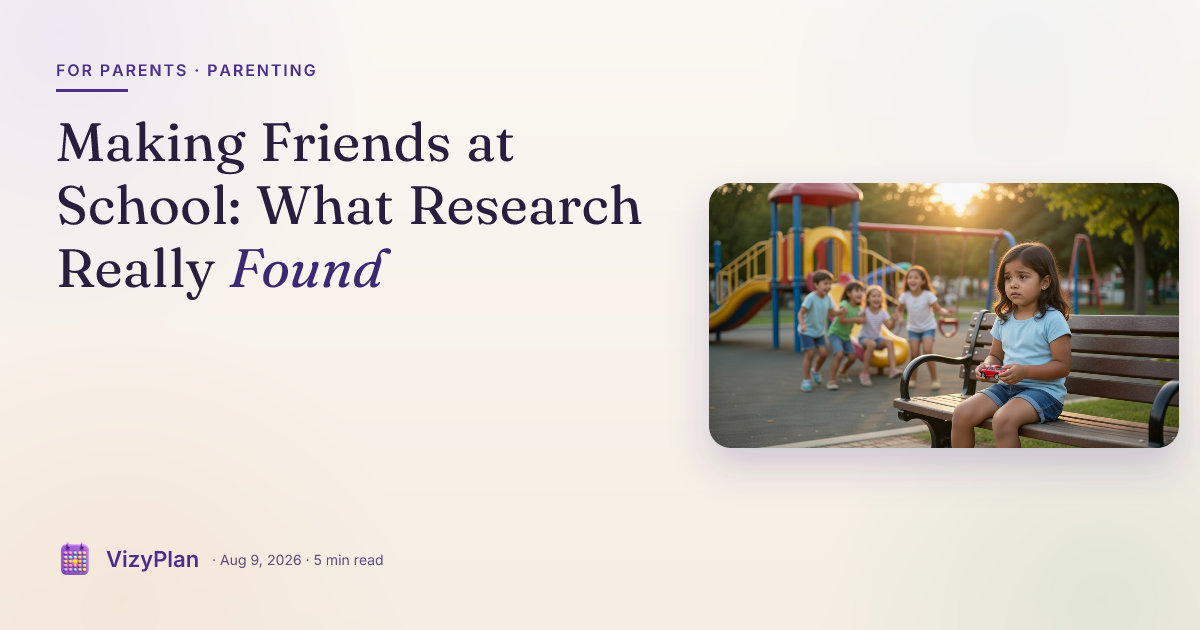
You watch your child at pickup, standing near a group rather than in it, and the worry arrives on schedule. Making friends at school is the thing parents of autistic children lose the most sleep over, and it is also the area where the research quietly disagrees with the assumptions most of us are carrying.
What the research found about making friends at school
A 2024 study published in Autism took an unusually direct approach. Researchers put RFID proximity sensors on 47 autistic children and 52 allistic classmates, ages 8 to 13, and tracked actual face-to-face contact during recess alongside peer nominations and self-reports.
The results are worth sitting with. There were no significant group differences in total time spent in social contact, in the number of interaction partners, or in playground centrality. The autistic children were not physically isolated. What they did have was significantly fewer reciprocated friendships, meaning fewer cases where a child named a peer and that peer named them back.
And loneliness itself showed no group difference overall. What differed was what predicted it. For autistic children, lower loneliness tracked with being more central among classmates. For allistic children, it tracked with time spent in social contact. Different children were getting their sense of connection from different things.
A separate 2023 study in Molecular Autism of 100 children ages 6 to 15 found most children in both groups reported having at least one friend, but ten autistic children described being often lonely, a pattern absent among non-autistic participants. Every one of those frequently lonely children still reported having a friend.
What that actually means for your child
Three things follow, and they change what is worth working on.
Proximity is not the goal. Being on the playground with other children is already happening. Pushing for more social exposure is solving a problem that the data suggests is not the bottleneck.
Reciprocity is the goal. The gap is in mutual, named, two-way friendship. That is a smaller and more solvable target than "social skills," and it usually needs a structure rather than a lesson.
Having a friend does not rule out loneliness. If your child says they feel lonely and also has a friend, both things are true. Do not argue them out of it.
Enjoying this article?
Get practical tips and insights delivered to your inbox — no spam, ever.
Six things that build the mutual kind
- Aim for one, not a group. One reciprocated friendship does more for a child's week than being tolerated by eight. Ask your child who they like, not who likes them.
- Build it around a shared interest, not a social occasion. Two children who both care about the same thing have a reason to talk. Two children in a room have an obligation. Our post on special interests as a skill engine covers how to use that deliberately.
- Host, and keep it short and structured. Ninety minutes, at your house, with a planned activity and a clear end. Home turf, known rules, and an exit make a first playdate survivable.
- Ask the teacher who your child gravitates toward. Teachers see the pattern you do not. That question is more useful than asking whether your child has friends.
- Support the friendship, do not coach the child out of themselves. The instinct to teach a child to mask better is understandable and it has costs. Our post on the double empathy problem covers why social difficulty is usually a two-way mismatch rather than a deficit to correct.
- Protect the recovery time around it. Socializing is expensive. A playdate on the same afternoon as a hard school day will not go well, and that is a scheduling issue rather than a social one.
A word about the start of the year
The first weeks of school are when groups form and then set, which makes early September genuinely higher leverage than October. It is worth asking, in that first week, whether your child can be seated near a specific peer, or paired for a first project. Small structural nudges early do more than social coaching later.
It is also worth remembering that unstructured time is where this all happens, and unstructured time is the hardest part of the school day for a lot of these students. Our post on recess and lunch covers what schools can put in place, and it is a reasonable thing to raise with a teacher.
VizyPlan was built by an autism dad and an autism mom who is a licensed speech-language pathologist so the parts of the day that are hardest to predict, including recess and a first playdate, can be shown in advance instead of walked into cold.
One friend who names your child back is the whole goal. It is a much smaller target than the one most of us are carrying around, and it is reachable.
Download VizyPlan and start your 7-day free trial today. Let your child see the social parts of the day coming, from recess to the first playdate. Just $6.99/month after your trial, no credit card required upfront.
VizyPlan was built by an autism dad and an autism mom who is a licensed speech-language pathologist who needed something that did not exist. Start your free trial.