Most holiday advice for autism families is about receiving: the wrapping paper, the surprise, the gift that is not quite right. This post is about the other side. An autistic child giving gifts is doing something quietly huge: thinking about what another person likes, making or choosing something, wrapping it with their own hands and then handing it over in front of an audience.
We started treating giving as its own small project in our house, separate from the present-opening chaos. My son does better when the holiday has jobs in it, and giving a gift turned out to be a job he could own.
Why an autistic child giving gifts is worth the effort
There is good research suggesting that giving feels good, even very early in life. In a 2012 study in PLoS ONE, Aknin, Hamlin and Dunn found that toddlers under two looked happier giving treats to a puppet than receiving treats themselves, and happier still when the treat they gave away was their own. The study was small and in typically developing toddlers, so treat it as a hopeful hint, not a promise.
Giving also asks a child to imagine someone else's point of view. Here it helps to be fair to autistic kids. Researcher Damian Milton's 2012 paper on the double empathy problem argues that misunderstandings between autistic and non-autistic people run in both directions. Your child is not missing empathy. Your child may simply show care in a different way, and plenty of grown-ups misread autistic kids just as often. Our post on the double empathy problem for parents goes deeper.
Choosing a gift: start with what your child loves
For an autistic child giving gifts, perspective-taking is easier when it starts on familiar ground. Instead of asking "What would Grandma like?" cold, try a bridge from your child's own interests.
- Pick one person. One gift for one person is plenty for a first year. Show a photo of that person.
- Start with what your child loves. A train fan might ask, "Grandma likes the color blue. Which blue train sticker should she get?" The interest stays your child's, and the choice becomes about someone else.
- Offer two or three picture choices. An open question like "What should we get?" is hard. Two photos of a mug, a drawing or a bag of her favorite tea make the decision doable.
- Say the reason out loud. "You picked tea because Grandma drinks tea every morning." Naming the reason teaches the thinking behind the gift.
If your child picks something only they would love, that is fine too. A gift that shares a favorite thing is still a gift.
A simple homemade gift your child can finish
Homemade gifts work well because an autistic child giving gifts can control every step and see the finish line. Keep the project to one session and three or four steps. Good options include a drawing in a dollar-store frame, a painted rock, a photo of your child with a short dictated note, or a bag of cookies they helped stir.
Wrapping as a fine motor task
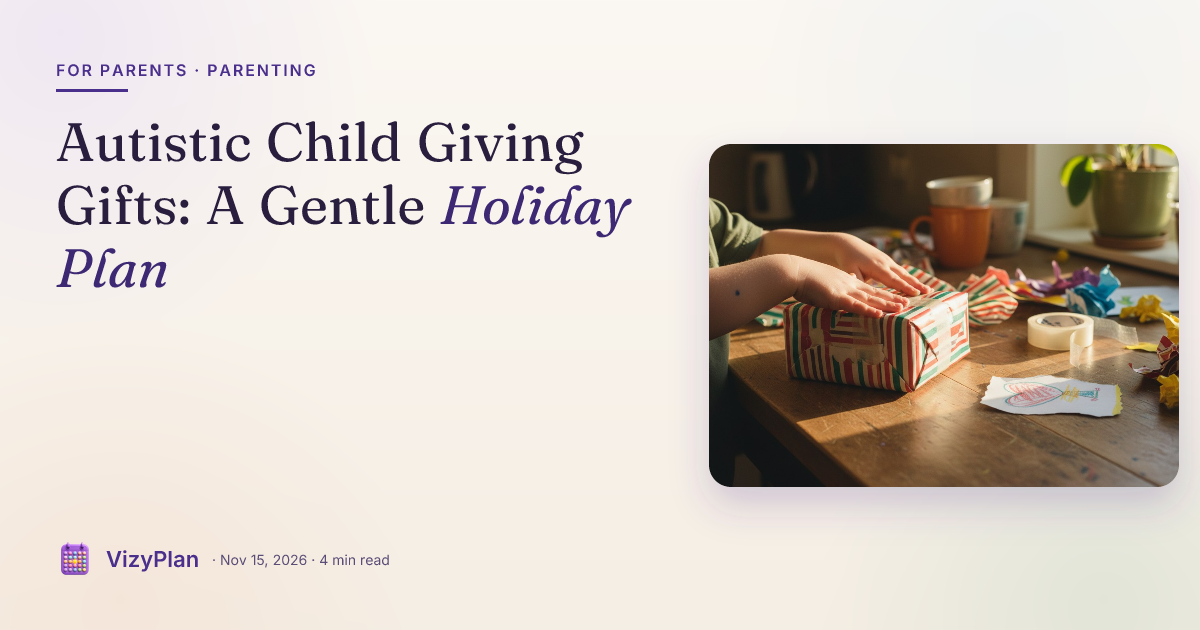
For an autistic child giving gifts, wrapping paper is a lot: slippery paper, scissors, tape that sticks to everything. Break it down, or skip the hard parts entirely.
- Pre-cut the paper. Cut a square that fits the box so your child only folds and tapes.
- Pre-tear the tape. Stick five or six pieces on the edge of the table so your child can grab one at a time.
- Use a gift bag if paper is too much. Tissue paper stuffed into a bag still counts, and the stuffing is satisfying for many kids.
- Add a sticker or a name tag. Writing or stamping the person's name is the final step, and it makes the gift clearly from your child.
Wrapping slowly is still wrapping. A slightly crooked package with a lot of tape is a package your child made.
Enjoying this article?
Get practical tips and insights delivered to your inbox — no spam, ever.
The moment of handing it over
Handing over a gift has a lot of unwritten rules: wait for the right time, say something, watch the person open it, cope with whatever face they make. Write those rules down. The National Clearinghouse on Autism Evidence and Practice 2020 report reviewed 972 studies and listed both visual supports and social narratives among its 28 evidence-based practices. A social narrative is a short, often illustrated story that describes a situation and what people in it might think and feel.
For an autistic child giving gifts, a four-picture story can cover it: "I bring the gift to Grandma. I say, 'This is for you.' Grandma opens it. She might smile or say thank you." Read the story a few times before the visit, and let your child practice with you as the pretend Grandma. Our guide to writing a social story walks through the format.
Give your child a quiet version of the moment too. Some kids would rather hand the gift over before everyone arrives, or leave it on a chair with a tag. Giving does not need a crowd to count.
When your child wants to keep the gift
The gift is shiny, they made it, and now it is supposed to leave. Wanting to keep it is normal, not selfish, and it happens to almost every autistic child giving gifts for the first time. A few things help:
- Make two. If it is a drawing or a painted rock, make one to give and one to keep.
- Take a photo first. A picture of the finished gift lets your child hold onto it in a way.
- Use a "first, then" card. "First we give the gift, then we have cocoa" gives the hard step a clear, good ending.
- Let it wait. If the moment is too hard today, the gift can go to Grandma next week. A delayed gift is still a gift.
If the holiday itself is the bigger challenge, our posts on gifts for autistic kids and opening presents with an autistic child cover the receiving side.
VizyPlan was built by an autism dad and an autism mom who is a licensed speech-language pathologist, so the pick, make, wrap and give steps can live in one picture routine your child can check off, with the cocoa waiting at the end.
Download VizyPlan and start your 7-day free trial today. Turn gift giving into a picture routine your child can follow. If it helps, keep going for $6.99/month or $59.99/year.
VizyPlan was built by an autism dad and an autism mom who is a licensed speech-language pathologist who needed something that did not exist. Start your free trial.