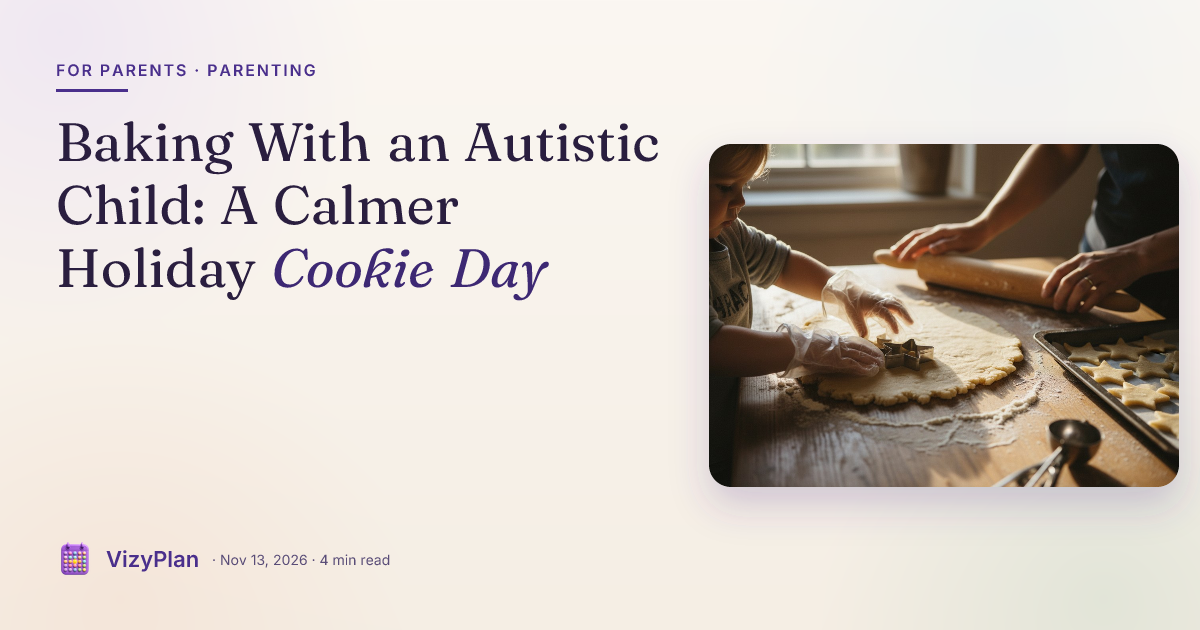
Holiday cookies look simple on a greeting card. In real life there is flour on the floor, a sticky hand held up in horror and a timer that seems to last forever. Baking with an autistic child can still be one of the best parts of December, because a recipe is already what so many of our kids love: a clear list of steps with a predictable ending.
In our house, the kitchen went from a place my son avoided to a place he asks for. The difference was not a better recipe. The difference was setting up the activity the way his brain already works.
Why baking with an autistic child can work so well
A recipe is a task analysis in disguise. Task analysis means breaking a big activity into small, ordered steps, and visual supports means showing those steps in pictures. Both appear on the list of 28 evidence-based practices in the 2020 National Clearinghouse on Autism Evidence and Practice report by Steinbrenner, Hume, Odom and colleagues, a systematic review of autism intervention research from 1990 to 2017.
Cookies also come with built-in practice. Measuring is counting. Stirring and rolling are heavy work for the hands. Waiting for the oven is real waiting with a real reward on the other side. Occupational therapists use cooking for exactly these reasons: an Evidence Connection article in the American Journal of Occupational Therapy describes using visual supports during culinary lessons with an autistic teen, drawing on strong evidence that visual supports and video modeling build independence in daily living tasks.
Set up the kitchen before anyone walks in
Most cookie meltdowns start before the first egg is cracked. A little setup changes the whole afternoon.
- Make a picture recipe. One photo or drawing per step, in order: wash hands, measure flour, add sugar, stir, scoop, bake, wait, cool, eat. Fewer words, bigger pictures.
- Pre-measure the tricky parts. Put ingredients in small bowls ahead of time so your child gets the satisfying dump and stir without the stress of leveling a cup.
- Pick a quiet time. Bake when the house is calm, not while guests arrive or the mixer competes with the TV.
- Plan the noisy moments. Stand mixers are loud. Show the mixer step on the recipe card, offer headphones, or switch to a hand whisk.
- Show the ending. Put the last picture where your child can see it, whether that is eating one warm cookie or putting them in a tin for Grandma. Knowing the finish makes the start easier.
Give your child one real job
When baking with an autistic child, a defined role beats a vague request to "help." Pick one job your child can own from start to finish: the dumper, the stirrer, the cookie cutter, the sprinkle boss or the timer keeper.
The timer keeper is an underrated role. Waiting for the oven is hard for many autistic kids, and a visual timer turns ten empty minutes into something you can watch shrink. Pair the wait with a small task, like lining up the cooling rack or picking the plate for the finished cookies.
Sticky dough, sensory differences and the gloves question
Many autistic children experience textures more intensely. A review by Cermak, Curtin and Bandini in the Journal of the American Dietetic Association connects sensory sensitivity to food selectivity in autistic kids, with texture showing up again and again. Sticky dough on the fingers can feel genuinely awful, not just messy.
Baking with an autistic child does not mean pushing through that feeling. Offer food-safe gloves, a cookie scoop instead of rolling balls by hand, a rolling pin and cutters instead of shaping, and a damp towel within arm's reach. Some kids are happy to touch dry flour but not wet dough. Let your child choose the tools, and celebrate the job done, not how it got done.
Enjoying this article?
Get practical tips and insights delivered to your inbox — no spam, ever.
Food exposure without pressure for picky eaters
Here is the part that surprised me most. Baking with an autistic child is low-pressure food exposure, because the goal is the cookie, not the bite.
A 2020 study in Nutrients by Garcia and colleagues followed 121 parent and preschool child pairs. After four weekly 90-minute cooking sessions, food fussiness scores in the cooking group fell from 3.0 to 2.6 on a five-point scale, with no change in the comparison group, and the cooking children were more willing to try green vegetables. The children in that study were not autistic, and the authors call the results preliminary, but the idea fits what many of us see at home: handling food without being asked to eat it lowers the stakes.
So let your child smell the cinnamon, crack the egg or press the cutter without any expectation to taste. If tasting happens, great. If it does not, the exposure still counts. Our post on safe foods and the sensory science of food refusal explains why that patience pays off, and these mealtime strategies for picky eating carry the same calm approach to the dinner table.
Kitchen safety when baking with an autistic child
Safety rules work best as pictures too. Add a "hot, adult only" card for the oven step, and keep the oven mitts with the grown-up.
The other rule is less obvious: no tasting the raw dough. The CDC explains that most flour is raw and can carry germs such as E. coli, and raw eggs can carry Salmonella. The CDC also advises against letting children play with raw dough, including homemade craft dough. If licking the spoon is your child's favorite part, bake a few extra cookies and let the first warm one be the reward.
Keep it short and end on a win
Baking with an autistic child does not need to be a whole-day production. One batch, one job and one clear finish is plenty. If your child taps out after scooping, that is a successful bake. The holiday season brings enough surprises already, and our guide to holidays and special events has more ideas for keeping the month predictable.
VizyPlan was built by an autism dad and an autism mom who is a licensed speech-language pathologist so a cookie recipe can become a picture routine your child can follow, step by step, with the warm cookie right there at the end.
Download VizyPlan and start your 7-day free trial today. Build your picture recipe before the first batch. If it helps, keep going for $6.99/month or $59.99/year.
VizyPlan was built by an autism dad and an autism mom who is a licensed speech-language pathologist who needed something that did not exist. Start your free trial.