The door at Grandma's house sticks, so somebody props it open while carrying in the casserole. In July, a few quiet minutes would be scary. In December, with the light gone by five and a pond at the end of the road, those same minutes carry much higher stakes. A winter wandering safety plan does not need to be complicated. The plan needs to be ready before you pull into the driveway.
We wrote a full guide to elopement and wandering in autism for the rest of the year. Today's post is the cold-weather, holiday-visit version, because the season changes the risks in a few specific ways.
Why wandering is common in autistic children
Wandering is not rare, and it is not a parenting failure. In a 2012 study in Pediatrics, Anderson and colleagues surveyed families of 1,218 autistic children and found that 49% had wandered or bolted at least once after age four. More than half of those parents named wandering among the most stressful behaviors they cope with.
The CDC summarizes the same research: about half of autistic children and youth were reported to wander, and about one in four of those children were missing long enough to cause concern. Children often wander toward something they love, like water, a favorite place, or away from noise that has become too much.
Why winter wandering safety plans matter more in the cold
Three things change once the temperature drops.
Cold works fast on small bodies. The CDC's winter weather guidance calls hypothermia a medical emergency and notes that it can happen even above 40°F when a person gets wet from rain, sweat or cold water. In babies and young children, the CDC lists bright red, cold skin and very low energy as warning signs. A child who bolts without a coat, or who refuses the coat because of winter coat sensory issues, has much less time outside before the cold becomes dangerous.
Water does not look like water. Drowning is the outcome families fear most, and for good reason. A study of national death records by Guan and Li in the American Journal of Public Health found that drowning was among the most common causes of injury death in autistic people, with the excess risk of injury death highest in children under 15. In winter, a pond with a thin skin of ice can look like a flat, interesting surface to walk on.
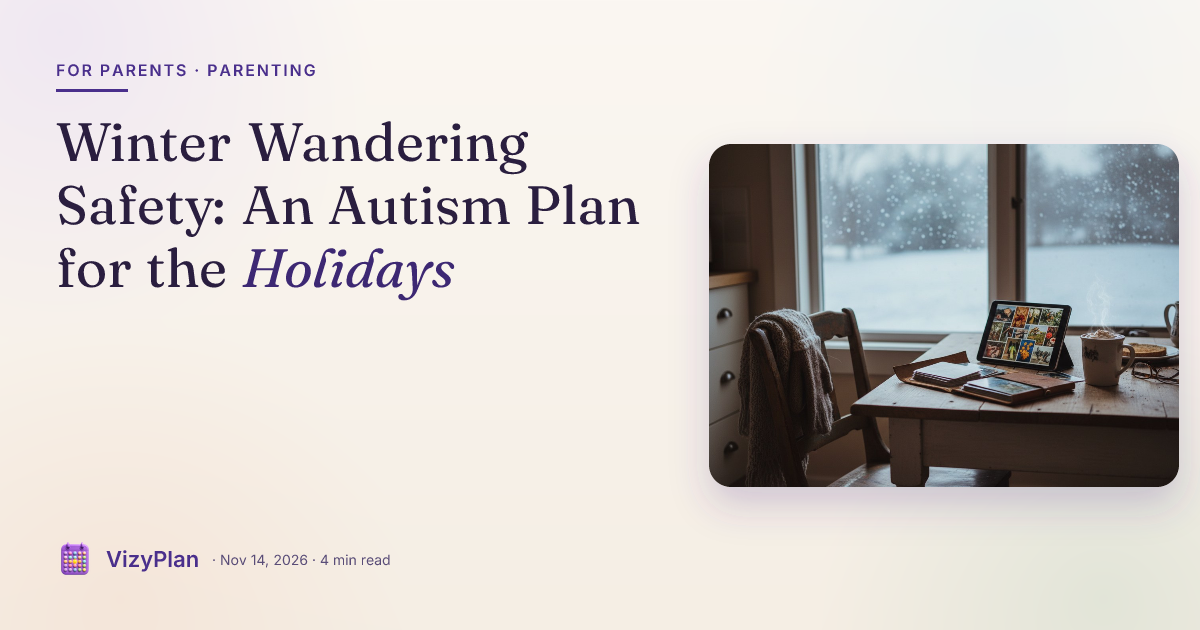
Darkness comes early. Any winter wandering safety plan has to account for the light. By late afternoon in December, a child in a dark coat is hard to spot from a porch, and searchers are working with flashlights.
Holiday visits mean new doors and more of them
At home, you know every lock, alarm and gate. At a relative's house, a hotel or a friend's party, none of that is in place. Doors may open with a lever your child can push in one motion. Guests come and go carrying bags and dishes, and a door left open for a minute is easy to miss in a loud kitchen.
Crowds make the problem worse, not better, which is why winter wandering safety planning has to include the other adults in the room. When ten adults are in the house, each one tends to assume someone else is watching. Our guide to holiday family gatherings and overstimulation covers the sensory side, and noise and crowding are often exactly what a child is trying to escape.
Enjoying this article?
Get practical tips and insights delivered to your inbox — no spam, ever.
A winter wandering safety checklist
- Pack portable door alarms. Battery chimes that stick to a door frame are cheap, light and quick to install. The National Autism Association describes door and window chimes as very inexpensive and effective. Put one on every exterior door at the house you are visiting, because alarms are the backbone of winter wandering safety families can carry in a bag.
- Walk the house when you arrive. Before coats come off, check which doors lead outside, whether there is a pool, pond, creek or busy road nearby, and which room can be a quiet spot.
- Tell the host and the guests. A short, calm heads-up works: "My son may try to leave. Please make sure the door clicks shut behind you." Ask your host to keep exterior doors closed and to tell you if anyone props one open.
- Put ID on your child. The CDC recommends an ID bracelet or information card with your name and phone number. A wristband, shoe tag or a card sewn into a coat all work, so choose the one your child will tolerate.
- Take a photo the morning you leave. The CDC advises keeping a current photo and description ready. A picture on your phone showing today's clothes and coat saves precious minutes.
- Practice "stop" and name response. The CDC lists responding to a "stop" command and saying their name and phone number among the safety skills to teach. Practice at home in short, playful rounds before the trip.
- Assign a watcher in shifts. Name one adult at a time as the "door person" for 30 minutes, then hand off out loud. A named job beats a room full of people who each assume someone else is watching.
If your child goes missing: the first five minutes
- Call 911 immediately. The National Autism Association's guidance is to always call 911 right away when a child is missing. Do not spend twenty minutes searching first. Say that your child is autistic, may not respond to their name, and may be drawn to water.
- Search water first. The National Autism Association advises searching the highest-risk areas first, such as nearby water and busy streets. In winter, that includes ponds, pools under covers, creeks and drainage ditches.
- Send the photo. Hand responders the photo you took that morning, along with your child's coat color.
- Split the house and the yard. One adult checks small hiding spots indoors, like closets, cars, sheds and under beds, while others head outside.
When your child is found, check for wet clothing, shivering, confusion or cold, bright red skin. The CDC says a body temperature below 95°F needs medical attention immediately.
Make the plan visual for your child
Many autistic children do better when the visit is predictable. A picture plan of who is coming, which room is the quiet room, and when it is time to go home can lower the pressure that leads to bolting. A VizyPlan routine can show the drive, the door rule, the quiet spot and the drive home as one simple sequence your child has seen before you arrive.
VizyPlan was built by an autism dad and an autism mom who is a licensed speech-language pathologist, and a winter wandering safety plan is one of the routines we hope you never need and are always glad you made.
Download VizyPlan and start your 7-day free trial today. Build your holiday visit plan before the first trip. If it helps, keep going for $6.99/month or $59.99/year.
VizyPlan was built by an autism dad and an autism mom who is a licensed speech-language pathologist who needed something that did not exist. Start your free trial.