
Every teacher knows the student who is bright, kind and somewhere else for half of independent work time. You redirect, the student refocuses, and five minutes later you redirect again. Self-monitoring for students with ADHD flips that loop. Instead of the teacher noticing every drift, the student learns to notice, mark a simple checklist and get back to work. Done well, self-monitoring hands a little of the reminding over to the student, one quiet check at a time.
Self-monitoring is not a punishment chart or a public behavior board. Self-monitoring is a private tool a student uses to answer one small question, many times a day: am I doing what I planned to do?
What the research says about self-monitoring for students with ADHD
Self-monitoring for students with ADHD has one of the deepest research bases in the classroom. A meta-analysis by Reid, Trout and Schartz in Exceptional Children (2005) pooled studies of four self-regulation approaches for children with ADHD: self-monitoring, self-monitoring plus reinforcement, self-management and self-reinforcement. Combined effect sizes for all four were greater than 1.0 for on-task behavior, inappropriate behavior, and academic accuracy and productivity. In plain terms, the effects were large.
A later systematic review by Bruhn, McDaniel and Kreigh in Behavioral Disorders (2015) pulled together 41 studies from 2000 to 2012 of self-monitoring with K-12 students who had persistent behavior problems, looking closely at how reinforcement, feedback, the reason behind a behavior and technology shape results.
The evidence covers autistic students too. The National Clearinghouse on Autism Evidence and Practice 2020 review lists self-management as an evidence-based practice for autistic children and youth.
Two kinds of self-monitoring: attention and performance
Self-monitoring for students with ADHD comes in two main versions, and both fit in a general education classroom.
Self-monitoring of attention. At set moments, the student asks, "Was I paying attention?" and marks yes or no. The prompt can be a soft tone, a timer or a vibrating device. In one well-known study, Amato-Zech, Hoff and Doepke (2006) taught three elementary students to self-monitor attention using a MotivAider, a small pager-style device that vibrates at set intervals. On-task behavior rose for all three, and both teachers and students rated the approach as acceptable.
Self-monitoring of performance. The student counts or checks the work itself: problems finished, sentences written, steps of a routine completed. Performance checks fit students who stay seated and quiet but finish very little.
Many students do best with a mix: a short self-monitoring checklist for the steps of a task, plus an attention check during longer work blocks.
Enjoying this article?
Get practical tips and insights delivered to your inbox — no spam, ever.
A teacher plan for self-monitoring for students with ADHD
- Pick one behavior and define it in student words. "Eyes on my work, pencil moving" beats "on task." Choose a behavior the student can actually see in themselves.
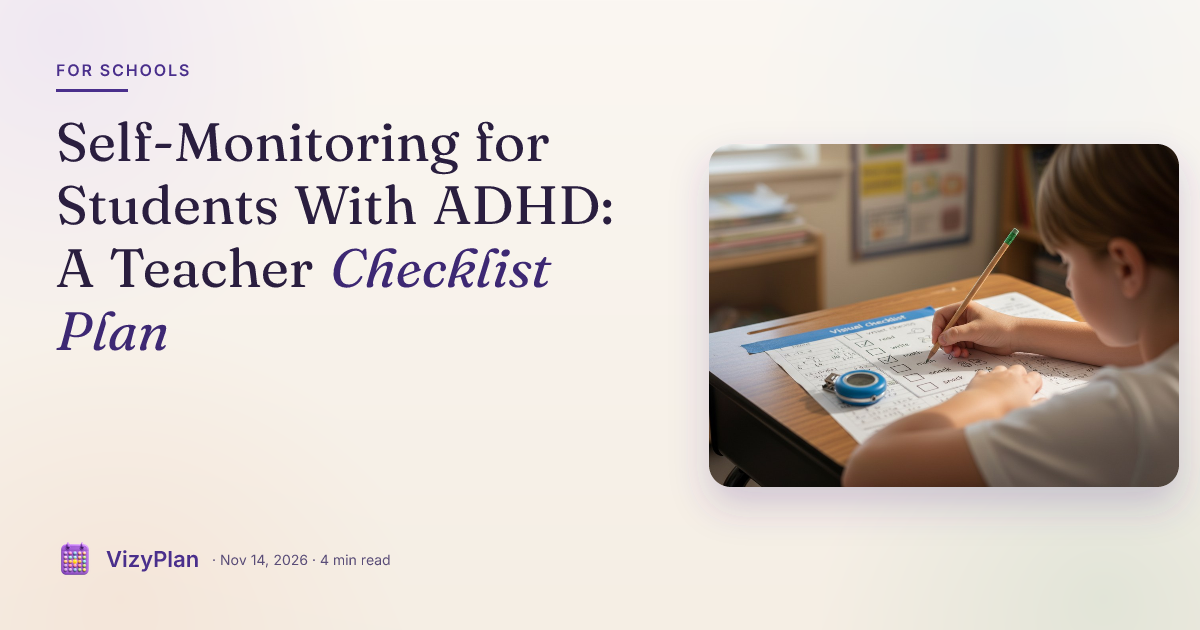
- Build a short checklist. Three to five boxes, with a picture beside each step for younger students or students who read below grade level. Tape it to the desk or slip it into a folder.
- Teach it directly before using it. Model a yes moment and a no moment. Have the student practice marking both. A self-monitoring checklist only works once the student can tell the difference.
- Choose a quiet prompt. A vibrating watch or a MotivAider-style device keeps the prompt private. Start with short intervals, such as every three to five minutes, during one class period.
- Match ratings with the student. You rate the same intervals on your own sheet, then compare at the end of the period. A match earns praise or a point, even when both of you marked "no."
- Review briefly and celebrate honesty. Two minutes, private, specific. "You caught yourself drifting twice and came right back. That is the skill."
- Fade the support on purpose. Once the student hits the goal for a couple of weeks, stretch the interval, drop the teacher match to spot checks, and eventually let the checklist stand on its own.
Why the teacher match matters
Matching is where self-monitoring for students with ADHD becomes self-awareness. A 2021 study by Bruhn and colleagues in Assessment for Effective Intervention compared 249 interval ratings from 19 student and teacher pairs. Overall agreement was strong, but agreement varied from pair to pair, and students tended to rate themselves higher than teachers did.
That pattern is normal, and the match is how a student learns to see themselves accurately. Reward accuracy, not perfection. A student who honestly marks "no" and gets back to work is doing exactly what the tool is for.
Tips for autistic students and students with ADHD
- Keep the checklist visual. Pictures or icons cut the reading load and make each step concrete.
- Use the same layout every time. Predictability lowers stress, especially for autistic students who rely on routine.
- Start where the student succeeds. Self-monitoring for students with ADHD builds on early wins, so set the first goal low enough to win on day one.
- Connect it to bigger routines. The same checklist approach works for packing up at the end of the day, which our guide to losing school supplies and executive function walks through.
Self-monitoring also pairs well with the supports in our teacher's guide to homework accommodations, so a student can check the same kind of steps at home that they check in class.
VizyPlan was built by an autism dad and an autism mom who is a licensed speech-language pathologist so a student can carry a picture checklist from the classroom to the kitchen table and follow the same steps in both places.
Share VizyPlan with your families so the self-monitoring checklist your students use in class keeps going at home. The 7-day free trial lets a family try it first. If it helps, keep going for $6.99/month or $59.99/year.
VizyPlan was built by an autism dad and an autism mom who is a licensed speech-language pathologist who needed something that did not exist. Explore VizyPlan.