
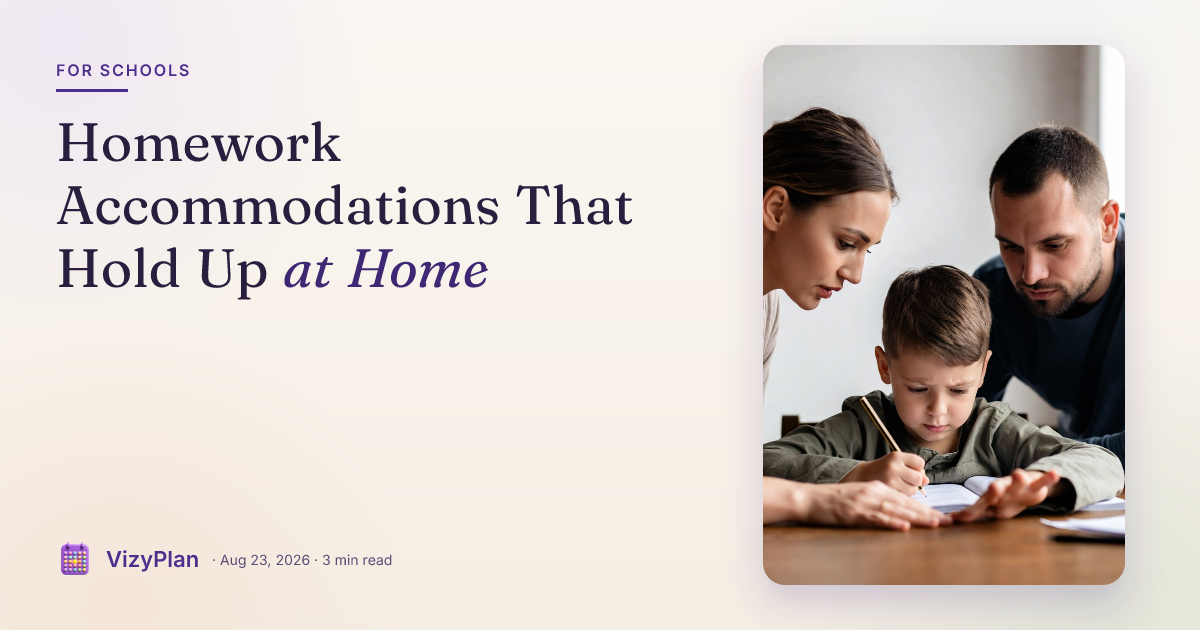
Twenty minutes of reading and a worksheet. In a number of the homes on your roster, that is a ninety minute standoff ending with a crying child, an exhausted parent, and a page finished by an adult. Homework accommodations agreed in September are the cheapest way to prevent a conflict most families will never report to you.
What the homework research supports
The evidence for elementary homework is weaker than the tradition suggests. The most cited synthesis, Cooper, Robinson, and Patall's 2006 review in Review of Educational Research, found the average correlation between time spent on homework and achievement was near zero for elementary students, while the relationship strengthened at secondary level.
The common ceiling comes from the same place. The National Education Association and National PTA guideline is roughly ten minutes per grade level per night. A third grader is therefore working to a thirty minute expectation, and that guideline assumes a child who can start, sustain, and finish without a second adult beside them.
For students with executive function difficulty, none of those assumptions hold. Focus groups with autistic middle schoolers and their parents, reported in the Journal of Autism and Developmental Disorders, confirmed the need for direct support around academic executive function skills rather than more assigned work.
Homework accommodations worth setting now
- Set a time cap, not a task cap. Twenty minutes of genuine effort, signed by a parent, counts as complete. The cap protects the family and still tells you what the child could do.
- Cut the repetition. Odd numbers only. Five problems demonstrate the skill as well as twenty and cost a quarter of the fight.
- Send the assignment where the parent can see it. A photo of the board or a posted list removes the nightly guessing game about what was even assigned.
- Separate practice from performance. Make clear which work is graded. Families will spend their limited energy correctly if they know where it counts.
- Ask each family once, in September, what home actually looks like. Therapy schedules, siblings, and shift work shape homework more than motivation does.
Enjoying this article?
Get practical tips and insights delivered to your inbox — no spam, ever.
The part you do not see
By the time a student reaches the kitchen table, the school day has already spent most of what they had. A parent who reports that homework is impossible is usually describing depletion rather than defiance, a pattern our post on after school restraint collapse explains in detail. The parent side of the same evening appears in homework battles.
VizyPlan was built by an autism dad and an autism mom who is a licensed speech-language pathologist so the evening has a visible shape instead of an open ended demand.
Share VizyPlan with your families so the plan you set at school has a structure at home. The 7-day free trial lets a family try it first. If it helps, keep going for $6.99/month or $59.99/year.
VizyPlan was built by an autism dad and an autism mom who is a licensed speech-language pathologist who needed something that did not exist. Explore VizyPlan.