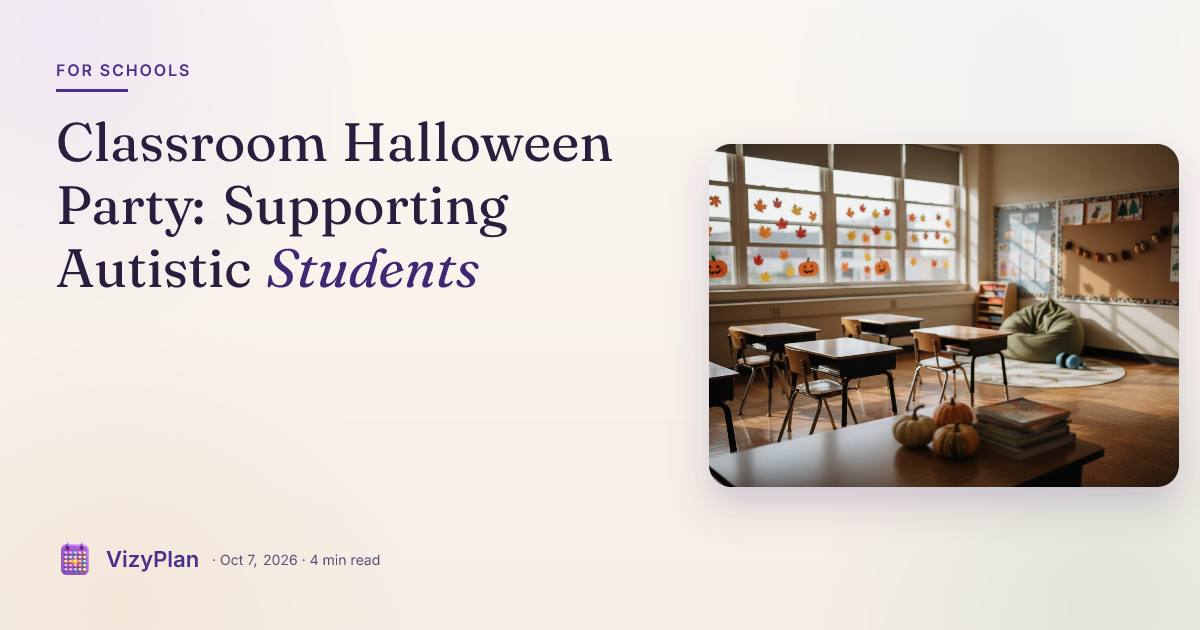
A classroom is predictable on purpose, and for one afternoon in late October that predictability is taken away on purpose too. A classroom Halloween party is usually planned for the students who find parties easy, which leaves the students who do not without a plan at all.
The schedule on the wall still says reading block. The room says something else entirely. For an autistic student who has spent eight weeks learning to trust that wall, the gap between the two is the hardest part of the day.
What a classroom Halloween party asks of an autistic student
A party removes the structure and keeps the demands. The lights change, the volume doubles, the furniture moves, and the social rules shift from "raise your hand" to an unwritten set nobody teaches. Costumes make familiar classmates unrecognizable. Food appears that a student with food aversions cannot eat while sitting at a table where everyone else is eating. Add the surprise element that Halloween decorations are designed around, and a student who was regulated at 1pm is not at 1:40.
The behavior that follows is almost always read as the student's problem. It is the room's.
Seven things that make the afternoon work
- Put the party on the visual schedule a week out. Not the morning of. The student needs to see the change in the same place they see every other change, repeatedly, before it happens.
- Give the party a shape and an end time. Blocks of twenty minutes with a named activity each beat an open hour. An end time the student can count down to converts an unbounded event into a bounded one.
- Name the quiet space before the party, not during it. Point at the door, say it out loud, and agree what asking looks like. A break card in a pocket is only useful if using it was rehearsed.
- Keep the lights and the audio at ordinary levels. Skip the strobe, the fog machine, and the sound effects track. Decorations that do not jump, scream, or flash are still decorations.
- Make costumes optional and name the alternative. Say "costume or Halloween colors," so opting out is a stated choice rather than a visible failure. Masks and face paint cause most of the costume problems worth avoiding.
- Offer a job to any student who wants one. Handing out napkins, running the music, or guarding the door gives a student a script for the part of the party that has none, which is the part that overwhelms them.
- Expect the cost to land after school, not in your room. A student who held it together all afternoon often falls apart at home, which our guide to after school restraint collapse explains for the families you will hear from that evening.
Enjoying this article?
Get practical tips and insights delivered to your inbox — no spam, ever.
Costume day deserves its own warning home
The single most useful thing a classroom teacher can do for a Halloween party is send the plan home a week early, with the costume rules in writing. Families can then rehearse the costume at home, swap a mask for face-free alternatives, and decide whether their child wears it all day or changes into it after lunch. The same logic applies to spirit week, and the families who get that email are the ones whose children arrive ready.
Nothing on this list makes the party less fun for the students who were always going to love it. The lights stay on, the music plays, and one more student is still in the room at the end of it.
VizyPlan was built by an autism dad and an autism mom who is a licensed speech-language pathologist so the party, the costume, and the quiet space can be on a schedule a student sees at home all week.
Share VizyPlan with your families so the week before the party is spent preparing instead of guessing. The 7-day free trial lets a family try it first. If it helps, keep going for $6.99/month or $59.99/year.
VizyPlan was built by an autism dad and an autism mom who is a licensed speech-language pathologist who needed something that did not exist. Explore VizyPlan.