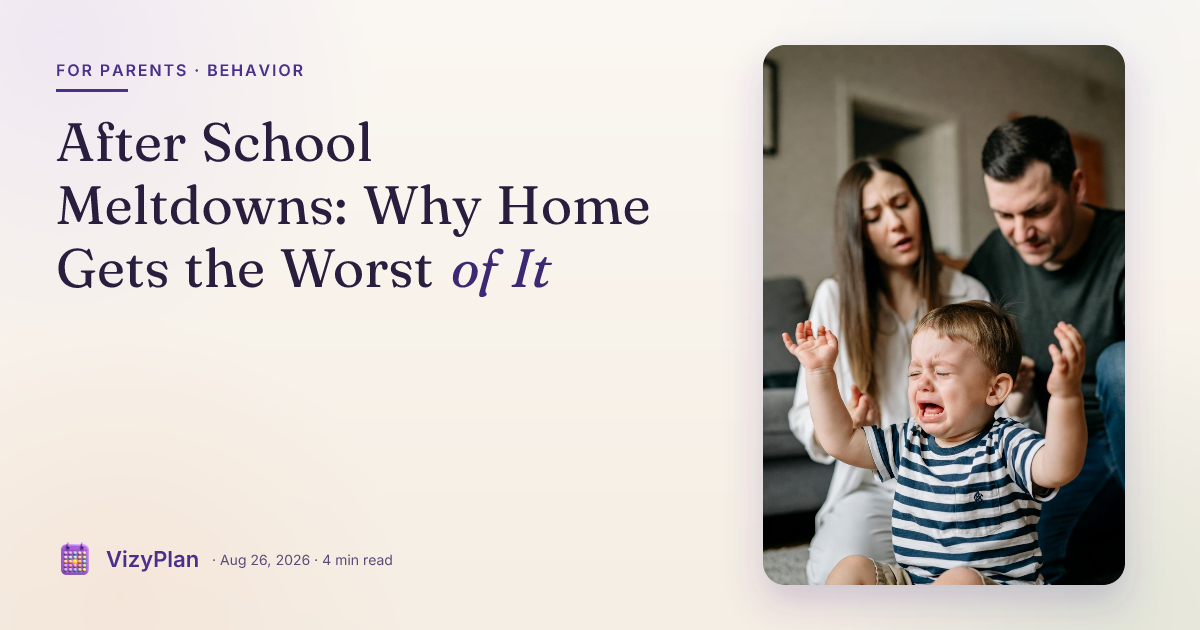
The pickup smile lasts about ninety seconds. By the car, the shoes are a problem. By the driveway, the wrong snack is a catastrophe, and the after school meltdowns are underway. When you gently ask the teacher about it, you get the sentence every parent of a masking child knows by heart: we never see that here.
After school meltdowns are one of the most misunderstood patterns in neurodivergent childhood, because the two adults comparing notes are each seeing a real, but incomplete, half of the same child.
Why after school meltdowns happen
The pattern has a name: after school restraint collapse. A child spends the entire day suppressing impulses, filtering sensory input, decoding social rules, and meeting behavioral expectations. That suppression, often called masking, runs on a finite supply of self control. When the child finally reaches a safe place and a safe person, the supply is empty and everything held in all day comes out at once. The Autism Awareness Centre describes restraint collapse as the release that happens precisely because home feels safe, and notes it may be especially common in autistic girls, who often mask hardest.
Read that carefully, because it contains the reframe that changes everything. The meltdown happens at home because your child trusts you. You are not the cause. You are the safe place.
The compliment that stings
We never see that here sounds like an accusation, but it is actually evidence. A child who performs regulation all day at school and collapses at home is working, not failing. The version the teacher sees is real. The version you see is real. Your job is not to make home look like school. It is to make the landing softer. If every conversation about the school day dead ends in one word, our post on when fine is the only answer has scripts that help.
Building a decompression routine
The goal is a predictable, low demand runway between the last bell and the first expectation. Here is the structure that works for most families:
- Feed them before you ask them anything. A protein snack in the first ten minutes, before questions, before homework, before errands.
- Protect a no-questions window. Thirty minutes where nothing is required, no how was your day, no did you have homework. Connection can be silent.
- Offer a sensory reset, not a screen by default. Trampoline, swing, bath, heavy blanket, or yes, sometimes a show. Match it to what your child seeks.
- Make the afternoon visible. A short visual routine, snack, break, homework, dinner, removes the negotiation that triggers half the battles.
- Move homework later, or shorter. A tired child cannot learn at 3:45. If homework is war every night, read homework battles before you fight another one.
Enjoying this article?
Get practical tips and insights delivered to your inbox — no spam, ever.
When it is more than collapse
A rough hour after school in September is common. A child who is aggressive for entire evenings, stops eating, or dreads school more each week may be telling you about a problem inside the school day itself. Trust the trend line, and protect the weekend while you investigate, something we cover in protecting the weekend.
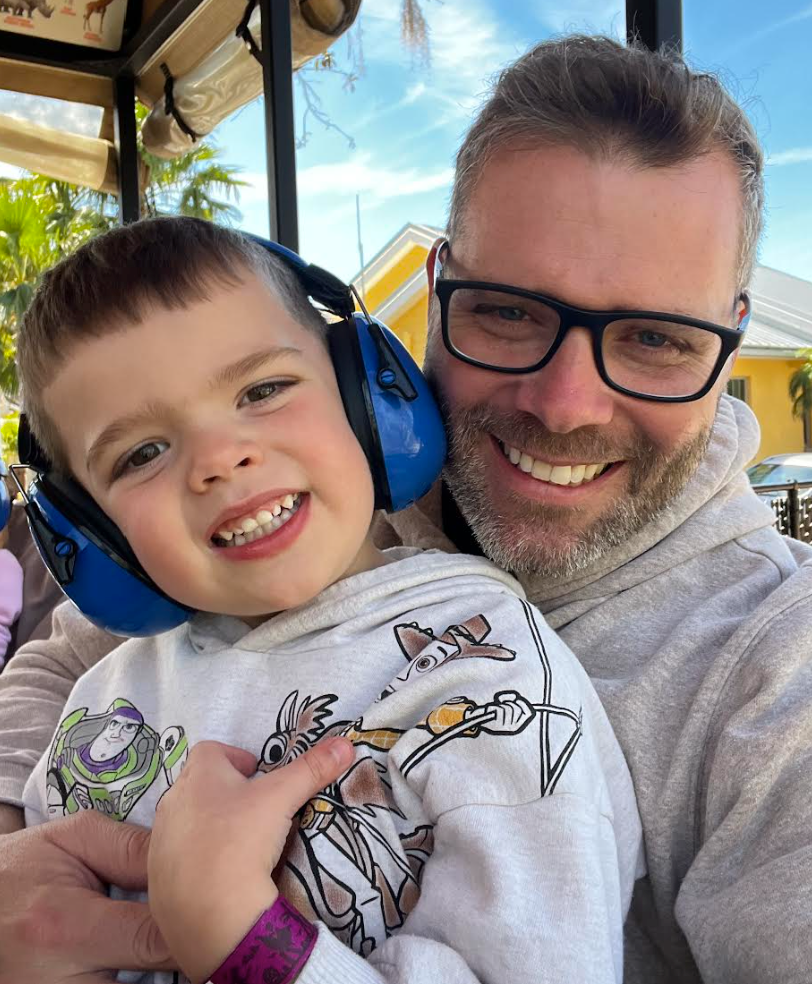
VizyPlan was built by an autism dad and an autism mom who is a licensed speech-language pathologist so the after school hours can run on a routine your child can see, not on negotiations nobody has the energy for.
Download VizyPlan and start your 7-day free trial today. Build the after school routine once and let it absorb the four o'clock chaos. If it helps, keep going for $6.99/month or $59.99/year.
VizyPlan was built by an autism dad and an autism mom who is a licensed speech-language pathologist who needed something that did not exist. Start your free trial.