

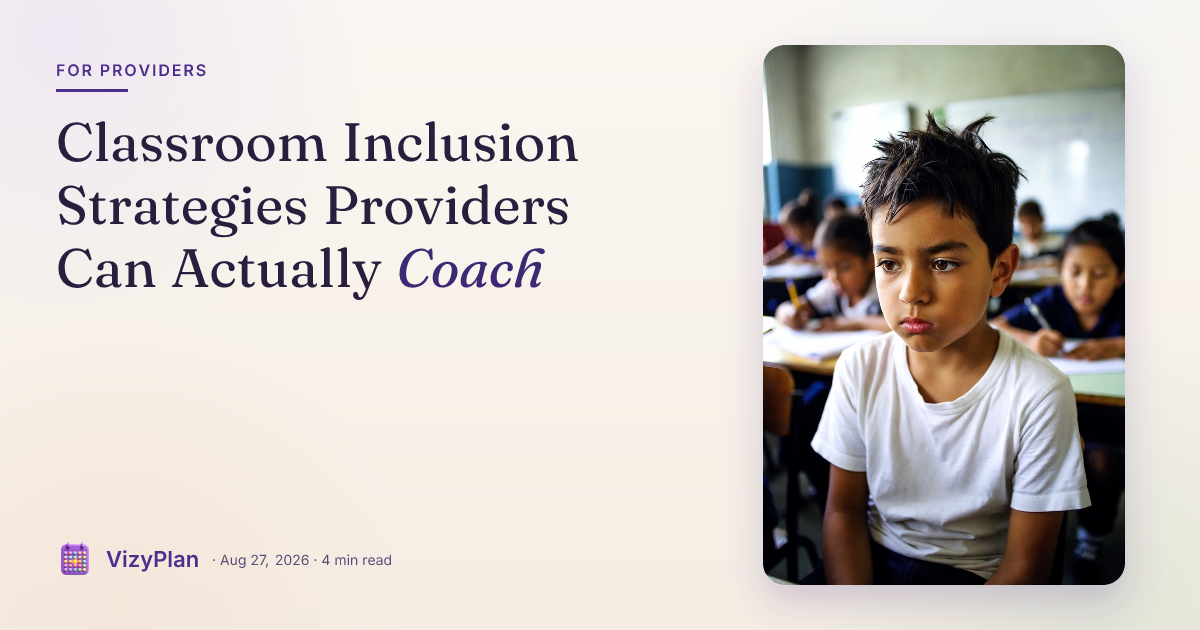
A student can receive every service minute on the IEP and still spend lunch alone, get benched in gym, and never once be handed a role that matters in the classroom. Present is not the same as included, most providers can name a student on their caseload who proves it, and the fix is a set of classroom inclusion strategies you can coach.
The good news is that inclusion is not a vibe the school either has or lacks. The most reliable classroom inclusion strategies in the research are concrete, teachable structures, and a provider who is already in the building is perfectly positioned to coach them.
Classroom inclusion strategies with evidence behind them
The strongest evidence base belongs to peer-mediated intervention: teaching classmates, not just the target student, how to initiate, prompt, and sustain interaction. A review of peer-mediated intervention studies reports consistent positive effects on social and academic outcomes for autistic students, and one systematic review calculated an average effect size of 0.82, which is large by any educational standard. A pilot study in Frontiers in Psychology found peer-mediated approaches improved social interaction skills, and teachers consistently report a second effect: the whole class gets kinder, because the intervention teaches peers what to do instead of leaving them to guess.
The logic matters for your caseload. Working the skill one to one and hoping it transfers to peers is the weakest link in the chain. Teaching the peers builds the environment the skill has to survive in.
What you can coach in ten minutes with a teacher
You do not need a training day. You need one routine, a couple of willing classmates, and a teacher who gets a structure instead of a lecture:
- Pick one daily routine, not the whole day. Morning arrival, a center rotation, or lineup. Small enough to run every day without heroics.
- Give two or three peers an actual job. Show, wait, then help is a script an eight year old can run. Rotate the helpers so it never becomes a caretaking role.
- Coach the peers, not just the student. Five minutes of teaching classmates how to invite and how to wait beats another month of adult prompting.
- Put the visual support where everyone can use it. A routine strip the whole table uses removes the stigma of the support only one child holds. Whole-class visuals are inclusion.
- Measure one thing. Initiations at centers, minutes engaged in gym, turns taken at lunch. You will want the number in the spring, as we argued in baseline data in the first month.
Enjoying this article?
Get practical tips and insights delivered to your inbox — no spam, ever.
The provider's seat is the advantage
You see the student in the room where inclusion succeeds or fails, which is exactly the argument we made about service delivery in push-in versus pull-out. And a short, structured look at how the classroom actually runs, covered in our classroom observation guide, will usually surface the one routine where a peer structure would change the student's day.
Inclusion is not extra credit for schools, and it is not a favor to families. It is the setting where the goals you write are supposed to live.
VizyPlan was built by an autism dad and an autism mom who is a licensed speech-language pathologist so the same visual supports can follow a student from the therapy room to the classroom to home.
Share VizyPlan with your families so the support does not stop at the classroom door. The 7-day free trial lets a family try it first. If it helps, keep going for $6.99/month or $59.99/year.
VizyPlan was built by an autism dad and an autism mom who is a licensed speech-language pathologist who needed something that did not exist. Explore VizyPlan.