
Every claim you make in the spring meeting gets measured against a number you take in the next three weeks. Baseline data collected in the first month of school is the most consequential data of the year, and it is usually gathered in the busiest and least representative conditions of the year.
Why baseline data taken now can mislead
Two problems arrive at once. The first is setting. A multi-site randomized trial analysis in Research in Autism Spectrum Disorders found that 126 of 168 children showed zero disruptive behavior during structured direct observation, despite moderate disruptive behavior being required for enrollment. A clean clinic baseline can mean the room, not the child.
The second is timing. A child three weeks into a new classroom, a new teacher, and a new bus is not at their stable level. Take a number now and you may be measuring the transition rather than the skill.
Neither is a reason to skip it. Both are reasons to record what the conditions were.
What to actually capture
- Probe before you teach. Cold probes on three to five priority targets in session one. It is the only clean baseline you get all year.
- Record the context alongside the number. Time of day, setting, who was present, how far into the school year. A number without conditions cannot be compared to anything.
- Take at least two points, not one. A single session is noise. Two or three across different days tells you where the middle is.
- Get a home number too. Parent report catches what a clinic room does not. A study of 109 toddlers found parents frequently reported skills that direct testing had missed.
- Write down the criterion now. What will count as progress in six months, decided before you are invested in the answer.
Enjoying this article?
Get practical tips and insights delivered to your inbox — no spam, ever.
Keep the system light enough to run
Ambitious data plans collapse. A 2024 survey of 203 BCBAs found most collected procedural-fidelity data on 20 percent or fewer of their supervision sessions, and the reasons were logistical rather than motivational: time, caseload, resources. If trained clinicians with dedicated time cannot sustain heavy data collection, a plan that assumes they can is a plan that produces gaps.
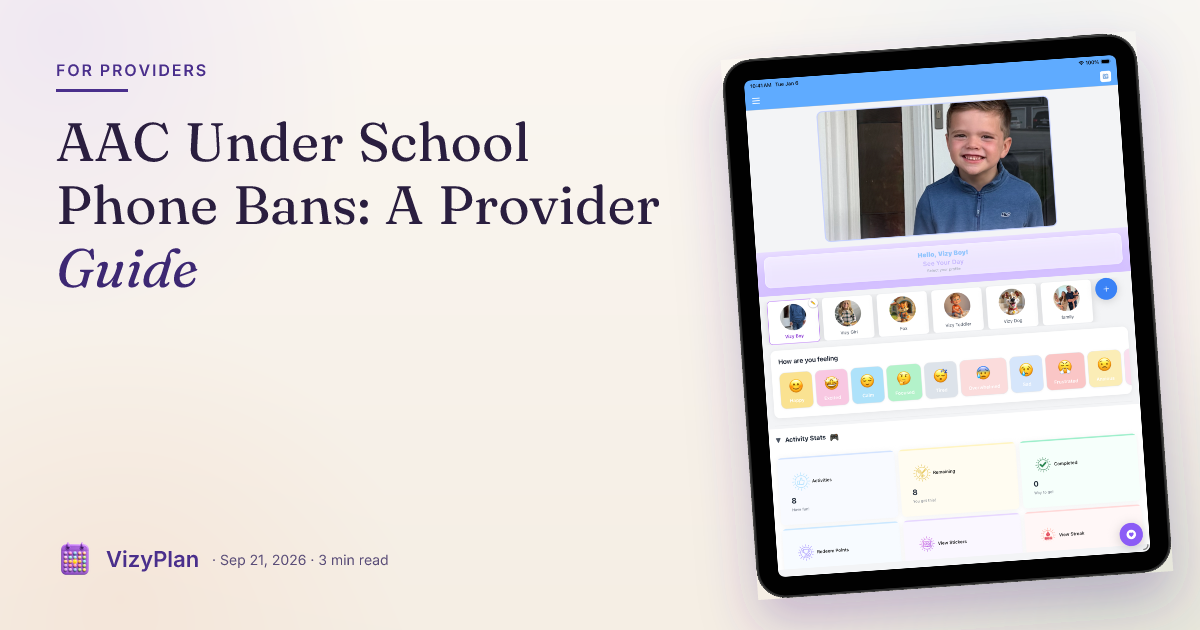
The lightest baseline is one nobody has to remember. A visual routine that a family already runs records completion as a byproduct, which our post on home data collection covers in detail.
VizyPlan was built by an autism dad and an autism mom who is a licensed speech-language pathologist so the routine a family runs anyway becomes the evidence you need in the spring.
Share VizyPlan with your families so the fall baseline includes what home actually looks like. The 7-day free trial lets a family try it first. Just $6.99/month after, no credit card required upfront.
VizyPlan was built by an autism dad and an autism mom who is a licensed speech-language pathologist who needed something that did not exist. Explore VizyPlan.