A sensory-friendly holiday event at your clinic can be the one celebration of the season where a client does not have to hold it together. The building is familiar, the staff already know which sounds and textures are hard, and families do not have to explain anything at the door. That combination is rare in December, and families notice it.
A clinic party also carries real risks: a crowded lobby, a surprise visitor in a red suit, a cookie with tree nuts, and a phone camera pointed at a client whose picture is protected health information. A little planning handles all of them.
Why a sensory-friendly holiday event matters for your caseload
Sensory over-responsivity is common, not occasional. In a representative sample of 925 children aged 7 to 11, Ben-Sasson, Carter and Briggs-Gowan (2009) found that about 16% of parents reported at least four touch or sound sensations bothered their child, and elevated over-responsivity was linked to more internalizing, externalizing and dysregulation problems. A meta-analysis of 14 studies by the same lead author found autistic participants differed from typical peers in under-responsivity, over-responsivity and sensation seeking.
Most holiday parties stack the exact triggers those studies describe: loud music, crowds, unexpected touch and long waits. A sensory-friendly holiday event removes the stack instead of asking clients to push through it.
Food deserves the same care. FARE estimates that about 1 in 13 U.S. children has a food allergy, roughly two in every classroom, and that more than 40% of children with food allergies have had a severe reaction. A clinic event with 30 children is likely to include at least one.
A 10-step plan for a sensory-friendly holiday event
- Call it a winter event. Not every family celebrates the same holiday, and some celebrate none. A neutral name like "Winter Open House" or "Snow Day Social" welcomes everyone, and families can still bring their own traditions.
- Send an RSVP with sensory questions. Ask about sounds, lights, crowds, touch, food allergies, preferred arrival time and what helps when a client is overwhelmed. Offer two or three arrival windows so the room never fills at once.
- Build a visual schedule of the event. Show each part in pictures: arrive, craft table, snack, story, goodbye. Send it home a week early so families can preview it, and post a large copy at the entrance.
- Set the lights and music low. Use lamps or natural light instead of overhead fluorescents, skip flashing lights, and keep music soft enough to talk over. Choose one person to control the volume.
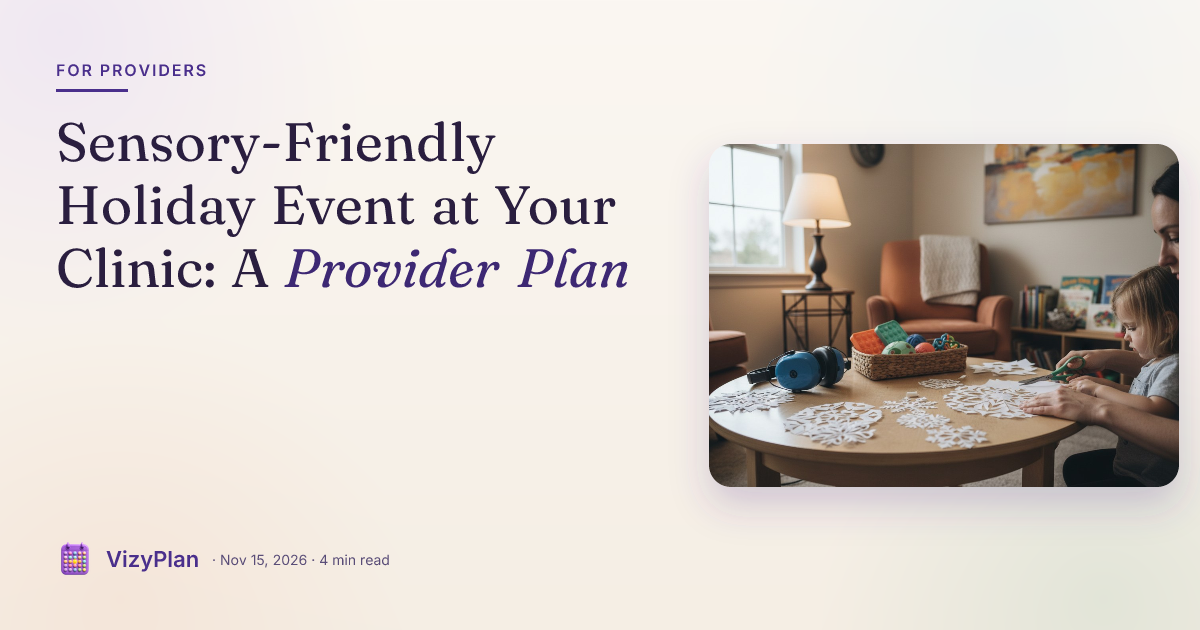
- Open a quiet room. A therapy room with dim light, a weighted lap pad, noise-reducing headphones and a few fidgets gives any client, sibling or parent a place to reset. Label it with a picture on the door and staff it with one familiar adult.
- Make every activity optional. Offer two or three stations, such as a sensory bin, a coloring table and a movement corner, and let clients wander or simply watch. Watching is participating.
- Plan inclusive food. Use the RSVP answers, keep packaged items with labels intact, offer at least one option free of the top allergens, and include familiar safe foods. Label every dish with its ingredients so families can choose without asking.
- Make visitors a choice, not a surprise. If a costumed character comes, put the visit on the schedule, keep it in a separate room and let clients wave from the doorway. No one should be placed on a lap or posed for a picture. The parent guide to sensory-friendly Santa is a good link to share with families.
- Get written authorization before any photo is shared. See the next section.
- Plan the goodbye. A predictable ending, such as a closing song or a take-home bag, helps clients transition out the door. Send a short note afterward thanking families and asking what would make next year easier.
Client photos at a sensory-friendly holiday event are PHI
Under the HIPAA de-identification standard at 45 CFR 164.514(b), full-face photographs are one of the identifiers that make information about a patient identifiable. A photo of a client at your clinic, taken by your clinic, is protected health information because it shows that the person is your patient.
HHS guidance on marketing explains that the Privacy Rule requires a written authorization for uses or disclosures of PHI for marketing, with narrow exceptions. The rules for a valid authorization are in 45 CFR 164.508. Enforcement is real: in 2016 a Los Angeles physical therapy practice paid $25,000 after posting patient testimonials with full names and full-face photos without valid authorizations.
For your sensory-friendly holiday event, that means:
- Collect a signed, HIPAA-compliant photo authorization before the event, separate from intake paperwork, and let families say yes to some uses and no to others.
- Give clients without authorization a visible, discreet marker, such as a sticker color, so staff know not to photograph them.
- Ask staff to keep personal phones away, and take any clinic photos on a clinic device.
- Ask attending families not to post photos that include other clients.
Check the details with your own compliance officer or attorney. This article is general information, not legal advice.
Enjoying this article?
Get practical tips and insights delivered to your inbox — no spam, ever.
Prepare clients in session the week before
Use the week before as practice. SLPs can rehearse greetings and a "No thank you" script, as in our holiday social scripts guide. OTs can trial headphones and the quiet room ahead of time. BCBAs can build a simple "first, then" for arrival. Our Halloween therapy sessions guide uses the same preview approach for costumes.
VizyPlan was built by an autism dad and an autism mom who is a licensed speech-language pathologist, so a family can carry the event's visual schedule on a phone and preview it at home all week.
Share VizyPlan with your families so the sensory-friendly holiday event you plan feels familiar before they walk in. The 7-day free trial lets a family try it first. If it helps, keep going for $6.99/month or $59.99/year.
VizyPlan was built by an autism dad and an autism mom who is a licensed speech-language pathologist who needed something that did not exist. Explore VizyPlan.