First-semester report cards are the moment many families of students with disabilities wait for and dread at the same time. Report card comments for students with IEPs carry extra weight, because a parent will often read those two or three sentences more times than any other line on the page. A comment written with care can tell a family exactly where their student stands and what comes next.
General education and special education teachers often write these comments separately, on tight deadlines, in different systems. A shared approach keeps the message clear, accurate and kind.
What federal guidance says about report cards and transcripts
In October 2008, the U.S. Department of Education Office for Civil Rights issued a Dear Colleague letter on report cards and transcripts for students with disabilities, along with a Questions and Answers document. The key points for teachers:
- Report cards go to parents. A report card may say that a student receives special education or related services, and may refer to the IEP or a Section 504 plan, as long as the report card informs parents about progress or level of achievement.
- A label alone is not enough. OCR says a report card that only notes an IEP, without meaningful information about progress, falls short. Report cards for students with disabilities must be as informative as report cards for everyone else.
- Notations are allowed with an explanation. A report card may use a notation or asterisk to show that progress was measured against a modified curriculum or that the student received accommodations, as long as families get a real explanation of progress.
- Transcripts are different. Transcripts go to colleges and employers, so a transcript may not disclose a disability or special education services. A transcript may note a modified or alternate curriculum, the same way it notes honors or remedial classes.
Most teachers do not control the report card template, so check your district policy. What teachers do control is the comment box, and report card comments for students with IEPs are where these principles come to life.
Line up report card comments for students with IEPs with the progress report
Under IDEA, every IEP must describe how progress toward annual goals will be measured and when periodic reports will be shared, "such as through the use of quarterly or other periodic reports, concurrent with the issuance of report cards" (34 CFR 300.320(a)(3)). For many students, the IEP progress report and the report card land in the same envelope.
A family notices when the two documents disagree. A report card comment that says "doing great in reading" next to a progress report showing limited progress on a reading fluency goal creates confusion and erodes trust. A quick five-minute check between the general education teacher and the special education teacher before comments are finalized prevents that mismatch. Our IEP progress report guide covers how to write the goal-by-goal side clearly.
How to write report card comments for students with IEPs
- Read the IEP goals and the progress report first. Know which goals the student is working on and what the data says before you write a word.
- Lead with one specific strength. IDEA asks IEP teams to consider "the strengths of the child" (34 CFR 300.324(a)(1)(i)). Report card comments for students with IEPs can do the same. Name a real skill, interest or moment from this semester.
- Describe progress with something a family can picture. Use a number, a work sample or a before-and-after. "Reads 62 words per minute, up from 45 in September" beats "making progress."
- Name the support that is working. If a visual schedule, a break card or extra time is helping, say so. Families can use the same support at home.
- Give one clear next step. Say what the class will focus on next and, if it fits, one thing the family can try.
- Remove the jargon. Replace "FBA," "LRE," "BIP" and "accommodations per IEP" with plain words. If a term is unavoidable, define it in the same sentence.
- Read the comment as the parent. Ask whether a parent would know more after reading it, and whether the comment would feel fair if written about your own student.
Enjoying this article?
Get practical tips and insights delivered to your inbox — no spam, ever.
Weak vs. strong report card comments
Weak: "Has an IEP. Receives accommodations. Needs to focus." Strong: "Maya used her visual checklist to finish four of five independent math tasks this month, up from one in September. Next, we are working on starting tasks without a reminder. A matching checklist at homework time may help."
Weak: "Struggles with transitions and behavior." Strong: "Leo now moves from recess to reading in under three minutes on most days when he gets a two-minute warning and a picture of what comes next. We will keep practicing transitions to specials."
Weak: "Making progress toward IEP goals." Strong: "Ava met her goal of asking for help using her communication card in three of four observed opportunities. Her IEP progress report includes the full data for each goal."
The strong versions share the same shape: strength, measurable progress, the support that helped, and what comes next. None of the strong versions mention a diagnosis, and every one of them tells a family something new. Strong report card comments for students with IEPs read like a short story of the semester, not a label.
After the report card goes home
Report card comments for students with IEPs often open a conversation, which is a good thing. Invite questions in the comment itself, and if a family wants to talk, use the same structure you would use in a conference. Our guide to parent-teacher conferences with families of autistic students walks through that shape step by step.
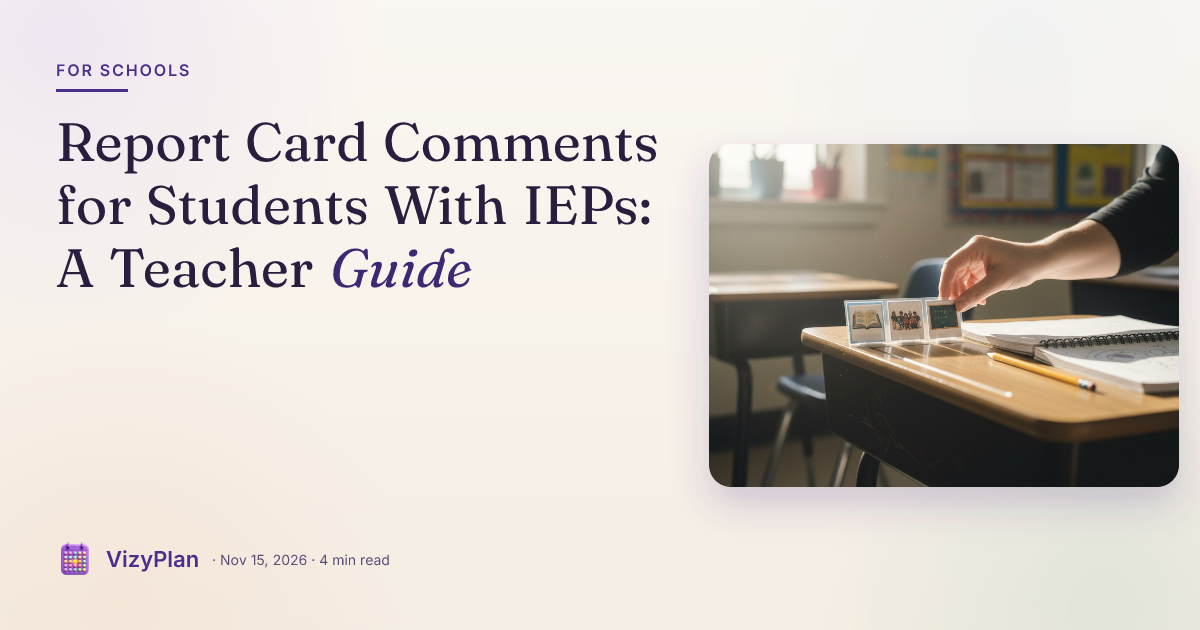
When a comment mentions a support that works, such as a picture schedule or a first-then routine, families get the most out of it when they can see the actual support. VizyPlan was built by an autism dad and an autism mom who is a licensed speech-language pathologist so the visual routine a student follows at school can look the same at home.
Share VizyPlan with your families so the supports you name on the report card carry over to home. The 7-day free trial lets a family try it first. If it helps, keep going for $6.99/month or $59.99/year.
VizyPlan was built by an autism dad and an autism mom who is a licensed speech-language pathologist who needed something that did not exist. Explore VizyPlan.