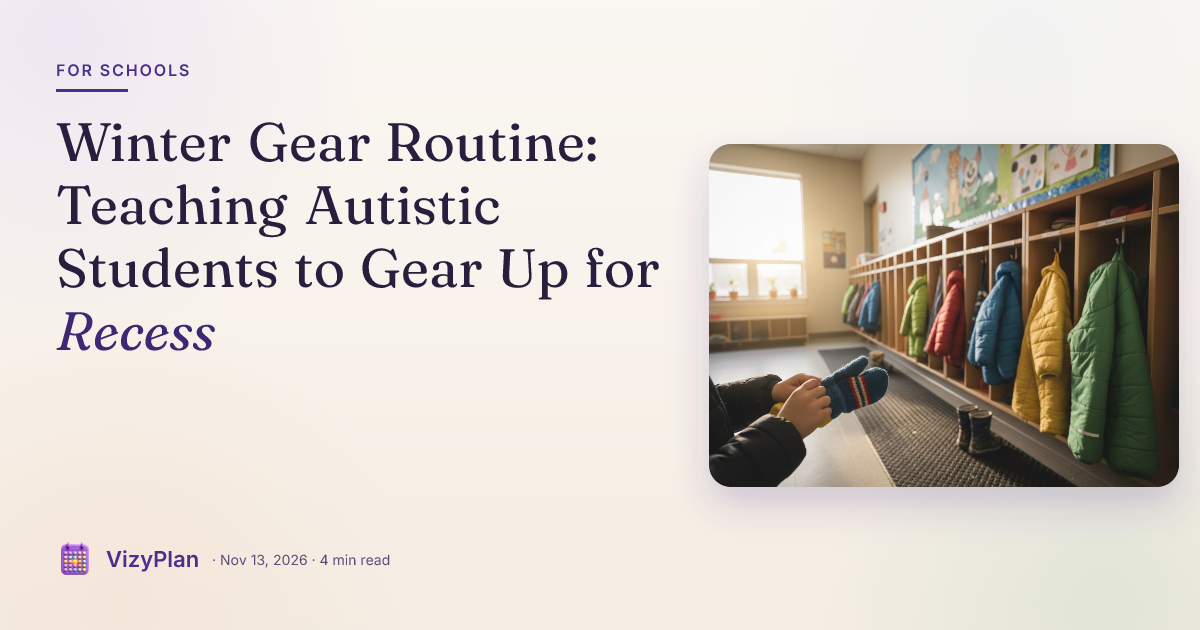
Outdoor recess in January asks a lot of a five-year-old. Snow pants, boots, coat, zipper, hat and two mittens, all before the line leaves, and then all of it comes off again twenty minutes later, wet. For many autistic students in PreK through second grade, the winter gear routine is the hardest part of recess, long before anyone reaches the playground.
The good news: a winter gear routine is a skill, and skills can be taught. Teachers, paras and OTs already have the tools. The trick is using them on purpose, every day, from the first cold week.
Why the winter gear routine is so hard
Getting dressed for snow is a long chain of motor steps done in a crowded, noisy space under time pressure. A student has to remember the order (snow pants before boots, boots before coat), manage fasteners, tolerate scratchy or tight fabric, and keep track of two small mittens. Any one of those can stall the whole line.
Recess also doubles the work. Unlike dismissal, students gear up and gear down at least twice a day, and coming back inside adds wet mittens, snowy boots and the switch back to classroom shoes.
What the evidence says
The National Clearinghouse on Autism Evidence and Practice (NCAEP) 2020 report identifies 28 evidence-based practices for autistic children and youth. Several fit a winter gear routine almost perfectly:
- Task analysis: breaking an activity into small, manageable steps to assess and teach the skill.
- Visual supports: a visual display that helps a learner do a skill without extra prompts.
- Prompting and time delay: giving verbal, gestural or physical help, then fading that help with a short wait before stepping in.
- Modeling, video modeling and peer-based instruction: showing the skill, live, on video or through classmates.
Chaining is a common way to teach the steps of a task analysis. In a 2019 study in *Developmental Neurorehabilitation*, Richard and Noell combined video prompt-models with backward chaining to teach autistic children to tie their shoes, and most participants still had the skill one week after mastery. Shoe tying is not snow pants, but the method transfers well to any long dressing sequence.
How to teach a winter gear routine at recess
- Write the task analysis. List every step in order: snow pants, boots, coat, zip, hat, mittens. Break hard steps smaller (sit down, find the leg holes, pull up to the waist).
- Turn the steps into a picture sequence. Post the pictures at eye level beside the cubbies, top to bottom or left to right. Use real photos of the student's own gear when you can.
- Use backward chaining. An adult does every step except the last one, and the student finishes, often pulling on the second mitten. Once the student does that step reliably, the student takes the last two steps, then three. Every attempt ends with success.
- Fade prompts on purpose. Start with the least help that works, point to the picture before you speak, and add a short pause before stepping in. The goal is a student who looks at the sequence, not at the para.
- Build in extra time. Start gearing up three to five minutes before the class, or send a small group first. Rushing turns a teachable moment into an adult doing it all.
- Teach the way back in, too. Make a second, shorter sequence for coming inside: mittens in the bin, hat in the sleeve, boots on the mat, shoes on.
Set up the cubby for success
The cubby is part of the routine. Hang gear in the order it goes on, with snow pants on the lowest hook or bottom of the cubby and the coat on top. Tuck the hat and mittens into one coat sleeve so they never get separated. A small picture strip inside the cubby repeats the sequence where the student actually stands.
Label everything. Ask families to write names on every item, and add a small symbol or colored tape for students who are not reading yet. A mitten clip on the sleeve saves a lot of hunting.
Enjoying this article?
Get practical tips and insights delivered to your inbox — no spam, ever.
Peer modeling at the cubby
Classmates are the best models in the room. Pair a student with a peer who gears up calmly and steadily, and let the student watch and copy one step at a time. Some teams film a peer, or the student, completing the full routine and show the short clip before recess, which fits NCAEP's video modeling practice.
Sensory-friendly swaps to suggest to families
Some resistance is sensory, not skill. If a student fights one item every day, share ideas with the family rather than battling at the cubby:
- Tagless, soft-lined hats and neck gaiters instead of scarves.
- Mittens rather than gloves for students who struggle to find finger holes.
- Snow pants with wide leg openings and boots with one large pull tab or hook-and-loop straps.
- A big zipper pull or key ring on the coat zipper for small hands.
Our parent guide on winter coat sensory issues walks families through these swaps at home, so it makes an easy link to send.
Keep students warm and dry
The American Academy of Pediatrics, on HealthyChildren.org, recommends several thin layers, warm boots, mittens or gloves, and a hat, and notes that hypothermia often happens when clothes get wet. Keep a spare set of mittens and socks in the room, and make "wet things off" part of the coming-in sequence.
On days when it is too cold to go out, our guide to indoor recess for autistic students covers that very different routine. For the end of the day, the winter dismissal routine builds on the same skills.
A steady winter gear routine pays off all season. By February, the student who needed help with every step can often gear up with just a glance at the pictures.
VizyPlan was built by an autism dad and an autism mom who is a licensed speech-language pathologist so the picture steps a student follows at the cubby can match the ones at the front door at home.
Share VizyPlan with your families so the winter gear routine you teach at the cubby carries over to the front door. The 7-day free trial lets a family try it first. If it helps, keep going for $6.99/month or $59.99/year.
VizyPlan was built by an autism dad and an autism mom who is a licensed speech-language pathologist who needed something that did not exist. Explore VizyPlan.