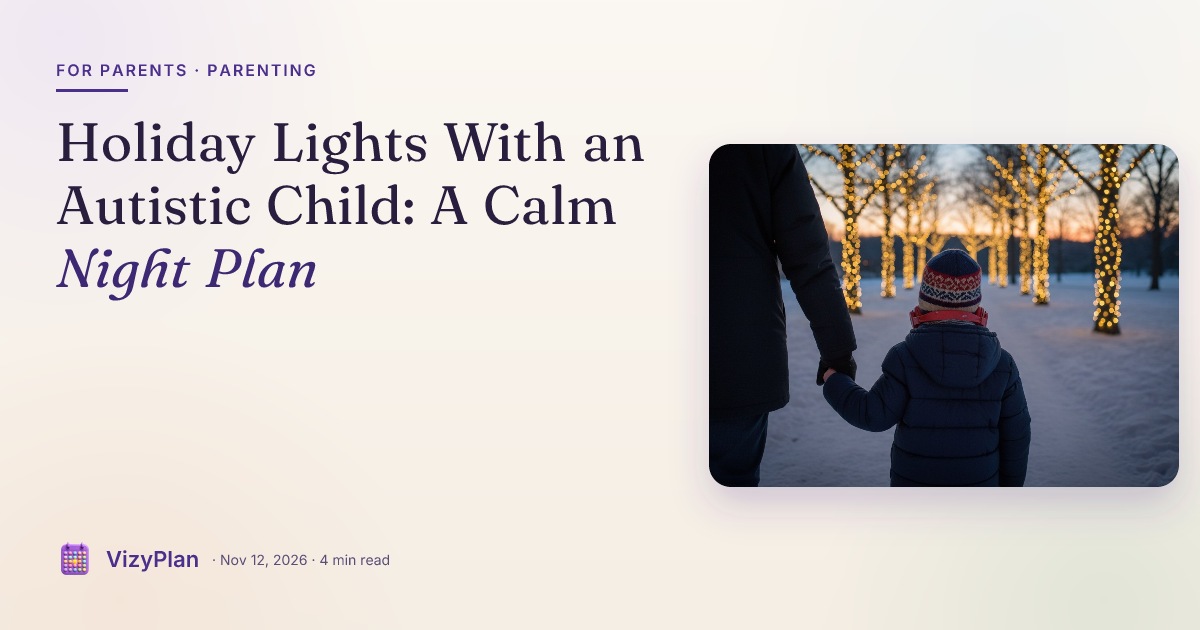
Every December, the neighborhood fills with photos of families walking through tunnels of twinkle lights, everyone smiling. Seeing holiday lights with an autistic child can be one of the best nights of the season, and it can also unravel in the first ten minutes. The difference is rarely the lights themselves. The difference is the crowd, the music, the cold, the waiting and not knowing what comes next.
We learned the hard way that "let's just go see the lights" is not a plan when you are seeing holiday lights with an autistic child. Here is the plan we use now.
Why the light show can be a lot
The CDC lists unusual reactions to the way things sound, look or feel among the common signs of autism. Sound is a big one. A 2022 study in the Journal of Autism and Developmental Disorders by Carson and colleagues looked at caregiver reports for more than 4,000 autistic people and found that about 60% were currently over-responsive to sound, and about 71% had been at some point.
A walk-through light display stacks almost every input at once: speakers playing music, a crowd talking, bright and moving lights, cold air, a scratchy coat and a long line to get in. Any one of those might be fine. All of them together, after dinner, on a school night, is where the night tips over.
Drive-through or walk-through?
Neither is better for every family. When you plan holiday lights with an autistic child, pick the format that fits your child.
Drive-through shows keep your child in a familiar, warm seat with their own things. You control the music volume (or turn the radio station off), and nobody bumps into anyone. The tradeoff is waiting. Popular shows can mean a long line of cars with no way out once you are in the lane, and some kids hate being buckled in that long.
Walk-through displays let a child move, run ahead and leave at any point. The tradeoff is crowds, loud speakers and cold. Walk-through events at zoos and botanical gardens also tend to be the ones offering sensory-friendly nights.
A good rule from our house: if waiting is the hardest thing for your child, walk. If noise and bodies are the hardest thing, drive.
Sensory-friendly nights are growing
More venues now run special nights for families like ours. The Bronx Zoo's sensory-friendly Holiday Lights night, for example, lists reduced capacity, quieter music, mostly static displays with less movement, an indoor quiet area and free loaner sensory bags with noise-reducing headphones, fidgets and strobe-reduction glasses. Space Center Houston's Galaxy Lights added its first low sensory night in 2024, turning down both lights and music.
If you want to try holiday lights with an autistic child in a calmer crowd, search your local zoo, botanical garden or light festival with the words "sensory night" or "low sensory" before you buy tickets. Dates usually post in November and sell out.
Enjoying this article?
Get practical tips and insights delivered to your inbox — no spam, ever.
Flashing lights and safety
Parents sometimes ask whether flashing displays are dangerous. For most kids, flashing lights are a comfort question, not a safety one. According to the Epilepsy Foundation New England, about 3 to 5% of people living with epilepsy have photosensitive epilepsy, and lights that flicker between 16 and 25 times per second are among the biggest holiday triggers. Photosensitive epilepsy is rare overall. If your child has epilepsy or has ever had a seizure, ask your child's neurologist about light displays before you go.
How to see holiday lights with an autistic child
The step-by-step plan below for seeing holiday lights with an autistic child is the one that has worked best for us.
- Preview the show at home. Look up photos and videos of the exact display, including the parking lot and the entrance. Watch them together a few times so the real thing looks familiar. A short social story about the night works well too.
- Pick a quiet time. Weeknights early in the season are usually calmer than weekends right before the holidays. Go right when it gets dark, before the crowd builds and before bedtime gets close.
- Pack the sensory kit. Headphones or earplugs, sunglasses or a hat brim for bright spots, a favorite snack and drink, a soft layer that does not itch. For a drive-through, add a comfort toy and a charged tablet for the line.
- Dress for the wait, not the walk. Kids get cold standing still. A familiar coat beats a new one; our winter coat sensory guide has ideas for kids who hate jackets.
- Agree on an exit plan. Tell your child, before you leave home, how they can say "done" (a word, a card or a hand squeeze) and what happens next. Then honor it. Leaving after fifteen happy minutes is a win.
- Show the whole night as pictures. Car, lights, hot cocoa, home, pajamas. Seeing the end of the evening makes the middle easier to handle.
Make it your tradition
Seeing holiday lights with an autistic child does not have to look like anyone else's photos. Some years ours was ten minutes in the car with the radio off and the windows fogged up, and that counted. If decorations at home are also a big change, our guide to holiday decorations and autism covers that side, and the sensory-friendly Santa guide helps with the other big December outing.
VizyPlan was built by an autism dad and an autism mom who is a licensed speech-language pathologist so the car, the lights, the cocoa and the ride home can be a picture plan your child sees before you ever leave the driveway.
Download VizyPlan and start your 7-day free trial today. Build your light-show plan tonight. If it helps, keep going for $6.99/month or $59.99/year.