
Every November there is a morning when the temperature drops, the coat comes out of the closet, and your child acts like you handed them a wet blanket made of sandpaper. Winter coat sensory issues are one of the most predictable fights of the year, and one of the least talked about, because from the outside it looks like a kid who simply will not listen.
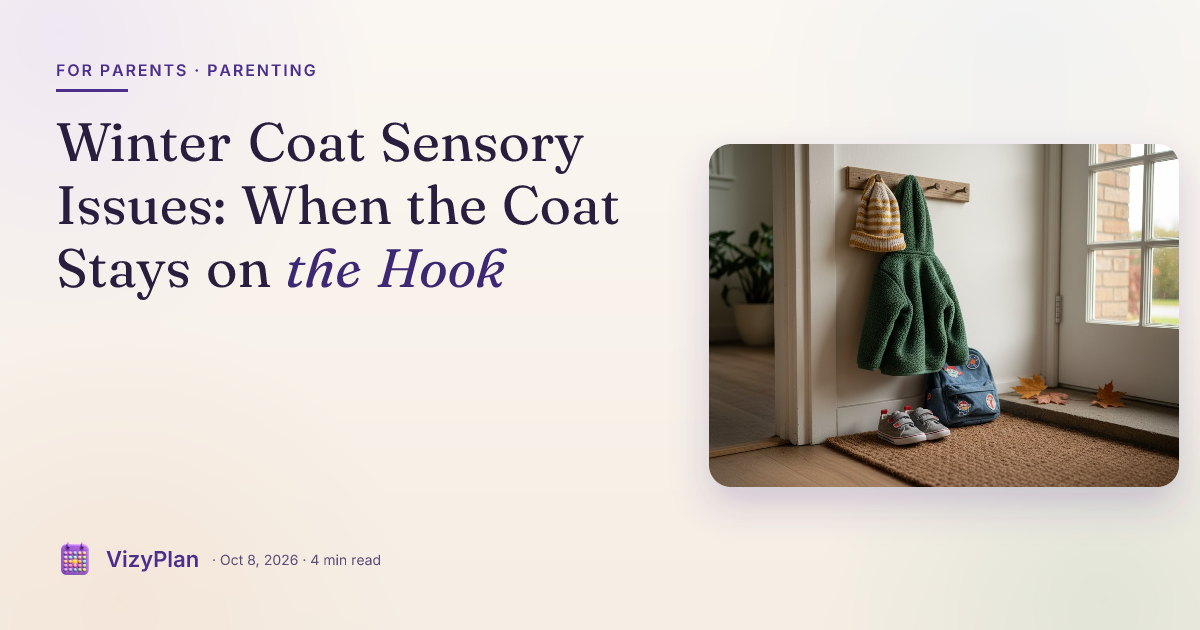
Our son wore a short sleeve shirt to the bus stop in 30 degree weather for most of one winter. We tried bribes, logic, and the coat in his backpack "just in case." The coat never came out. The problem was never the cold. The problem was the coat.
Why winter coat sensory issues are not defiance
Sensory over-responsivity, a nervous system that registers ordinary input as too much, shows up in an estimated 56 to 70 percent of autistic youth. Touch is one of the most common channels. A winter coat stacks nearly every tactile trigger into a single garment: a stiff shell that rustles at every move, a zipper pressing against the chin, elastic cuffs gripping the wrists, a hood brushing the neck, and a puffy weight that changes how arms move.
Research also suggests that autistic kids with sensory over-responsivity habituate less to repeated touch. Most children stop noticing a sleeve after a few minutes. A child with tactile sensitivity may feel that sleeve just as sharply at minute twenty as at minute one, which is why "you will get used to it" rarely comes true.
Cold, meanwhile, can register less urgently for some autistic kids than the texture does. A child choosing to be cold over wearing the coat is making a rational trade with the information their body gives them.
The car seat rule that changes the plan
Before buying the warmest coat in the store, know what the American Academy of Pediatrics says about it. AAP guidance on winter car seat safety is that bulky coats and snowsuits should not be worn under a car seat harness, because the padding compresses in a crash and leaves the straps too loose. The AAP suggests thin layers, a thin fleece, and a coat or blanket placed over the child after they are buckled.
For a sensory-sensitive kid, that rule is good news. The layering approach the AAP recommends for safety is often the same approach that works for comfort.
Enjoying this article?
Get practical tips and insights delivered to your inbox — no spam, ever.
Seven steps to a coat your child will wear
- Start now, not on the first freezing morning. Late October gives you weeks of mild days to practice. A coat introduced under pressure is a coat refused under pressure.
- Let your child touch before you buy. Take them to the store or order two or three options to try at home. Brushed fleece, soft knit, and quiet shells beat stiff nylon for most sensory-sensitive kids.
- Remove what you can. Cut out tags, choose coats without elastic cuffs, and pick a zipper with a fabric guard at the chin. A detachable hood is a coat with one less complaint.
- Build warmth from layers instead of bulk. A familiar long sleeve shirt, a fleece, and a thin windproof layer can be as warm as one puffy coat, and each piece can be adjusted alone.
- Practice the coat in short, easy doses. Wear it for the walk to the mailbox, then around the block, then to the car. Tolerance grows faster with ten good minutes than with one forced hour.
- Keep the coat in the routine, not the argument. Put "coat on" as a picture step between "shoes on" and "out the door." A step the child sees every morning becomes part of leaving the house rather than a negotiation about it.
- Have a fallback that counts. If the coat is not happening today, a fleece and a hat is still a win. Send the coat to school in the backpack and let the teacher know it is there.
Talk to the school about it
Recess duty staff often see a coatless kid as a supervision problem. A short note to the teacher explaining winter coat sensory issues, and listing what your child can wear, keeps your child outside with everyone else. Our guide to school clothes and sensory issues covers the rest of the wardrobe, and why clothing can feel like a daily battle explains the science in more depth.
VizyPlan was built by an autism dad and an autism mom who is a licensed speech-language pathologist so "coat on" can be a picture step your child sees every morning, before the cold makes it urgent.
Download VizyPlan and make the coat part of the routine. Try it free for a week. If it helps, keep going for $6.99/month or $59.99/year.
VizyPlan was built by an autism dad and an autism mom who is a licensed speech-language pathologist who needed something that did not exist. Start your free trial.