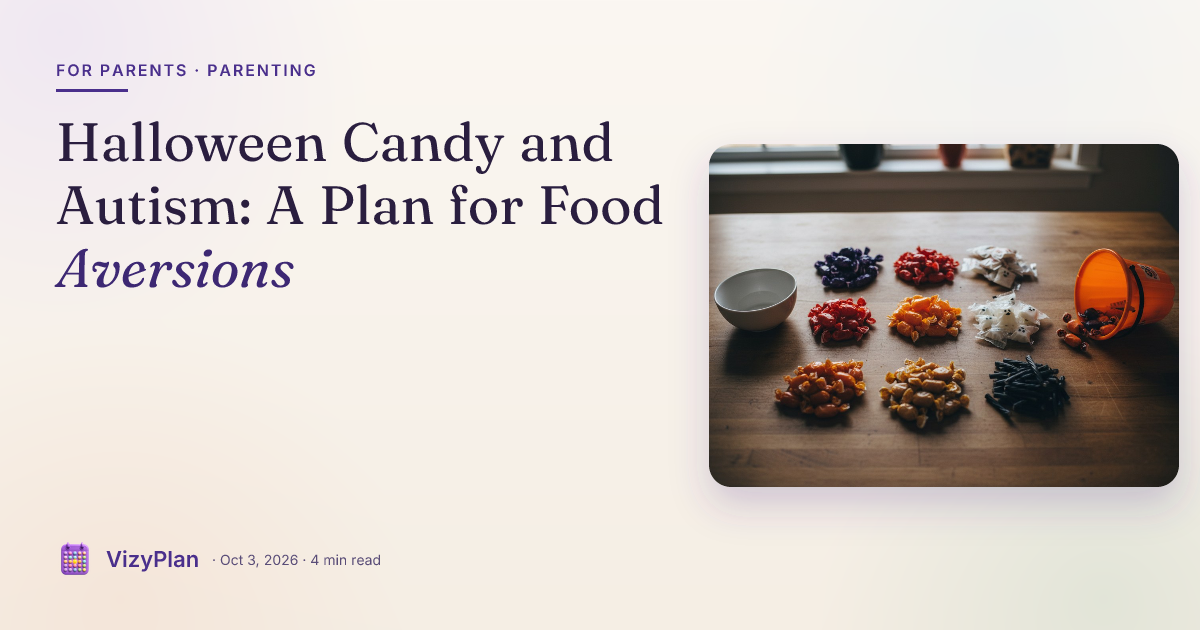
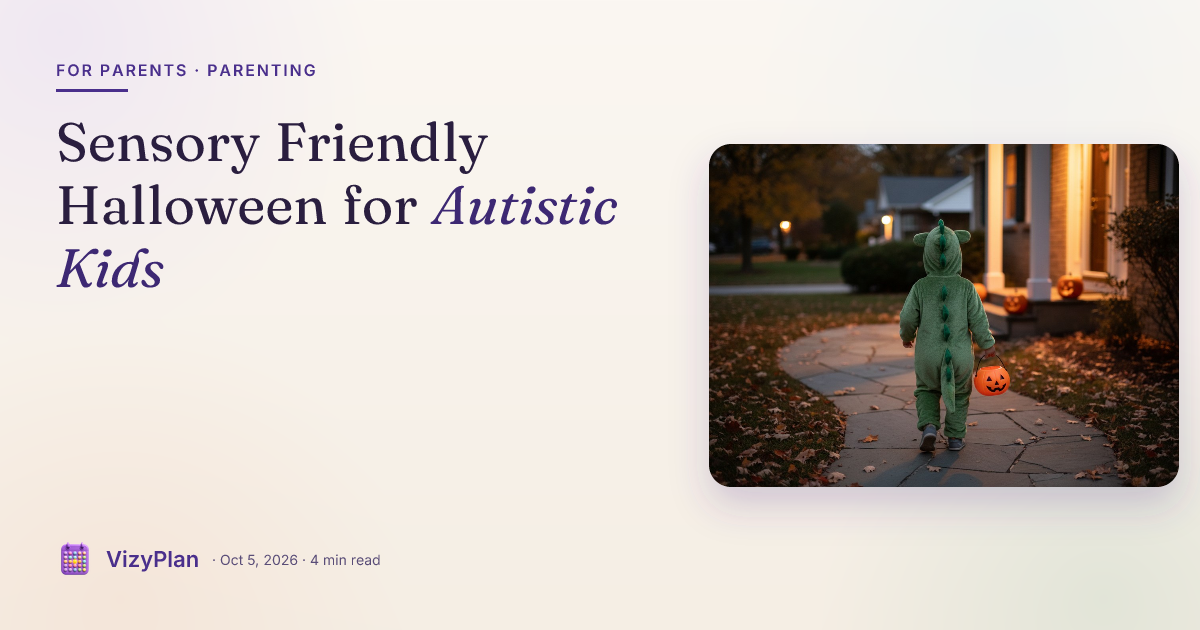
Every kid deserves a night that makes sense to them. A sensory friendly Halloween starts with admitting something the flyer on the school door will never say: the parts of Halloween that make it fun are the exact parts that make it hard. Flashing lights. Sudden noises. Strangers in masks. People hiding in bushes on purpose.
Our son loved the idea of Halloween for weeks and lasted eleven minutes on the sidewalk. The problem was not the holiday. The problem was that we planned a neighborhood when we should have planned a route.
What a sensory friendly Halloween actually asks of a child
Walk through the night as a list of demands instead of a list of treats, and the difficulty becomes obvious. A child in a costume is wearing an unfamiliar texture for three hours. A mask narrows vision and muffles sound at the moment the street gets loudest. Doorbells trigger dogs. Decorations jump, scream, and fog. The social script changes at every door, and the reward for getting it right is food they may not eat.
None of that means skipping it. It means the night needs a plan with an ending in it.
- Pick the route before the costume. Three or four houses you already know, on one side of one street. A short loop finished happily beats a long one abandoned in tears.
- Go early, while it is still light. The 5pm sidewalk is quieter, the decorations are not yet lit, and the dark is doing none of the work it does an hour later.
- Practice the costume for a week. Put it on for ten minutes at home, then twenty. A costume rehearsed is a costume tolerated. A costume unwrapped at 5pm is a costume on the floor.
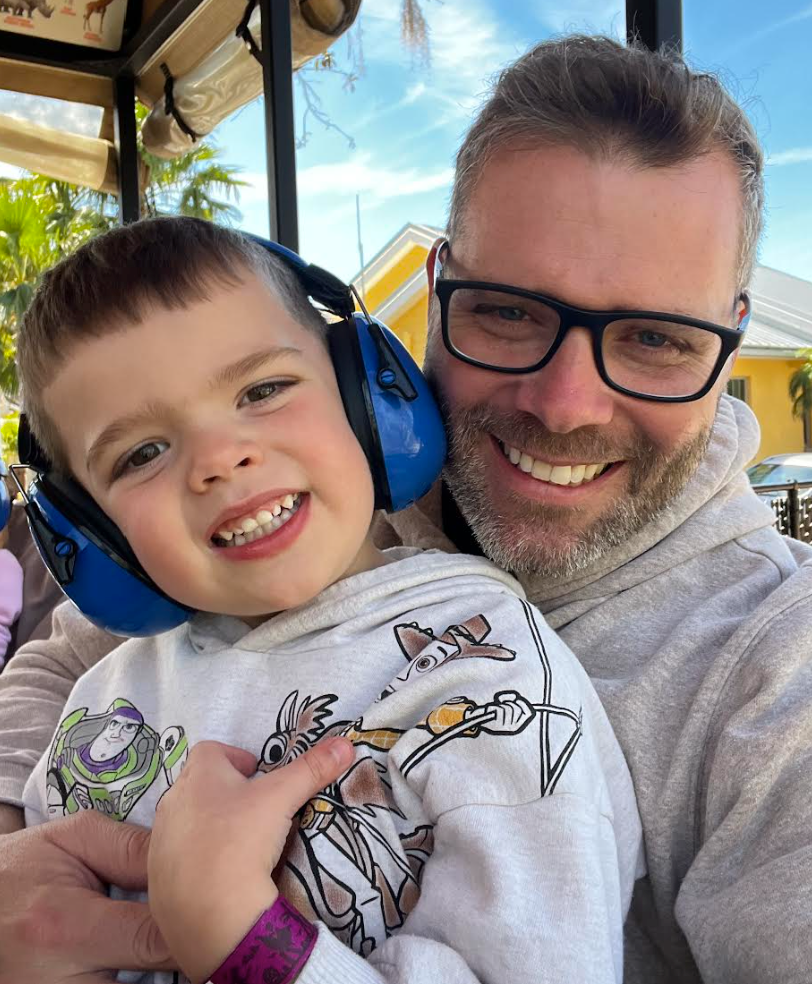
- Build the costume from clothes your child already wears. Soft, familiar, and no mask. A hoodie with felt shapes glued on is a legitimate costume, and it is the one that stays on.
- Pack the exit kit. Headphones, a fidget, water, and whatever snack actually gets eaten. Headphones are not a failure of the evening, they are what makes the evening last.
- Name the ending out loud before you leave. Four houses, then home, then candy sorting on the floor. A child who knows where the night stops can relax inside it.
- Leave while it is still good. The memory is made in the last ten minutes, which is the same rule that governs a pumpkin patch with an autistic child.
Blue buckets and teal pumpkins, honestly
Two Halloween symbols get mixed up every October, and they are not the same thing.
The teal pumpkin goes on your house. Started in 2014 by Food Allergy Research and Education, it signals that non-food treats are available, which matters for the roughly 1 in 13 children with a food allergy and for plenty of autistic kids with food aversions. Stickers, glow sticks, and small toys cost less than candy and get eaten by nobody.
The blue bucket goes on the child, and it is genuinely contested. The National Autism Association supports it as a dignified way to signal that a trick-or-treater may not speak or say thank you. Autistic advocates, including the writers at NeuroClastic, argue the opposite: it discloses a diagnosis the child did not consent to share, can single them out, and ties autism to branding many autistic adults reject.
Both positions come from people who care about the same kids. Our take is that the teal pumpkin asks something of the neighborhood and the blue bucket asks something of the child, and that difference is worth sitting with before you buy one. If your child is old enough to have an opinion, the decision is theirs.
Enjoying this article?
Get practical tips and insights delivered to your inbox — no spam, ever.
When the plan is no plan
Trunk-or-treat in a parking lot, a costume parade in the living room, handing out candy from the porch instead of walking for it, or a candy-free scavenger hunt in the backyard all count as Halloween. A child who hands out treats is still in costume, still part of it, and standing in one familiar place with a job to do. Some years that is the version that works, and it is not a lesser night.
VizyPlan was built by an autism dad and an autism mom who is a licensed speech-language pathologist so the four houses, the headphones, and the ending can be a routine your child sees the night before, in pictures of themselves.
Download VizyPlan and start your 7-day free trial today. Show Halloween before Halloween. If it helps, keep going for $6.99/month or $59.99/year.
VizyPlan was built by an autism dad and an autism mom who is a licensed speech-language pathologist who needed something that did not exist. Start your free trial.