
The good fall memory is usually about forty minutes long. Every kid deserves the pumpkin patch on their own terms, and a pumpkin patch with an autistic child works best when you stop planning a day and start planning an hour. We learned that the year our son picked the perfect pumpkin in the first ten minutes and then spent the next two hours telling us, loudly, that he was done.
Why the pumpkin patch is a sensory stack
A farm in October is a pile of inputs arriving at once: the hay smell, the tractor engine, the crowd at the entrance, mud on the shoes, a petting zoo that moves, a corn maze with no visible end. A meta-analysis of 55 studies found large differences in sensory over-responsivity between autistic children and their peers, which means the tractor is louder for your kid than it is for you. Layer on the unknown. Research on intolerance of uncertainty shows it drives much of the anxiety autistic children carry, and a festival with no schedule is uncertainty with a hayride attached.
The fix is not to skip it. The best-evidenced practice for exactly this is a visual preview: show the day before the day. Our post on recognizing triggers before a meltdown covers the signals to watch once you are there.
How to do a pumpkin patch with an autistic child
- Pick two things and say them out loud. "We are getting a pumpkin and riding the hayride." Everything else is a bonus, not a promise, and two things are easy to show in pictures.
- Go at opening, on a weekday if you can. The first hour on a Saturday is the second-best choice. Many farms now list sensory-friendly hours, and the parking lot at 10 a.m. is a different place than at 2 p.m.
- Preview with real photos the night before. Most farms post them. Put them in order: car, tickets, pumpkin, hayride, snack, car. Our social stories guide shows how to turn that into a story.
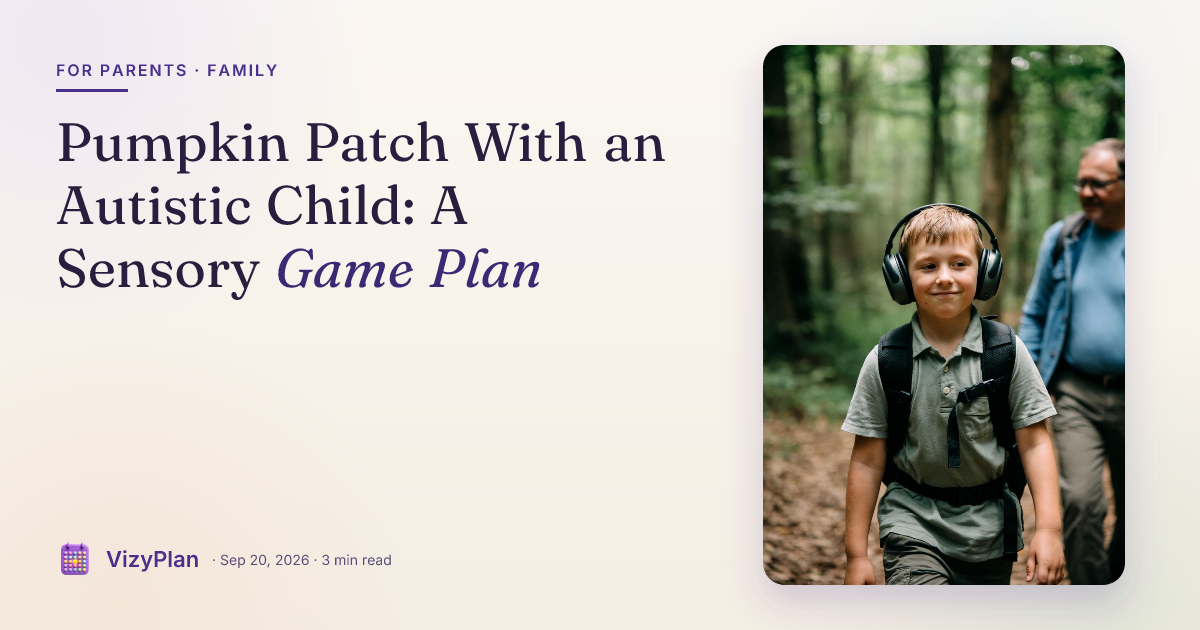
- Pack the kit. Headphones, a familiar snack, dry socks, and the exit phrase you both agreed on. The exit phrase is the most important item in the bag.
- Skip the corn maze unless it is short and open. A maze is an uncertainty machine. If your kid wants one, walk the kids' maze with an exit you can see. Staying regulated during transitions helps with the walk from one station to the next.
- Leave while it is still good. The memory is the last ten minutes. Leaving on a high note is not quitting; it is why he will want to go back next year.
Two things, then home. The pumpkin on the porch does not know how long you stayed.
VizyPlan was built by an autism dad and an autism mom who is a licensed speech-language pathologist so the pumpkin patch morning can be a routine your child sees the night before, with the farm's own photos.
Enjoying this article?
Get practical tips and insights delivered to your inbox — no spam, ever.
Download VizyPlan and start your 7-day free trial today. Show the pumpkin patch before the pumpkin patch. Just $6.99/month after your trial, no credit card required upfront.
VizyPlan was built by an autism dad and an autism mom who is a licensed speech-language pathologist who needed something that did not exist. Start your free trial.