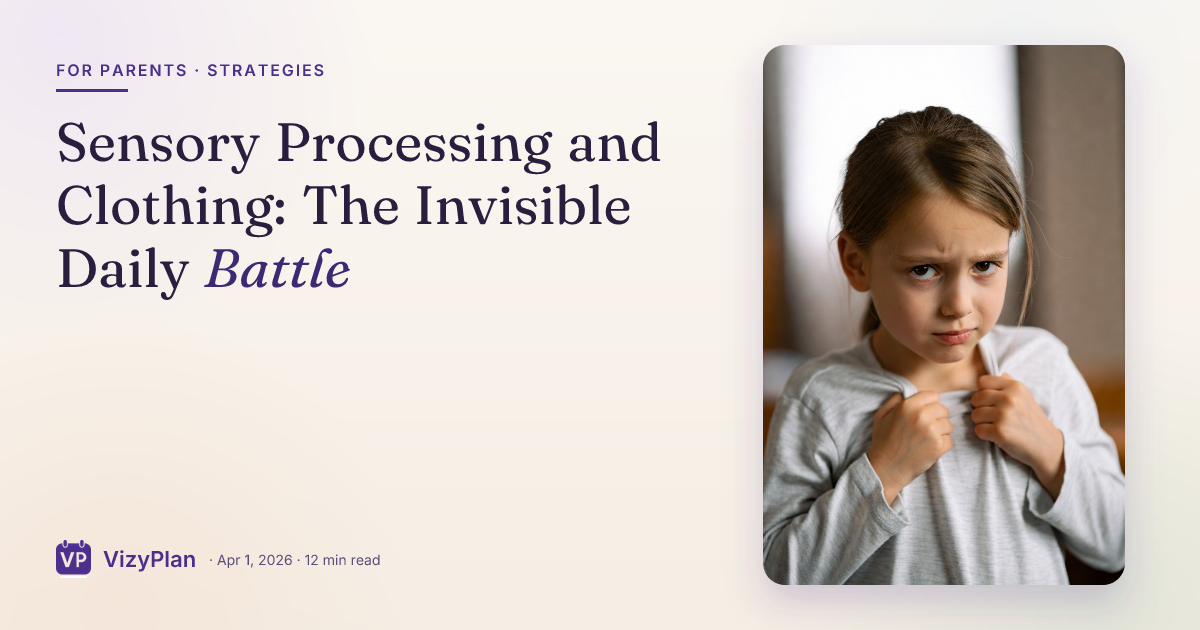
It is 7:15 AM on a school day. Your child is standing in the middle of their bedroom in underwear, screaming. The shirt you laid out has a tag. You cut the tag. Now there is a bumpy residue where the tag was. You find a different shirt. The seams feel wrong. A third shirt is the wrong color and they will not wear it. The socks have a line across the toes. The pants are too tight at the waist. The jacket is too stiff.
It is now 7:42 AM. The bus comes in eight minutes. Your child is still in underwear and you are both crying.
If you live some version of this morning, you are not alone. Research shows that up to 95% of parents report sensory processing differences in their autistic children, and clothing is one of the most consistent battlegrounds. A 2025 study found that 73.2% of autistic adults regularly avoid certain clothing types, 55.8% cut labels from their clothes, and 46.5% avoid garments where seams contact their skin.
Your child is not being dramatic. Their brain is processing the physical sensation of clothing in a fundamentally different way than yours does, and understanding that neuroscience changes everything about how you approach the problem.
Why Your Brain Ignores Clothing and Theirs Cannot
Put on a shirt right now and pay attention to how it feels against your skin. You can feel the fabric, the seams, the weight of it on your shoulders. Now stop thinking about it. Within a minute or two, the sensation fades from your awareness entirely. Your brain has decided the shirt is not a threat, and it stops sending you information about it.
This process is called neural habituation, and it is one of the most basic functions of the sensory system. Your brain learns that repeated, non-threatening stimuli do not need your attention, so it filters them out. It is why you stop hearing the hum of an air conditioner after a few minutes. It is why you do not constantly feel the chair you are sitting in.
In autistic children, this process is impaired. Research published in Developmental Cognitive Neuroscience found that autistic children demonstrate reduced GABA levels in the somatosensory cortex, the brain region that processes touch. GABA is the neurotransmitter responsible for inhibiting neural activity, for telling the brain "you can stop paying attention to this now." With less GABA available, the brain keeps responding to the sensation of clothing against skin all day long.
A separate study published in Translational Psychiatry found that thalamic GABA levels are significantly correlated with sensory over-responsivity severity. The thalamus is the brain's sensory gatekeeper. It decides which sensory information gets passed along to higher brain regions for conscious processing and which gets filtered out. In autism, lower GABA in the thalamus means the gate stays open. Every seam, every tag, every fold of fabric keeps getting flagged as something that requires attention.
This is not a preference. It is not a phase. It is a measurable neurochemical difference in how the brain processes tactile input. When your child says the shirt hurts, their brain is literally not doing the thing that would make the shirt stop hurting.
What Clothing Actually Feels Like to Your Child
Autistic adults in a 2025 study published in the journal Autism described the sensation of disliked fabrics as feeling like "needles picking" or "ants crawling" on their skin. One participant described trying on clothes as "the worst because it feels like bugs are all over my skin." Another said they feel "trapped in my safe clothes and would feel silly trying anything else now."
These descriptions are not exaggerations. They are the lived experience of a nervous system that processes touch through a different neurological pathway.
The Sensory Modalities at Play
Research has identified specific sensory channels that drive clothing distress:
Texture is the dominant factor. A study comparing autistic and neurotypical children found that 64% of autistic children showed atypical oral and tactile sensory sensitivity, compared to just 7% of typically developing peers. Children with tactile hypersensitivity refused significantly more sensory input across all domains, and fabric texture was the most consistent predictor of clothing acceptance or rejection.
Fabric preferences are measurable. A controlled study had participants handle and evaluate different fabrics. Ninety percent disliked hessian and spandex. Seventy percent disliked polyester. Sixty percent disliked wool. On the preferred side, 70% liked satin for its softness and smoothness, and 60% liked cotton for its neutral, comfortable quality.
Tightness and compression cut both ways. Nearly half of autistic adults avoid constricting clothing because it creates feelings of suffocation. But some autistic individuals, particularly those who are hyposensitive to touch, actively seek tight clothing because it provides proprioceptive feedback that helps them feel where their body is in space. Temple Grandin, who described stiffening and pulling away from light touch, simultaneously craved deep pressure so intensely that she built a squeeze machine at age 18. This is why one child refuses anything with an elastic waistband while another insists on wearing compression shirts under their clothes.
Body regions vary in sensitivity. Research shows the upper body, particularly the shoulders, arms, and neck area, tends to be more sensitive than lower extremities. The neck is especially reactive due to its high concentration of sensory nerve endings. This explains why tags at the neckline cause disproportionate distress compared to seams in less sensitive areas.
The Real Triggers: A Research-Backed List
Understanding exactly what triggers your child helps you solve problems instead of guessing. Based on the research:
Tags and labels. Over half of autistic adults routinely cut labels from clothes. Even after cutting, the residual material can worsen irritation. Look for tagless clothing or garments with printed labels rather than sewn-in ones.
Seams. Nearly half avoid seams contacting skin. Sock seams across the toes are one of the most common meltdown triggers in the research literature. Flat seams or fully seamless designs significantly reduce distress.
Elastic waistbands. Tight elastic creates constant pressure that the brain cannot filter out. Drawstring or adjustable waistbands provide a looser fit without the continuous squeeze.
Fabric type. Synthetic fabrics like polyester and spandex are overwhelmingly rejected. Natural fibers like cotton, bamboo, and satin are generally preferred. The key variable is predictability: the fabric needs to feel the same way every time.
Temperature mismatch. Autistic individuals may have difficulty regulating body temperature and can become hot or cold much faster than expected. Clothing that traps heat or fails to insulate adequately adds another layer of sensory distress.
Decorative elements. Sequins, embroidery, sparkly fibers, and printed designs that create texture differences across the garment all add unpredictable sensory input.
Beyond the Morning: How Clothing Sensitivity Ripples Through Everything
The clothing battle does not end when your child finally gets dressed. It continues all day, consuming cognitive resources that could be directed toward learning, socializing, and emotional regulation.
School and Academic Impact
If your child spends the entire school day with part of their brain monitoring the uncomfortable sensation of their shirt seam against their shoulder, that is cognitive bandwidth unavailable for paying attention to the teacher, processing language, managing social interactions, or regulating emotions. Research confirms that sensory experiences compromise the ability to concentrate in a classroom. Some children refuse to attend school entirely when their clothing is intolerable.
If your child's clothing sensitivity significantly impacts their school performance, write sensory accommodations into their IEP or 504 plan. Allowing flexible dress code options, keeping backup sensory-friendly clothing at school, and permitting your child to remove uncomfortable layers are reasonable accommodations that cost nothing and can transform the school day.
Social Participation and Self-Expression
Formal events, school uniforms, swimwear, and seasonal clothing all force autistic children into fabrics and fits that their nervous system rejects. One autistic adult in the 2025 Autism study described the impact: "Sometimes at formal events if my clothes are very uncomfortable, I am extra anxious and self conscious."
For older children and teenagers, the impact extends to identity. A 2025 study found a significant negative relationship between tactile hypersensitivity and self-esteem, moderated by appearance dissatisfaction. Autistic adults reported more negative appearance evaluations than both the general population and adults with visible appearance differences. One participant captured the bind perfectly: "Being non-binary, I would love to explore fashion more, but I can not because the clothes I want to wear make me have a meltdown."
Fashion is how children and adults express identity. When sensory barriers restrict clothing choices to a handful of safe items, the loss is not just physical comfort. It is self-expression.
Enjoying this article?
Get practical tips and insights delivered to your inbox — no spam, ever.
The Financial and Emotional Toll on Parents
Sensory-friendly clothing costs more than standard children's clothing. When your child finds one acceptable pair of pants, you buy five pairs because you know the manufacturer might change the fabric or discontinue the line. When shopping for clothes requires your child to physically handle every item before purchase, online shopping becomes a cycle of ordering and returning. When one parent has to leave work because the school called to say your child stripped off their uniform and will not put it back on, the financial impact compounds.
And then there is the judgment. "Just make them wear it" from relatives who do not understand. "They are being dramatic" from teachers who have never felt a fabric like needles against their skin. The isolation and blame that parents of autistic children face is well documented, and clothing battles are one of the most visible and least understood triggers.
What Actually Helps: Evidence-Based Strategies
Build a Sensory-Friendly Wardrobe Strategically
Eliminating seemingly minor irritants, tags, seams, rough fabrics, tight elastic, reduced dressing-related meltdowns by up to 65% in observed participants. That is a significant reduction from changes that cost relatively little.
Start with what your child already tolerates and look for more of the same. If they live in one specific cotton t-shirt, find identical or near-identical options. If seamless socks are the only socks that work, stock up. If elastic waistbands are a trigger, switch everything to drawstring or adjustable waist.
Key features to look for: tagless or printed labels, flat seams or seamless construction, soft natural fabrics like cotton or bamboo, elastic-free or adjustable waistbands, no decorative textures, and compression options for children who seek proprioceptive input.
Use Deep Pressure to Regulate Before Dressing
A 2025 systematic review found strong evidence that deep pressure tactile input improves functional outcomes for autistic children. Temple Grandin's own research showed that 15 minutes of deep pressure reduced anxiety for 45 to 60 minutes. If your child's morning clothing battle happens because their nervous system is already dysregulated from waking up, a few minutes of deep pressure activities before getting dressed can shift their baseline enough that clothing becomes tolerable.
This might look like a tight hug, rolling up in a blanket, wearing a compression garment briefly, or doing "heavy work" activities like pushing against a wall or carrying a heavy object. The goal is to activate the proprioceptive system, which has a calming effect on the tactile system.
Give Your Child Choices and Control
Let your child participate in selecting their own clothing. When a child chooses their outfit from pre-approved sensory-friendly options, the act of choosing provides a sense of control that reduces anxiety and resistance. Choice boards with photos of acceptable outfits can make this process visual and concrete.
For children with demand avoidance profiles, being told what to wear triggers the same avoidance response as any other demand. Presenting options instead of instructions changes the dynamic entirely.
Create a Visual Getting-Dressed Routine
A predictable, visual sequence for getting dressed removes the decision fatigue and uncertainty that amplify sensory distress. When your child knows exactly what comes next, they can focus their cognitive resources on managing the sensory experience rather than also processing the unpredictability of the routine.
VizyPlan lets you build a personalized visual dressing routine with AI-generated images of your child doing each step in their own bedroom with their own clothes. When the routine is visual and familiar, the morning goes from combat to sequence.
Introduce New Clothing Gradually
If your child needs to wear something new, whether for a seasonal change, a formal event, or a school uniform, gradual exposure is essential. An occupational therapy approach involves first touching the fabric, then draping it over an arm, then wearing it briefly at home with no pressure, then extending the duration over days or weeks.
Research shows it can take multiple exposures before a new clothing item moves from "threat" to "tolerable." Rushing this process guarantees a meltdown. Planning for it, with weeks of lead time before the event or season change, gives the nervous system time to adapt.
Dr. Stephanie Weber, a psychologist at Cincinnati Children's Hospital, emphasizes that "insistence on routine and resistance to change are particularly common among those who have autism." Seasonal transitions are especially difficult. Build tolerance incrementally rather than expecting your child to switch from summer to winter clothing overnight.
Know When to Seek Professional Help
If clothing sensitivity is causing daily meltdowns that disrupt your family's ability to function, school refusal, or significant distress for your child, an occupational therapy evaluation is warranted. Ayres Sensory Integration therapy is now classified as an evidence-based intervention for autistic children. A qualified OT can assess your child's specific sensory profile and develop targeted strategies that go beyond general recommendations.
A 2025 systematic review also found strong evidence for caregiver training on sensory strategies. Sometimes the most effective intervention is not treating the child directly but teaching you how to respond to and accommodate their sensory needs in ways that reduce distress for everyone.
What Your Child Needs You to Know
Your child is not choosing to be difficult about clothing. Their brain is doing something measurably different with the sensory information it receives. Where your brain filters out the feeling of fabric within minutes, theirs keeps processing it all day. Where a tag feels like a minor annoyance to you, their brain registers it as something that demands constant attention, like a pebble in your shoe that you cannot remove.
The morning battle is not about control or defiance. It is about a nervous system that is overwhelmed before the day even starts. And the fact that you are standing in that bedroom at 7:15 AM, trying shirt after shirt, cutting tags and checking seams, is not a sign that you are doing something wrong. It is a sign that you are doing exactly what your child needs: taking their experience seriously even when the world tells you to just make them wear it.
Every time you honor what their body is telling them, you teach them that their sensory experience is valid. That lesson matters more than any shirt.
VizyPlan helps you build visual dressing routines with personalized images, track sensory patterns that reveal your child's triggers, and create the predictable morning structure that turns clothing battles into manageable sequences. Start your free trial and bring calm to the hardest part of your morning.