The social story worked perfectly in the therapy room. Your child's SLP read it three times. Your child answered the comprehension questions. They even acted out the scenario with a stuffed animal. Everyone felt great about the progress.
Then you got home. You tried to read the story before the situation it was supposed to prepare your child for, and they would not sit still. Or they sat still but the story did not seem to connect to anything real. Or you could not find the printed pages because they were somewhere between the car seat and the recycling bin. Or, honestly, you forgot about it entirely because dinner needed to happen and homework was not done and there were three other things on the list before bedtime.
Two weeks later, the SLP asks how the social story is going at home. You feel guilty. You say "good" and change the subject.
If this is your experience, you are not the exception. You are the rule. And the problem is not you. The problem is that social stories were designed for therapy rooms, not for the messy, unpredictable, overwhelming reality of daily life with a neurodivergent child.
What the Research Actually Says About Social Stories
Social stories, developed by Carol Gray in 1991, are one of the most widely used interventions for autistic children. Speech-language pathologists use them to target social communication, which sits squarely within their professional scope. The stories describe social situations using specific sentence types: descriptive sentences that explain what is happening, perspective sentences that describe how people feel, and directive sentences that suggest appropriate responses.
They sound like they should work perfectly. And in controlled settings, with trained professionals delivering them immediately before the target situation, they often do. A 2024 scoping review of 56 studies found that 66% reported positive effects, particularly for aggressive behaviors, following directions, self-care, and emotion identification.
But here is what those optimistic numbers hide. The largest randomized controlled trial of social stories ever conducted, the ASSSIST-2 study published in 2025, tested the intervention with 249 autistic children across 87 schools. The primary outcome measure showed no statistically significant effect. Children who attended at least six sessions did show improvement, but the global measure of social skills did not change in a meaningful way.
The Association for Science in Autism Treatment summarized the research bluntly: "Professionals should present Social Stories as having limited scientific support." And the What Works Clearinghouse found that only 5% of social story studies provided strong evidence of a causal relationship between the intervention and the outcome.
This does not mean social stories are useless. It means the way they are typically created and delivered is failing to produce the results families expect.
The Generalization Problem Is Massive
Here is the core issue that explains why social stories work in the therapy room and fall apart everywhere else. Autistic children often have specific difficulty generalizing learned skills to new settings. A foundational study by Rincover and Koegel found that nearly half of autistic children who learned new behaviors in a treatment room failed to transfer those skills to a different setting.
Nearly half. And that was the finding that launched decades of research into why.
A systematic review examining whether intervention gains transfer to daily life found that only 32% of eligible trials even measured generalization properly. Of the studies that did measure it, generalization was inconsistent. Skills transferred in some contexts but not others, for some children but not all. The researchers noted that many intervention studies rely on what they called a "train and hope" strategy, teaching skills in one setting and hoping they appear elsewhere without explicitly planning for transfer.
For social stories specifically, research found something even more telling. The strongest improvements in behavior occurred on days when social stories were used immediately before the target situation. This suggests social stories function more like prompts or reminders than lasting skill-builders. If the story is not available at the moment it is needed, the behavioral improvement often disappears.
This has enormous implications for how social stories are used at home. Reading a social story at bedtime about what will happen at the grocery store tomorrow is not the same as reading it in the car on the way to the grocery store. The timing matters, and the gap between therapy sessions and real life is where the timing falls apart.
Why the Therapy-to-Home Gap Exists
Your child's SLP creates beautiful, thoughtful social stories during sessions. They know the research. They follow Carol Gray's criteria (though only 41% of practitioners actually do, according to a 2024 scoping review). They read the story with your child in a quiet, controlled environment with no distractions, no siblings, no dinner burning on the stove.
Then they send the story home with you. And that is where the system breaks down.
Parents Are Overwhelmed
Research on parent-implemented interventions for autistic children documents exactly why carry-over fails. Parents of autistic children experience heightened stress and mental health challenges. Learning new intervention strategies requires 2 to 48 hours of training, and daily implementation adds 30 minutes to 20 hours per week of additional work. The perception of treatment burden directly predicts whether parents follow through.
You are not failing to implement the social story because you do not care. You are failing because you are already stretched beyond capacity, and adding one more thing to the pile sometimes feels impossible. The research validates this: introducing interventions decreased parent stress in some studies but actually increased it in others. Your SLP handing you a social story and saying "read this every day" without acknowledging the reality of your daily life is a setup for guilt, not success.
The Stories Are Not Personalized
Here is something that might surprise you: most social stories used in practice are not truly personalized. They use generic clip art or stock images rather than photos of your child, your home, your school, your grocery store. Research shows this matters enormously.
A direct comparison study found that personalized social narratives were more effective than generic ones for all three participants tested. The researchers explained why: "photos and symbols from a person's real life may be easier to relate with compared to generic images." When your child sees a cartoon character going to the dentist, they have to abstract that image and map it onto their own experience. When they see themselves at their actual dentist's office, the connection is immediate and concrete.
Yet most social stories your SLP sends home feature generic illustrations because creating personalized visual content takes time most clinicians do not have.
Paper Stories Cannot Be There When Needed
Remember the research finding that social stories work best when used immediately before the target situation? Now think about what paper-based social stories mean in practice. You need to remember to bring the printed pages. You need to find them. You need to read them in the car, at the doctor's office, in the grocery store parking lot, wherever the relevant situation is about to happen. You need them to survive being stuffed in a bag, dropped in a puddle, and torn by a sibling.
This is not a minor logistical issue. It is a fundamental design flaw. The most effective moment to use a social story is the exact moment when parents are most harried, most distracted, and least likely to have a stack of printed papers at hand.
The Stories Go Stale
Your child's situation changes. The routine at school shifts. The doctor's office moves locations. A new sibling arrives. A new teacher starts mid-year. The social story that was created in October may not match your child's reality by December. But who updates it? Your SLP sees your child once or twice a week and may not know the details have changed. You know the details have changed but creating a new story feels like one more thing you cannot get to.
Enjoying this article?
Get practical tips and insights delivered to your inbox — no spam, ever.
What Actually Closes the Gap
The research points clearly toward solutions, even if the current system does not make them easy to implement.
Make Stories Digital and Always Available
Every study comparing digital to paper social stories found digital delivery superior. In one study, 100% of children preferred digital formats. A pilot randomized controlled trial found that five daily digital sessions over just one week produced medium-to-large effect sizes for child understanding, perceived anxiety reduction, and closeness to story goals.
Digital social stories solve the access problem. They are on your phone, which is always with you. They can be pulled up in the car, in the waiting room, in the grocery store aisle, right before the moment they are needed. They do not get lost, torn, or forgotten in the therapy folder.
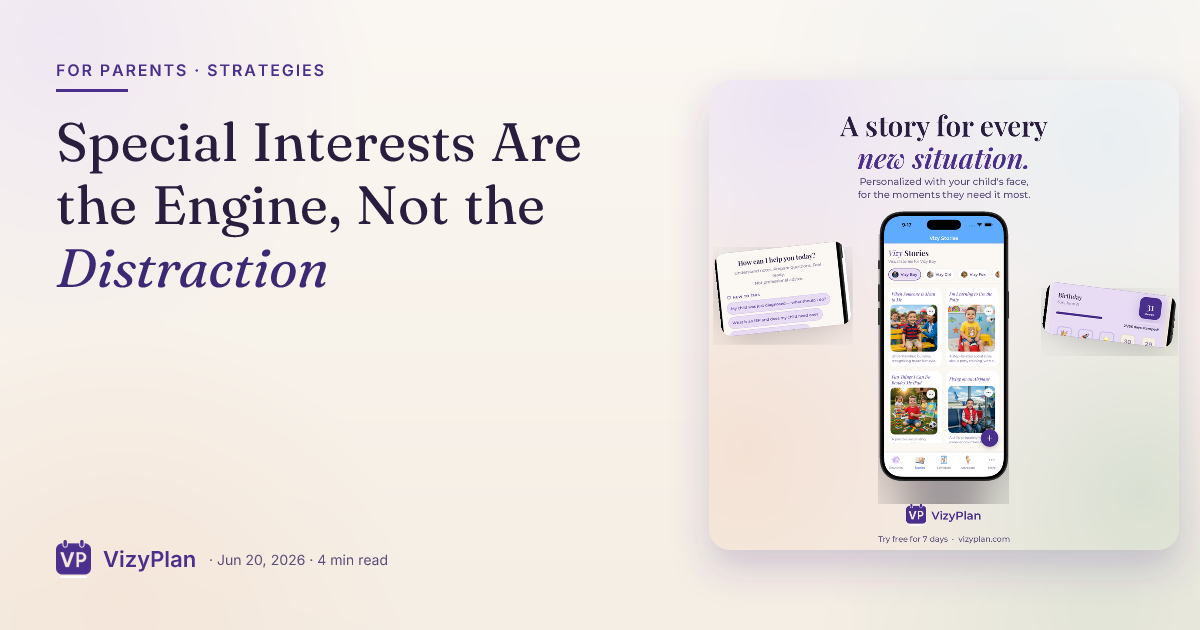
VizyPlan includes a guided social story builder that lets you create personalized stories using AI-generated images of your child in their actual environments. Your SLP can help you identify what situations need stories, and you can build and access them on your phone whenever the moment arises.
Personalize Everything
Generic social stories ask autistic children to do the thing their brain struggles with most: abstract and transfer meaning from one context to another. Personalized stories remove that cognitive demand entirely.
When the social story shows your child at their school, wearing their clothes, sitting in their actual classroom, the bridge between the story and reality is already built. Research confirms this: personalized photos are "concrete and meaningful" and help children understand content better than generic images.
This is where AI-generated imagery is changing the game. Instead of needing a photographer to visit every location and capture every scenario, tools like VizyPlan can generate personalized images that show your child doing each step of a social scenario in settings that match their real life.
Use Stories at the Point of Need
Stop reading social stories at bedtime for situations that will happen at 10 AM. The research is clear: the strongest effects occur when stories are used immediately before the target situation. This means:
- Read the grocery store story in the parking lot before you go in
- Review the doctor visit story in the waiting room
- Go through the birthday party story in the car on the way there
- Look at the classroom story during the morning transition
Digital access makes this possible. Paper stories make it aspirational. This single change, shifting from "read it sometime today" to "read it right before," may be the highest-impact adjustment you can make.
Let Your Child Help Build Them
A 2024 study in Frontiers in Digital Health found that consulting with the child during social story development improved outcomes. This makes sense. When a child participates in creating their own story, they have ownership over it. It is not something imposed on them. It is something they made.
For children with demand avoidance profiles, this is especially important. A social story that feels like another adult-directed demand will trigger avoidance. A social story the child helped create feels collaborative and empowering.
Partner With Your SLP Differently
The current model is: SLP creates story, hands it to parent, hopes it gets used. A better model involves your SLP in a different role.
Ask your SLP to help you identify which situations need social stories rather than creating the stories themselves for use only in sessions. Ask them to coach you on the timing: when should each story be read relative to the situation? Ask them to review stories you have created at home to make sure the language and structure are effective. Ask them to help you build stories that address emotional regulation and social communication goals simultaneously.
This shifts the SLP from content creator to consultant, which is actually a more efficient use of their clinical expertise. They know the social communication goals. You know your child's daily life. The best social stories happen when both perspectives combine.
The Bigger Picture: Why This Matters for Your Child
Social stories are not failing because the concept is wrong. The idea that autistic children benefit from structured, visual preparation for social situations is well-supported. Social stories are failing because the delivery system has not kept up with what the research says about how and when they need to be used.
Your child needs social stories that are personalized to their life, available at the moment of need, updated as their world changes, and consistent enough that the skills actually generalize beyond the therapy room. The gap between the social story your SLP reads during a session and the social story your child needs in the grocery store at 4:30 PM on a Wednesday is not a gap you can close with willpower. It is a systems problem that requires systems solutions.
The research on digital, personalized, parent-accessible social stories is pointing in a clear direction. Children prefer them. Parents become more competent with them. Implementation fidelity improves. And when stories are available at the point of need rather than locked in a therapy folder, the skills they teach have a fighting chance of showing up in real life.
Your child's SLP is doing important work. The social stories they create during sessions have value. But the work does not end when the session does. It begins again every time your child walks into a situation they need preparation for, and the tool that prepares them needs to be in your hand at that moment, not in a folder at home.
VizyPlan helps you build personalized social stories with AI-generated images of your child, access them on your phone at the moment of need, and create the visual preparation that bridges the gap between therapy sessions and real life. Start your free trial and give your child social stories that work beyond the therapy room.